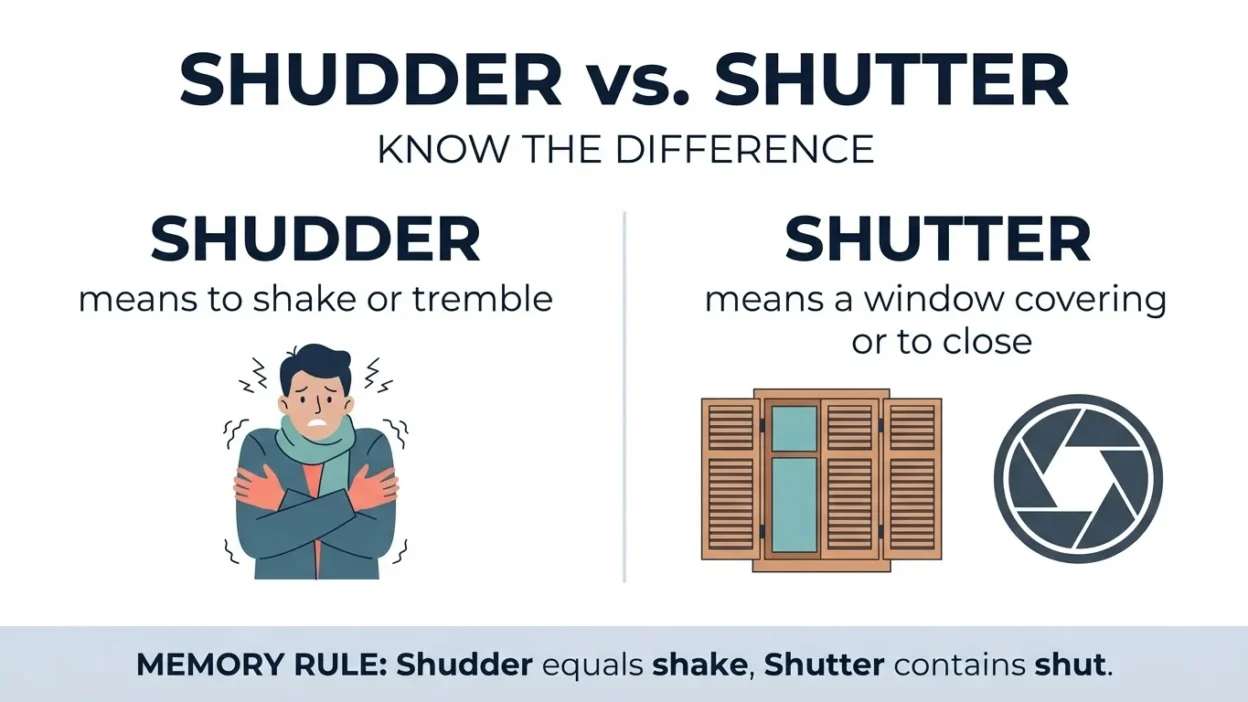
Choosing between shudder and shutter can be confusing because the two words look and sound similar. However, their meanings are completely different. Shudder usually means to shake or tremble suddenly because of fear, disgust, cold, or another strong feeling. For example, “She shuddered at the thought of entering the dark room” means the thought caused her to tremble or react strongly.
Shutter, on the other hand, commonly refers to a covering for a window or a mechanism associated with controlling light in a camera. It can also function as a verb meaning to close something, especially a business or building. For example, “The company shuttered the store” means the store was closed.
The easiest way to remember shudder vs shutter is to connect shudder with shaking and shutter with shutting or closing. Once you identify whether the sentence concerns trembling or closing, choosing the correct word becomes much easier.
Quick Answer
Shudder means to shake or tremble because of fear, disgust, cold, or strong emotion. Shutter usually means a window covering, a camera mechanism, or to close a business or building. Remember: shudder means shake, while shutter relates to shutting or controlling an opening.
Shudder vs Shutter Definition and Meaning
Shudder and shutter are both standard English words, but they have different meanings.
Shudder can be a verb or noun.
As a verb, it means to shake or tremble suddenly.
Example:
“She shuddered with fear.”
As a noun:
“A shudder ran through him.”
Shutter can also be a noun or verb.
As a noun, it can refer to a movable window covering.
Example:
“She closed the shutters.”
It can also refer to a camera mechanism.
As a verb, shutter can mean to close a business, building, or operation.
The basic distinction is:
SHUDDER equals SHAKE
SHUTTER equals SHUT or COVER
Why People Confuse Shudder and Shutter
People confuse shudder and shutter because their spellings and pronunciations are similar.
Compare:
shudder
shutter
Only the middle consonant sound and spelling change.
The words can also be especially difficult for English learners because both may be used as verbs.
For example:
“He shuddered.”
“The store shuttered.”
The first sentence involves trembling.
The second involves closing.
Because both words are valid, a spelling checker may not always recognize that you selected the wrong one.
The safest approach is to identify the meaning.
If something shakes or trembles, think shudder.
If something closes or covers an opening, think shutter.
What Does Shudder Mean?
As a verb, shudder means to shake or tremble suddenly, often because of a strong physical or emotional reaction.
Common causes include:
fear
disgust
horror
cold
an unpleasant thought
For example:
“She shuddered with fear.”
“He shuddered at the memory.”
“I shudder to think what could have happened.”
The verb forms are:
shudder
shudders
shuddered
shuddering
The movement described by shudder is often involuntary.
Someone does not necessarily decide to shudder. Instead, the body reacts naturally to an emotion, sensation, or disturbing thought.
What Does Shutter Mean?
Shutter has several meanings.
As a noun, it commonly refers to a movable covering for a window.
Example:
“He closed the shutters before the storm.”
In photography, a shutter is a mechanism that controls how long light reaches the camera’s recording surface or sensor.
Example:
“The camera shutter opened.”
As a verb, shutter can mean to close a business, building, facility, or operation.
Example:
“The company shuttered the factory.”
Therefore, shutter is strongly connected with closing, covering, and controlling openings.
Think:
SHUTTER contains SHUT
This provides an easy clue to its meaning.
Shudder vs Shutter Comparison
Shudder
Main meaning: Shake or tremble
Common cause: Fear, disgust, cold, or strong emotion
Can be a noun: Yes
Can be a verb: Yes
Example: “She shuddered with fear.”
Memory clue: Shudder equals shake
Shutter
Main meaning: Window covering or camera mechanism
Verb meaning: Close a business, building, or operation
Can be a noun: Yes
Can be a verb: Yes
Example: “They closed the shutters.”
Memory clue: Shutter contains shut
The simplest distinction is:
SHUDDER means SHAKE
SHUTTER relates to SHUTTING
Shudder vs Shutter Pronunciation Guide
Shudder and shutter sound similar, but they are not normally pronounced exactly the same.
Shudder is pronounced approximately:
“SHUD er”
Shutter is pronounced approximately:
“SHUT er”
In some accents, especially where certain consonants become softer in rapid speech, the distinction may sound less obvious.
However, the vowel and consonant patterns can still differ.
Because pronunciation may not always be enough to identify the correct spelling, meaning remains the most reliable guide.
Remember:
Shudder means tremble.
Shutter relates to closing or covering.
Grammar Rules for Shudder and Shutter
Both shudder and shutter can function as nouns and verbs.
As a verb:
“She shuddered.”
“The company shuttered the store.”
As a noun:
“A shudder went through him.”
“The window has wooden shutters.”
The regular verb forms are:
shudder, shudders, shuddered, shuddering
and:
shutter, shutters, shuttered, shuttering
Because their grammatical forms are similar, grammar alone may not tell you which word to use.
Meaning is the essential difference.
Ask:
Does the sentence involve trembling?
Use shudder.
Does it involve a covering or closing?
Use shutter.
Shudder as a Verb
As a verb, shudder describes a sudden trembling movement or strong physical reaction.
Examples:
“She shuddered when she heard the noise.”
“He shuddered at the thought.”
“The child shuddered with fear.”
“I shudder whenever I remember that experience.”
The verb is often followed by expressions such as:
“shudder at”
“shudder with”
“shudder to think”
These constructions commonly involve unpleasant thoughts, fear, disgust, or discomfort.
The key idea is always a strong reaction that resembles trembling.
Shudder as a Noun
Shudder can also be a noun.
It refers to a sudden trembling movement or feeling.
For example:
“A shudder ran through her.”
“He felt a shudder of fear.”
“The thought sent a shudder through me.”
The noun is often used in descriptive and literary writing because it communicates a physical response to an emotion.
Common expressions include:
“a shudder of fear”
“a shudder of disgust”
“with a shudder”
“send a shudder through someone”
Whether it is used as a noun or verb, shudder remains connected with trembling or a strong reaction.
Shutter as a Noun
As a noun, shutter most commonly refers to a movable covering for a window.
For example:
“She opened the shutters in the morning.”
“The house had wooden shutters.”
“The shutters were closed during the storm.”
The plural form is:
shutters
The word is also used in photography for the camera mechanism that controls the exposure of light.
For example:
“The camera shutter opened.”
“The photographer adjusted the shutter speed.”
These meanings are related to controlling an opening or the passage of light.
Shutter as a Verb
As a verb, shutter commonly means to close a business, building, factory, facility, or operation.
For example:
“The company shuttered the store.”
“The factory was shuttered last year.”
“The owners decided to shutter the restaurant.”
This use is especially common in business and news writing.
It suggests that an operation has been closed, sometimes permanently, although the exact duration depends on context.
The verb comes naturally from the idea of closing shutters over an opening.
Remember:
To shutter something means to close it.
When to Use Shudder
Use shudder when describing trembling caused by an emotion, sensation, or disturbing thought.
Examples:
“She shuddered with fear.”
“He shuddered at the sight.”
“I shudder to remember it.”
“The cold wind made her shudder.”
You can also use it as a noun:
“A shudder ran down his spine.”
Ask yourself:
Is someone or something trembling?
If yes, shudder is likely the correct word.
The strongest memory connection is:
SHUDDER equals SHAKE
Both words begin with sh, which can help reinforce the association.
When to Use Shutter
Use shutter when talking about window coverings.
Example:
“She closed the shutter.”
Use it in photography:
“The camera shutter opened.”
Use it as a verb for closing a business or operation:
“The company shuttered several stores.”
Common expressions include:
“window shutter”
“wooden shutters”
“camera shutter”
“shutter speed”
“shuttered store”
“shuttered factory”
A useful clue is hidden directly inside the word:
SHUTTER contains SHUT
If the meaning involves shutting, closing, or covering an opening, shutter is probably correct.
When to Use Each Word
Use shudder for:
trembling
fear
disgust
cold
strong emotional reactions
Use shutter for:
window coverings
camera mechanisms
closing businesses
closing facilities
closing operations
Compare:
“She shuddered with fear.”
Trembling
“She closed the shutters.”
Window coverings
“The company shuttered the factory.”
Closed the factory
The distinction becomes easy when you remember:
Shudder equals shake
Shutter equals shut
Shudder vs Shutter Examples
Here are 15 examples showing the correct usage:
- She shuddered with fear.
- He shuddered at the thought.
- I shudder whenever I remember that night.
- The cold wind made him shudder.
- A shudder ran through her body.
- The sight made me shudder.
- He gave a slight shudder.
- She closed the shutters before the storm.
- The house has wooden shutters.
- The camera shutter opened.
- The photographer changed the shutter speed.
- The company shuttered the store.
- Several factories were shuttered.
- They decided to shutter the business.
- The old building had green shutters.
Shuddered or Shuttered?
Both shuddered and shuttered are correct words, but they mean different things.
Shuddered means trembled.
Example:
“She shuddered with fear.”
Shuttered means closed or covered with shutters.
Example:
“The company shuttered the factory.”
It can also describe something that has been closed:
“The store remained shuttered.”
The easiest distinction is:
SHUDDERED equals TREMBLED
SHUTTERED equals CLOSED
Compare:
“He shuddered at the thought.”
“The business shuttered its stores.”
The spelling depends entirely on the intended meaning.
Shuddered With Fear or Shuttered With Fear?
The correct expression is:
shuddered with fear
For example:
“She shuddered with fear when she heard the sound.”
Here, shuddered means trembled.
Do not write:
“She shuttered with fear.”
Shuttered relates to closing something and does not normally describe a physical reaction to fear.
Other correct expressions include:
“shuddered with horror”
“shuddered with disgust”
“shuddered from the cold”
Remember:
Feelings can make you SHUDDER.
Shudder at the Thought Meaning
The expression shudder at the thought means to react with fear, disgust, discomfort, or horror when imagining something.
For example:
“I shudder at the thought of being trapped there.”
Another common form is:
“I shudder to think what might have happened.”
These expressions do not necessarily mean that someone visibly shakes every time. Shudder can also communicate a strong emotional reaction.
The correct word is:
shudder
not:
shutter
The expression involves emotion and reaction rather than closing something.
I Shudder to Think Meaning
I shudder to think is a common expression used when imagining a possibility that seems frightening, unpleasant, or disturbing.
For example:
“I shudder to think what would have happened without their help.”
The phrase communicates strong discomfort at imagining the alternative.
Another example:
“I shudder to think how much the repairs might cost.”
The reaction may be serious or sometimes exaggerated for effect.
The correct spelling is always:
shudder to think
not:
“shutter to think”
The expression is connected with an emotional reaction.
Shudder in Fear or Shudder With Fear?
Both structures can appear, but shudder with fear is especially natural when describing the emotion causing the reaction.
Example:
“She shuddered with fear.”
You may also encounter constructions such as:
“He shuddered in fear.”
The exact preposition can depend on the sentence and style.
Other natural combinations include:
“shudder with disgust”
“shudder at the thought”
“shudder from the cold”
“shudder in horror”
The important spelling remains:
shudder
because the person is trembling or reacting strongly.
Shudder Down My Spine Meaning
A more natural expression is often:
a shudder ran down my spine
or:
a shudder went through me
For example:
“A shudder ran down my spine when I heard the noise.”
This describes a sudden sensation associated with fear, excitement, disgust, or another strong emotion.
A related expression is:
“a chill ran down my spine”
The correct word is shudder because the expression involves a physical or emotional trembling sensation.
Shutter would not make sense in this context.
Window Shudder or Window Shutter?
The correct term for a window covering is:
window shutter
For example:
“The window shutter was damaged.”
The plural is:
window shutters
Example:
“She closed the window shutters.”
Do not write:
“window shudder”
when referring to the covering.
However, a window itself could theoretically shudder if it shakes violently.
For example:
“The window shuddered in the strong wind.”
Compare:
“The window has a shutter.”
“The window shuddered in the wind.”
One is an object.
The other describes shaking.
Close the Shutters or Shudders?
The correct expression is:
close the shutters
For example:
“Please close the shutters before the storm.”
Shutters are physical coverings placed over or beside windows.
Do not write:
“close the shudders”
A shudder is a trembling movement or reaction and is not something you normally close.
The word close provides a strong clue:
Close the SHUTTERS
because shutter contains shut.
This connection makes the spelling especially easy to remember.
Camera Shudder or Camera Shutter?
The correct term is:
camera shutter
The shutter is part of the mechanism involved in controlling the duration of light exposure in photography.
For example:
“The camera shutter opened.”
“The shutter made a clicking sound.”
“The photographer adjusted the shutter settings.”
Do not use:
“camera shudder”
for this mechanism.
However, camera shake is a separate photography concept involving unwanted movement that can contribute to image blur.
The equipment term itself is:
camera shutter
Shutter Speed or Shudder Speed?
The correct photography term is:
shutter speed
Shutter speed refers to the amount of time associated with the camera’s exposure mechanism remaining open or the sensor being exposed, depending on the camera system.
For example:
“The photographer selected a faster shutter speed.”
A fast or slow shutter speed can affect how motion appears in a photograph.
The correct spelling is always:
shutter speed
not:
“shudder speed”
Remember:
Camera equals SHUTTER
Trembling equals SHUDDER
Shuttered Business Meaning
A shuttered business is a business that has been closed.
For example:
“The street contained several shuttered businesses.”
As a verb:
“The company shuttered the store.”
The word can describe closure of:
stores
restaurants
factories
offices
facilities
operations
The exact context determines whether the closure is temporary or permanent.
Because shutter contains shut, the meaning is easy to remember.
Shuttered equals closed.
Shuttered Store Meaning
A shuttered store is a store that has been closed.
For example:
“The once busy street now has several shuttered stores.”
The term is particularly common in journalism, business reporting, and descriptions of economic change.
You can also say:
“The company shuttered three stores.”
Here, shuttered functions as a verb.
Compare:
“The store shuttered last year.”
“The frightened customer shuddered.”
The first concerns closure.
The second concerns trembling.
Shuttered Factory Meaning
A shuttered factory is a factory that has been closed or is no longer operating.
For example:
“The shuttered factory had once employed hundreds of workers.”
As a verb:
“The company shuttered the factory.”
This usage is common in economic and business reporting.
Do not confuse it with shuddered.
Compare:
“The factory was shuttered.”
It was closed.
“The building shuddered during the explosion.”
It shook.
This comparison demonstrates how one consonant change creates a completely different meaning.
Shudder and Shutter in Real Life Usage
Imagine watching a frightening movie.
You might say:
“I shuddered when the figure appeared.”
Here, shuddered describes your physical or emotional reaction.
Now imagine preparing your house for a storm.
You might say:
“I closed the shutters.”
Here, shutters are window coverings.
Finally, imagine reading business news:
“The company shuttered two stores.”
Here, shuttered means closed.
These situations show the basic distinction clearly:
Shudder involves shaking.
Shutter involves a covering or closing.
Shudder and Shutter in Business English
Shutter is particularly common in business journalism.
For example:
“The retailer shuttered several locations.”
“The company plans to shutter the facility.”
“The factory was shuttered last year.”
In these examples, shutter means close.
Shudder can also appear in business writing, but usually figuratively.
For example:
“Investors shuddered at the possibility of further losses.”
Here, shuddered communicates a strong negative reaction.
Therefore, both words can appear in business contexts, but their meanings remain clearly different.
Shudder and Shutter in Academic Writing
Both words can appear in academic writing depending on the subject.
Shudder may occur in literary analysis, psychology, descriptive research, or discussions of physical reactions.
Example:
“The character shuddered in response to the threat.”
Shutter may appear in photography, engineering, architecture, economics, or business studies.
Example:
“The experiment used a controlled shutter mechanism.”
Or:
“Several facilities were shuttered during the period.”
Formal writing requires careful spelling because both words are valid and a spelling checker may not detect incorrect substitution.
Formal vs Informal Use
Both shudder and shutter are standard English words suitable for formal and informal contexts.
Informal:
“That movie made me shudder.”
Formal:
“The participant shuddered in response to the stimulus.”
Informal:
“Close the shutters.”
Formal:
“The company shuttered several underperforming locations.”
The distinction does not depend on formality.
It depends on meaning.
Use shudder for trembling or strong reactions.
Use shutter for window coverings, camera mechanisms, and certain kinds of closure.
American vs British English
The basic meanings of shudder and shutter are the same in American and British English.
Both varieties use shudder for trembling or a strong physical reaction.
Both use shutter for window coverings and camera mechanisms.
The verb shutter can also be used for closing businesses, facilities, or operations.
Pronunciation can vary somewhat according to accent, but the spelling distinction remains unchanged.
Therefore, the same memory rule works for both:
SHUDDER equals SHAKE
SHUTTER equals SHUT
Common Mistakes With Shudder and Shutter
A common mistake is:
Incorrect:
“She shuttered with fear.”
Correct:
“She shuddered with fear.”
Another mistake is:
Incorrect:
“Close the shudders.”
Correct:
“Close the shutters.”
Another error is:
Incorrect:
“Adjust the camera shudder speed.”
Correct:
“Adjust the camera shutter speed.”
For business closure:
Correct:
“The company shuttered the store.”
The simplest way to avoid mistakes is to look for meaning.
Trembling requires shudder.
Closing or covering requires shutter.
Memory Trick for Shudder vs Shutter
Use this simple memory trick:
SHUDDER equals SHAKE
Both begin with SH.
Picture someone shaking because of fear.
Now look at:
SHUTTER
It contains the complete word:
SHUT
A shutter can shut or cover an opening.
A company can shutter a store by shutting it down.
Therefore:
SHUDDER equals SHAKE
SHUTTER equals SHUT
This is one of the easiest ways to remember the difference.
Expert Tips for Choosing Shudder or Shutter
First, ask whether the sentence involves trembling.
If yes, use:
shudder
Example:
“She shuddered with fear.”
Next, ask whether the sentence involves a window covering.
If yes, use:
shutter
Next, check for photography.
Use:
camera shutter
shutter speed
Finally, if the sentence discusses closing a business, factory, store, or facility, shutter may function as a verb.
Example:
“The company shuttered the factory.”
The word shut inside shutter is your strongest spelling clue.
Mistakes to Avoid
Do not use shutter for trembling.
Incorrect:
“He shuttered at the thought.”
Correct:
“He shuddered at the thought.”
Do not use shudder for a window covering.
Incorrect:
“wooden shudders”
Correct:
“wooden shutters”
Do not use shudder for camera terminology.
Incorrect:
“shudder speed”
Correct:
“shutter speed”
Remember:
Fear can make you shudder.
A window can have a shutter.
A company can shutter a store.
Similar Words
Several English word pairs are easy to confuse because only one or two letters differ.
Examples include:
shudder and shutter
ladder and latter
title and tittle
cavalry and Calvary
wander and wonder
breath and breathe
quiet and quite
loose and lose
The best way to master these words is to associate each spelling with a clear meaning.
For this pair:
Shudder means tremble.
Shutter means a covering or to close.
Related Confusing Words
If shudder vs shutter is confusing, these related topics may also be useful:
shake vs shudder
shutter vs shut
tremble vs shudder
quiet vs quite
lose vs loose
breath vs breathe
ladder vs latter
title vs tittle
cavalry vs Calvary
peeked vs peaked
sole vs soul
wore vs worn
Remember the core rule:
Shudder means shake.
Shutter relates to shut.
FAQs About Shudder vs Shutter
What is the difference between shudder and shutter?
Shudder means to shake or tremble, often because of fear, disgust, cold, or strong emotion. Shutter can mean a window covering, a camera mechanism, or to close a business or facility.
Is it shudder with fear or shutter with fear?
The correct expression is shudder with fear because shudder means tremble.
Is it window shudder or window shutter?
Use window shutter for the movable covering associated with a window.
Is it camera shudder or camera shutter?
The correct photography term is camera shutter.
Is it shutter speed or shudder speed?
The correct term is shutter speed.
What does shuddered mean?
Shuddered means shook or trembled suddenly, often because of fear, disgust, cold, or another strong reaction.
What does shuttered mean?
Shuttered can mean closed, especially when referring to a business, store, factory, facility, or building.
Is it shudder to think or shutter to think?
The correct expression is shudder to think. It means that imagining something causes fear, discomfort, or another strong negative reaction.
Final Verdict on Shudder vs Shutter
The difference between shudder and shutter becomes simple when you connect each word with its central meaning. Shudder means to shake or tremble, often because of fear, disgust, cold, or another powerful reaction. It can also be a noun describing the trembling itself. Expressions such as shudder with fear, shudder at the thought, and shudder to think all use this spelling.
Shutter has a completely different meaning. As a noun, it can refer to a window covering or a camera mechanism. As a verb, it can mean to close a store, factory, business, facility, or operation. The easiest rule is hidden inside the word itself: shutter contains shut. Remember the distinction as shudder means shake, while shutter relates to shutting, covering, or closing.
Remember This
SHUDDER
Means shake or tremble
Examples:
“She shuddered with fear.”
“I shudder to think about it.”
“A shudder ran through him.”
Think:
SHUDDER equals SHAKE
SHUTTER
Means a window covering, camera mechanism, or to close
Examples:
“Close the shutters.”
“Adjust the shutter speed.”
“The company shuttered the store.”
Think:
SHUTTER contains SHUT
The easiest memory rule is:
SHUDDER equals SHAKE
SHUTTER equals SHUT

Kevin Brian is a passionate author at BiblyWord, dedicated to sharing the message of the Bible through thoughtful and inspiring content. He focuses on creating clear and meaningful writings that help readers understand scripture, strengthen their faith, and find guidance in everyday life through God’s Word.