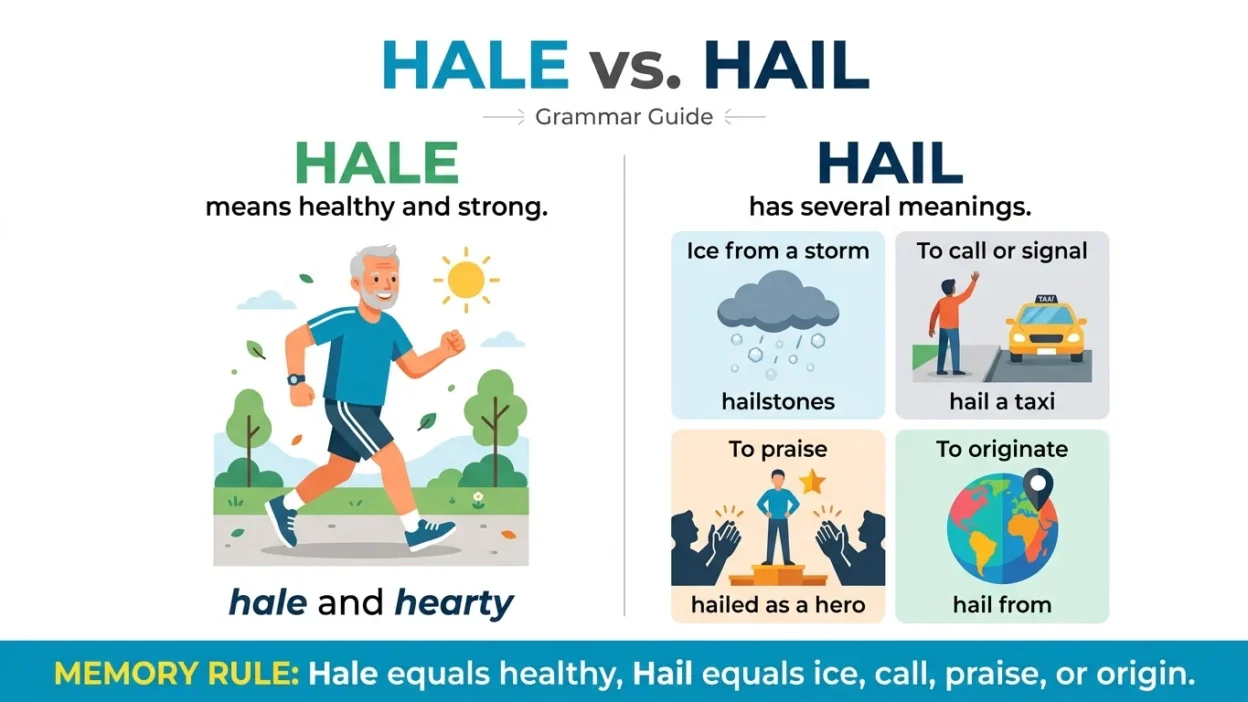
Choosing between hale and hail can be confusing because the two words sound the same in standard English but have very different meanings. Hale is mainly an adjective meaning healthy, strong, and vigorous, especially when describing someone who remains physically well despite being older. For example, “At eighty, he is still hale and active” means he remains strong and healthy.
Hail has several meanings. As a noun, it refers to small balls or pieces of ice that fall from the sky during certain storms. As a verb, it can describe this weather, enthusiastically greet or praise someone, call out to attract attention, or signal for a taxi. It also appears in the expression hail from, meaning to come originally from a particular place.
Since hale and hail are homophones, pronunciation usually cannot help you choose between them. Remember the basic distinction: hale means healthy and strong, while hail usually relates to ice, greeting, praise, calling, or origin.
Quick Answer
Hale means healthy, strong, and vigorous, as in “She is hale and active.” Hail can mean frozen precipitation, to greet or praise someone, to call for attention, or to come from a place in the expression hail from. They sound alike but have different meanings.
Hale vs Hail Definition and Meaning
Hale and hail are both correct English words.
Hale is most commonly an adjective meaning healthy and strong.
Example:
“He remained hale in old age.”
Hail can be a noun or verb.
As a noun, it can mean frozen precipitation.
Example:
“Hail damaged the crops.”
As a verb, it can mean to greet, praise, or call someone.
Example:
“The crowd hailed the winner.”
It also appears in:
“She hails from London.”
The basic distinction is:
HALE equals HEALTHY
HAIL equals ICE, GREET, CALL, or COME FROM
Why People Confuse Hale and Hail
People commonly confuse hale and hail because they are homophones.
That means they are pronounced alike even though their spellings and meanings differ.
Compare:
“He is hale and healthy.”
“Hail fell during the storm.”
The key words sound the same.
Because both are valid English words, ordinary spell checking may not always detect an incorrect substitution.
Another reason for confusion is that hail has several meanings. It can refer to weather, greeting, praise, calling for attention, or someone’s place of origin.
Hale, by comparison, has a much narrower everyday meaning.
The easiest solution is to connect hale with health.
What Does Hale Mean?
Hale is mainly an adjective meaning healthy, strong, and physically vigorous.
It is especially common when describing someone who remains healthy despite advanced age.
For example:
“At ninety, she remains remarkably hale.”
Another example:
“He looked hale and energetic.”
The word often appears in the traditional expression:
hale and hearty
This means healthy, strong, and full of energy.
The central idea is good physical condition.
Therefore, if your sentence is describing someone’s health, strength, or vigor, hale may be the correct choice.
What Does Hail Mean?
Hail has several common meanings.
First, it can refer to frozen precipitation.
Example:
“Hail fell during the storm.”
Second, it can mean to greet or call someone.
Example:
“She hailed a taxi.”
Third, it can mean to praise or publicly recognize someone or something.
Example:
“Critics hailed the film as a success.”
Fourth, hail from means to originate or come from a particular place.
Example:
“She hails from Lahore.”
Therefore, hail has a much broader range of meanings than hale.
Context determines which meaning is intended.
Hale vs Hail Comparison
Hale
Main meaning: Healthy and strong
Common grammatical role: Adjective
Example: “He is hale and active.”
Memory clue: Hale relates to health
Hail
Meaning one: Frozen precipitation
Example: “Hail damaged the roof.”
Meaning two: Greet or call
Example: “She hailed a taxi.”
Meaning three: Praise or acclaim
Example: “The book was hailed as a masterpiece.”
Meaning four: Come from a place
Example: “They hail from Pakistan.”
The easiest distinction is:
HALE equals HEALTHY
HAIL equals ICE, CALL, PRAISE, or ORIGIN
Hale vs Hail Pronunciation Guide
Hale and hail are pronounced the same in standard English.
Both are pronounced approximately:
“hayl”
This makes them homophones.
You cannot normally identify the correct spelling simply by listening to the word.
Instead, examine the meaning.
If someone is healthy and strong, use:
hale
If the sentence concerns ice falling from the sky, greeting, praise, calling someone, or someone’s origin, use:
hail
Compare:
“He is hale.”
“It began to hail.”
The pronunciation is the same, but the meanings are entirely different.
Grammar Rules for Hale and Hail
Hale is most commonly used as an adjective.
Example:
“She remains hale and active.”
It describes a person’s condition.
Hail can function as both a noun and a verb.
As a noun:
“The hail damaged the garden.”
As a verb describing weather:
“It began to hail.”
As a verb meaning call:
“She hailed a taxi.”
As a verb meaning praise:
“The critics hailed the performance.”
The verb forms include:
hail
hails
hailed
hailing
Understanding these grammatical roles can help distinguish the words.
When to Use Hale
Use hale when describing someone as physically healthy, strong, or vigorous.
Examples:
“He remains hale despite his age.”
“She looked hale and energetic.”
“My grandfather is still hale and active.”
The word is often associated with older people because it emphasizes continued good health.
You may also encounter:
hale and hearty
For example:
“At eighty five, he was still hale and hearty.”
If you can replace the word with:
healthy
strong
or:
vigorous
then hale is probably the correct choice.
When to Use Hail
Use hail when referring to frozen precipitation:
“Hail fell from the sky.”
Use hail when calling for someone’s attention:
“She hailed a taxi.”
Use hail when greeting or acknowledging someone:
“They hailed their leader.”
Use hail when praising something:
“Critics hailed the decision as a major success.”
Use hail from when talking about origin:
“He hails from Karachi.”
Because hail has several meanings, always examine the surrounding words and context.
When to Use Each Word
Use hale when you mean:
healthy
strong
vigorous
physically well
Use hail when you mean:
frozen precipitation
call or attract attention
greet
praise or acclaim
come from a place
Compare:
“He is hale and healthy.”
“The storm brought hail.”
“She hailed a taxi.”
“The film was hailed as a success.”
“He hails from Pakistan.”
The simplest memory rule is:
Hale equals healthy.
Hail has all the other common meanings.
Hale vs Hail Examples
Here are 15 examples showing correct usage:
- My grandfather remains hale and active.
- She looked remarkably hale for her age.
- He remained hale well into old age.
- At eighty, she was still hale and energetic.
- The older people man appeared hale and hearty.
- Heavy hail damaged the crops.
- Hail covered the ground after the storm.
- It began to hail during the afternoon.
- She hailed a taxi outside the hotel.
- He hailed the driver from across the street.
- Critics hailed the movie as a major success.
- The audience hailed her performance.
- She hails from Lahore.
- Many members of the group hail from different countries.
- The new discovery was hailed as an important breakthrough.
Hale and Hearty or Hail and Hearty?
The correct expression is:
hale and hearty
It means healthy, strong, energetic, and vigorous.
For example:
“My grandfather is eighty, but he is still hale and hearty.”
Do not normally write:
“hail and hearty”
The word hale is correct because the expression concerns health.
Both hale and hearty reinforce the idea of physical wellness and strength.
This phrase also provides an excellent memory trick.
Think:
HALE and HEALTHY
Both begin with H and share a similar meaning.
Hale and Healthy Meaning
Hale and healthy emphasizes good physical condition.
For example:
“She remained hale and healthy throughout her later years.”
Since hale itself already means healthy and vigorous, the expression can sound somewhat repetitive, but it may be used for emphasis.
A more traditional phrase is:
hale and hearty
The important spelling point is that health requires:
hale
not:
hail
Remember:
HALE equals HEALTH
This is the easiest way to distinguish it from the many meanings of hail.
Hail Storm or Hale Storm?
The correct expression is:
hail storm
You may also commonly see it written as the single word:
hailstorm
A hailstorm is a storm that produces hail.
For example:
“The hailstorm damaged several cars.”
Do not use hale storm.
Hale means healthy and strong, so it has no ordinary weather meaning.
Correct:
“hail”
“hailstorm”
“hailstones”
“Hail fell from the sky.”
If the context involves weather and pieces of ice, choose hail.
What Is Hail?
Hail is a form of precipitation consisting of balls or lumps of ice produced within certain thunderstorms.
Individual pieces are called:
hailstones
For example:
“Large hailstones damaged several cars.”
Another example:
“The storm produced heavy hail.”
Hail should not be confused with snow, even though both involve frozen water.
In grammar terms, hail can function as a noun:
“The hail was heavy.”
It can also function as a verb:
“It hailed yesterday.”
When discussing this type of weather, always use:
hail
not:
hale
Hail or Hailstones?
Hail refers collectively to the frozen precipitation.
For example:
“The storm brought heavy hail.”
A hailstone is an individual piece of hail.
For example:
“A large hailstone hit the window.”
The plural is:
hailstones
Example:
“Hailstones covered the ground.”
Therefore:
hail equals the precipitation
hailstone equals an individual piece
Neither should be confused with hale, which refers to health and strength.
It Hailed or It Haled?
When describing the weather, use:
It hailed.
For example:
“It hailed for several minutes yesterday.”
This is the simple past tense of the weather verb hail.
Do not write:
“It haled”
when you mean that hail fell from the sky.
The regular verb pattern is:
hail
hails
hailed
hailing
Example:
“It is hailing outside.”
If ice is falling from the sky, the correct spelling contains ai:
hail
Hail a Taxi Meaning
To hail a taxi means to signal or call to a taxi so that it stops for you.
For example:
“She stood outside the station and hailed a taxi.”
Another example:
“He tried to hail a cab.”
The word hail in this expression has nothing to do with frozen precipitation.
Instead, it means to call, signal, or attract attention.
The correct expression is:
hail a taxi
not:
“hale a taxi”
Remember that hale is mainly associated with being healthy and strong.
Hail a Cab or Hale a Cab?
The correct expression is:
hail a cab
For example:
“We walked outside and hailed a cab.”
Here, hail means to signal or call the vehicle.
You can also say:
“hail a taxi”
“hail a driver”
The past tense is:
hailed
Example:
“She hailed a cab outside the restaurant.”
Do not use hale for this meaning.
A simple clue is:
Hail can mean call.
Therefore:
hail a cab
is the correct expression.
Hail From Meaning
The expression hail from means to come originally from or be associated by origin with a particular place.
For example:
“She hails from Lahore.”
This means Lahore is her place of origin.
Other examples:
“He hails from London.”
“They hail from different regions.”
“The singer hails from a small town.”
The past tense is also possible:
“He hailed from a village in the north.”
Do not use hale from for this meaning.
The established expression is:
hail from
Hail From or Hale From?
When talking about someone’s place of origin, use:
hail from
Correct:
“She hails from Pakistan.”
Correct:
“He hailed from a small town.”
Incorrect for this meaning:
“She hales from Pakistan.”
The expression hail from is established in standard English and means to originate from a place.
A useful memory sentence is:
She hails from Lahore.
This helps separate hail meaning origin from hale meaning healthy.
Hailed as Meaning
Hailed as means publicly praised, acclaimed, or recognized as something important or impressive.
For example:
“The invention was hailed as a major breakthrough.”
Another example:
“She was hailed as one of the finest performers of her generation.”
In this construction, hailed does not relate to weather.
It means praised or acclaimed.
Common patterns include:
“hailed as a success”
“hailed as a hero”
“hailed as a breakthrough”
“hailed as a masterpiece”
The correct spelling is:
hailed as
not:
“haled as”
Hailed as a Hero Meaning
If someone is hailed as a hero, that person is publicly praised or recognized as heroic.
For example:
“The firefighter was hailed as a hero.”
This means people praised or celebrated the firefighter’s actions.
The word hailed is the past form of hail.
Another example:
“The rescue team was hailed for its bravery.”
This meaning is common in journalism and formal writing.
Do not confuse it with hale, which describes good health.
Hailed as a Success Meaning
The expression hailed as a success means widely praised or recognized as successful.
For example:
“The new program was hailed as a success.”
Other similar expressions include:
“hailed as a breakthrough”
“hailed as an achievement”
“hailed as a masterpiece”
“hailed as a major improvement”
This use of hail is especially common in news, reviews, and formal commentary.
The correct word is hailed because the meaning involves praise or acclaim.
All Hail Meaning
All hail is an expression used to greet, acclaim, praise, or show enthusiastic approval.
For example:
“All hail the champion!”
It can sound formal, dramatic, humorous, or ceremonial depending on context.
The word is:
hail
not:
hale
The expression has nothing to do with health.
It is connected with greeting or acclaim.
You may encounter all hail in literature, speeches, entertainment, and humorous everyday expressions.
Hail Someone Meaning
To hail someone can mean to greet, call to, or praise that person depending on context.
For example:
“She hailed him from across the street.”
Here, hailed means called to attract his attention.
Another example:
“The crowd hailed the victorious team.”
Here, it means greeted or acclaimed enthusiastically.
Another:
“She was hailed as a hero.”
Here, it means praised.
Because hail has multiple meanings, the rest of the sentence determines the intended sense.
Hale and Hail in Real Life Usage
Imagine describing a healthy older person:
“At eighty, he remains hale and active.”
Here, hale means healthy and vigorous.
Now imagine a storm:
“Hail damaged the roof.”
Here, hail means frozen precipitation.
Imagine needing transportation:
“She hailed a taxi.”
Here, hail means signaled or called.
Finally:
“The scientist was hailed as a pioneer.”
Here, hailed means praised.
These examples show why hail appears in many more contexts than hale.
Hale and Hail in Business English
Hail can appear frequently in business journalism and professional writing when something is praised.
For example:
“The merger was hailed as a major success.”
“The technology was hailed as a breakthrough.”
“The new strategy was hailed as an improvement.”
Hale is less common in ordinary business writing because it primarily describes physical health.
However, it can appear when describing a person:
“The founder remained hale and active in later life.”
The meaning of the sentence should always determine the spelling.
Hale and Hail in Formal Writing
Both words are acceptable in formal English.
Hale may appear in biographical, literary, or descriptive writing.
Example:
“He remained hale into old age.”
Hail can appear in meteorological writing:
“The storm produced large hail.”
It can also appear in journalism:
“The policy was hailed as a significant achievement.”
And biographical writing:
“The author hailed from a small village.”
Because hail has several meanings, context is especially important in formal writing.
Formal vs Informal Use
Both hale and hail are standard English words.
However, hale can sound somewhat literary or traditional in modern everyday speech.
For example:
“He is still hale and hearty.”
In casual conversation, people may simply say:
“He is still healthy and strong.”
Hail remains common across many contexts.
Examples:
“It started to hail.”
“She hailed a taxi.”
“The movie was hailed as a success.”
“He hails from Manchester.”
The words are not interchangeable regardless of formality.
American vs British English
The basic distinction between hale and hail is the same in American and British English.
Both use hale to mean healthy and vigorous.
Both use hail for frozen precipitation.
Both also use expressions such as:
“hail a taxi”
“hail from”
“hailed as”
Pronunciation can vary slightly by accent, but hale and hail remain homophones for standard speakers.
There is no major spelling difference between American and British English for this pair.
The same rule applies:
Hale equals healthy.
Hail has weather, calling, praise, and origin meanings.
Common Mistakes With Hale and Hail
A common mistake is:
Incorrect:
“He is hail and hearty.”
Correct:
“He is hale and hearty.”
Another mistake is:
Incorrect:
“She haled a taxi.”
Correct:
“She hailed a taxi.”
For weather:
Incorrect:
“The hale damaged the car.”
Correct:
“The hail damaged the car.”
For origin:
Incorrect:
“She hales from Lahore.”
Correct:
“She hails from Lahore.”
For praise:
Correct:
“The film was hailed as a masterpiece.”
Remembering the meaning of each word prevents these common errors.
Memory Trick for Hale vs Hail
The easiest memory trick is:
HALE equals HEALTHY
Both hale and healthy begin with H, and their meanings are closely connected.
Think:
Hale and healthy
For hail, remember several short examples:
Hail falls from the sky.
Hail a taxi.
Hail from a city.
Hailed as a hero.
You can reduce the rule to:
HALE equals HEALTH
HAIL equals ICE, CALL, PRAISE, or ORIGIN
If the sentence is specifically describing someone’s good health, choose hale.
Expert Tips for Choosing Hale or Hail
First, ask whether you mean healthy and strong.
If yes, use:
hale
Example:
“He remains hale and active.”
If the sentence involves frozen precipitation, use:
hail
If someone is calling or signaling a taxi, use:
hail
If someone or something is being praised, use:
hail
If the sentence describes where someone comes from, use:
hail from
This meaning based approach works better than pronunciation because hale and hail sound the same.
Mistakes to Avoid
Do not use hail when describing someone’s health.
Correct:
“hale and hearty”
Do not use hale for frozen precipitation.
Correct:
“heavy hail”
Do not use hale when signaling transportation.
Correct:
“hail a taxi”
Do not use hale from for someone’s origin.
Correct:
“hail from”
Do not use haled as when you mean praised.
Correct:
“hailed as”
The central memory rule remains:
HALE means HEALTHY
HAIL has the other common meanings
Similar Words
Hale and hail are homophones, meaning they sound alike but have different spellings and meanings.
Other common homophones include:
sole and soul
sea and see
whole and hole
pair and pear
peace and piece
right and write
hear and here
flour and flower
Homophones require careful attention to context because pronunciation cannot reveal the correct spelling.
For this pair:
Hale means healthy.
Hail can mean ice, call, praise, or come from.
Related Confusing Words
If hale vs hail is confusing, these related topics may also be useful:
sole vs soul
whole vs hole
weather vs whether
rain vs reign
reign vs rein
sea vs see
hear vs here
peace vs piece
right vs write
peek vs peak
cavalry vs Calvary
shudder vs shutter
The most important rule for the current pair is:
Hale relates to health.
Hail relates to ice, calling, praise, or origin.
FAQs About Hale vs Hail
What is the difference between hale and hail?
Hale means healthy, strong, and vigorous. Hail can mean frozen precipitation, to call or greet someone, to praise someone or something, or to come from a particular place.
Is it hale and hearty or hail and hearty?
The correct expression is hale and hearty, meaning healthy and strong.
Is it hail storm or hale storm?
Use hail storm, commonly also written as hailstorm, for a storm that produces hail.
Is it hail a taxi or hale a taxi?
The correct expression is hail a taxi, meaning to signal or call for a taxi.
Is it hail from or hale from?
Use hail from when describing someone’s place of origin.
What does hailed as mean?
Hailed as means praised, acclaimed, or publicly recognized as something.
Do hale and hail sound the same?
Yes. Hale and hail are homophones in standard English.
What does hale and hearty mean?
Hale and hearty means healthy, strong, energetic, and vigorous.
Final Verdict on Hale vs Hail
The difference between hale and hail becomes straightforward once you focus on meaning. Hale is primarily an adjective meaning healthy, strong, and vigorous. It is particularly familiar in the expression hale and hearty and is often used when describing someone who remains physically healthy in later life.
Hail has several meanings. It can refer to frozen precipitation, mean to call or signal someone, describe enthusiastic greeting or praise, and appear in hail from to indicate someone’s place of origin. Examples include hail a taxi, hail from Lahore, hailed as a hero, and heavy hail. Since hale and hail sound alike, rely on meaning rather than pronunciation. The simplest rule is: hale means healthy, while hail relates to ice, calling, praise, or origin.
Remember This
HALE
Means healthy, strong, or vigorous
Examples:
“hale and hearty”
“He remains hale and active.”
Think:
HALE equals HEALTHY
HAIL
Can mean frozen precipitation:
“Hail damaged the roof.”
Can mean call:
“She hailed a taxi.”
Can mean praise:
“He was hailed as a hero.”
Can indicate origin:
“She hails from Lahore.”
The easiest memory rule is:
HALE equals HEALTH
HAIL equals ICE, CALL, PRAISE, or ORIGIN

Donald Andrew is a dedicated author at BiblyWord, passionate about sharing biblical teachings in a clear and inspiring way. He creates meaningful content that helps readers understand scripture, reflect on their faith, and apply God’s Word in daily life. His work supports spiritual growth, guidance, and a deeper connection with biblical wisdom.