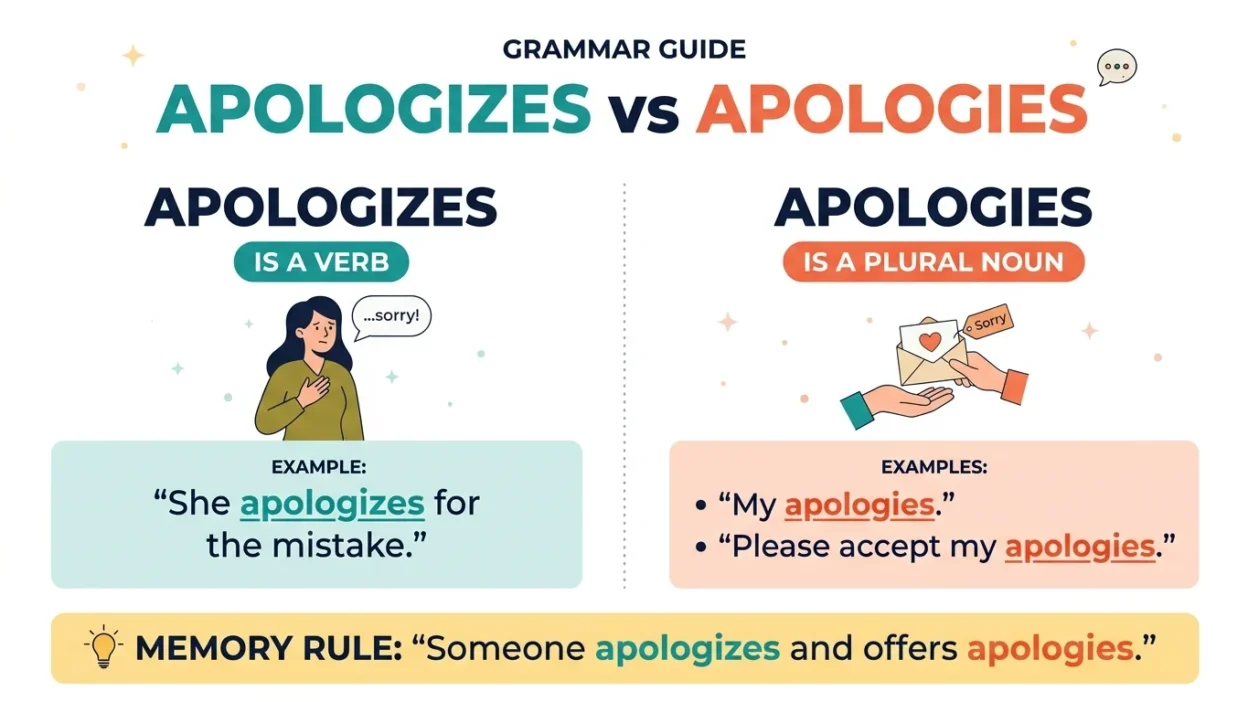
Choosing between apologizes and apologies can be confusing because the words look and sound similar, but they have different grammatical roles. Apologizes is a verb. It is the third person singular present form of apologize and describes the action of saying sorry or expressing regret. For example, “She apologizes when she makes a mistake” means that she expresses regret.
Apologies, on the other hand, is usually the plural noun form of apology. It refers to expressions or statements of regret. For example, “Please accept my apologies” means the speaker is offering an expression of regret.
The difference becomes easy when you identify if the sentence needs an action or a thing. If someone does the action of saying sorry, use apologizes. If you mean expressions of regret, use apologies. Remember the simple rule: apologizes is a verb, while apologies is a noun.
Quick Answer
Apologizes is a verb meaning expresses regret or says sorry, as in “She apologizes for the mistake.” Apologies is the plural noun of apology, as in “Please accept my apologies.” Use apologizes for an action and apologies for expressions of regret.
Apologizes vs Apologies Definition and Meaning
Both apologizes and apologies are correct English words.
However, they are not interchangeable.
Apologizes is a verb.
Example:
“He apologizes for being late.”
It describes what someone does.
Apologies is usually a plural noun.
Example:
“She offered her apologies.”
It refers to expressions of regret.
The simplest distinction is:
APOLOGIZES equals VERB
APOLOGIES equals NOUN
Ask yourself whether you need an action or a thing.
If someone is expressing regret, use apologizes.
If you are referring to the expressions of regret themselves, use apologies.
Why People Confuse Apologizes and Apologies
People confuse these words because their spellings are extremely similar.
Compare:
apologizes
apologies
The main visual difference is the z in apologizes.
Their meanings are also closely related because both come from the same word family.
Compare:
“He apologizes for the error.”
“He offers his apologies for the error.”
Both sentences communicate regret, but their grammatical structures differ.
In the first sentence, apologizes is the action.
In the second, apologies is a noun.
Recognizing the part of speech is the easiest way to choose correctly.
What Does Apologizes Mean?
Apologizes is the third person singular present form of the verb apologize.
It means expresses regret, acknowledges a mistake, or says sorry.
Examples:
“She apologizes when she is wrong.”
“He apologizes for the delay.”
“The company apologizes for the inconvenience.”
The basic verb forms are:
apologize
apologizes
apologized
apologizing
Use apologizes with a singular third person subject such as:
he
she
it
or a singular noun.
For example:
“Sarah apologizes.”
“The manager apologizes.”
“The company apologizes.”
What Does Apologies Mean?
Apologies is the plural form of the noun apology.
An apology is an expression of regret for something someone has done or for an unfortunate situation.
Singular:
apology
Plural:
apologies
Examples:
“Please accept my apologies.”
“She offered her apologies.”
“We received several apologies.”
The word is a noun, not the third person form of the verb apologize.
A useful clue is that apologies can often follow words such as:
my
your
his
her
our
their
For example:
“My apologies for the confusion.”
Apologizes vs Apologies Comparison
Apologizes
Part of speech: Verb
Meaning: Expresses regret or says sorry
Example: “She apologizes for the mistake.”
Used with: He, she, it, or a singular noun
Basic form: Apologize
Apologies
Part of speech: Plural noun
Meaning: Expressions of regret
Example: “Please accept my apologies.”
Singular form: Apology
Common phrase: “My apologies”
The easiest rule is:
APOLOGIZES equals ACTION
APOLOGIES equals EXPRESSIONS OF REGRET
Apologizes vs Apologies Pronunciation Guide
Although apologizes and apologies look very similar, their pronunciations differ.
Apologizes is pronounced approximately:
“uh POL uh jy ziz”
It contains an additional syllable at the end because it is formed from the verb apologize plus s.
Apologies is pronounced approximately:
“uh POL uh jeez”
It is the plural of apology.
Listening carefully can therefore help distinguish the words in speech.
In writing, however, grammar is the most reliable guide.
Remember:
She apologizes.
She offers apologies.
Grammar Rules for Apologizes and Apologies
The most important grammatical difference is their part of speech.
Apologizes is a verb.
Use it with third person singular subjects in the simple present tense.
Examples:
“He apologizes.”
“She apologizes.”
“The teacher apologizes.”
“The company apologizes.”
Apologies is a plural noun.
Examples:
“His apologies were sincere.”
“Please accept our apologies.”
“The company issued several apologies.”
Because apologies is plural, it can take a plural verb when it functions as the subject.
Example:
“Her apologies were accepted.”
This distinction makes the correct choice much easier.
Apologize, Apologizes, Apologized, and Apologizing
These are forms of the verb apologize.
Apologize
“I apologize for the mistake.”
Apologizes
“She apologizes for the mistake.”
Apologized
“She apologized yesterday.”
Apologizing
“She is apologizing now.”
The form apologizes is used in the simple present with a third person singular subject.
For example:
“He apologizes.”
However:
“I apologize.”
“You apologize.”
“We apologize.”
“They apologize.”
Only the third person singular form normally takes the final s.
Apology vs Apologies
Apology is singular.
Example:
“She gave me an apology.”
Apologies is plural.
Example:
“She offered her apologies.”
Compare:
“One apology”
“Two apologies”
“Several apologies”
“Many apologies”
Notice the spelling change:
apology
becomes:
apologies
The final y changes to ies because the word ends in a consonant followed by y.
This is a common English plural pattern.
For example:
story becomes stories
category becomes categories
apology becomes apologies
When to Use Apologizes
Use apologizes when a third person singular subject performs the action of expressing regret.
Examples:
“He apologizes for being late.”
“She apologizes whenever she makes a mistake.”
“The manager apologizes for the inconvenience.”
“The company apologizes for the delay.”
“My friend always apologizes when he is wrong.”
A quick test is to replace apologizes with another verb such as says sorry.
For example:
“She apologizes.”
“She says sorry.”
If this replacement makes sense, apologizes is likely correct.
When to Use Apologies
Use apologies when referring to expressions of regret.
Examples:
“Please accept my apologies.”
“My apologies for the delay.”
“She offered her apologies.”
“His apologies seemed sincere.”
“We extend our apologies to everyone affected.”
Common expressions include:
“my apologies”
“our apologies”
“sincere apologies”
“deepest apologies”
“formal apologies”
“accept my apologies”
“offer apologies”
If you can place a possessive word such as my, our, his, or her before it, apologies is often the correct form.
When to Use Each Word
Use apologizes when someone performs an action.
Example:
“She apologizes for the mistake.”
Use apologies when referring to expressions of regret.
Example:
“She offers her apologies for the mistake.”
Compare:
“The company apologizes for the delay.”
“The company offers its apologies for the delay.”
Both sentences are correct.
However, the grammar differs.
In the first:
apologizes is a verb
In the second:
apologies is a noun
The easiest memory rule is:
Someone APOLOGIZES.
Someone offers APOLOGIES.
Apologizes vs Apologies Examples
Here are 15 examples showing correct usage:
- She apologizes whenever she is wrong.
- He apologizes for arriving late.
- The company apologizes for the inconvenience.
- The manager apologizes for the error.
- Sarah always apologizes when she makes a mistake.
- The teacher apologizes for the confusion.
- He apologizes sincerely.
- Please accept my apologies.
- My apologies for the delay.
- She offered her apologies to the customer.
- We extend our sincere apologies.
- His apologies were accepted.
- They offered their apologies for the mistake.
- The organization issued formal apologies.
- Our apologies for any inconvenience caused.
My Apologizes or My Apologies?
The correct expression is:
my apologies
For example:
“My apologies for the delay.”
Do not write:
“my apologizes”
The reason is simple.
After my, you need a noun.
Apologies is a noun.
Apologizes is a verb.
Therefore:
my apologies
is grammatically correct.
Other correct examples include:
“your apologies”
“his apologies”
“her apologies”
“our apologies”
“their apologies”
Remember:
MY plus APOLOGIES
My Apologies Meaning
My apologies is a polite expression meaning:
“I am sorry.”
For example:
“My apologies for arriving late.”
Another example:
“My apologies for the misunderstanding.”
It can sound slightly more formal than simply saying:
“Sorry.”
The phrase is useful in professional, business, and polite communication.
You can also strengthen it:
“My sincere apologies.”
“My deepest apologies.”
“My heartfelt apologies.”
The correct spelling is always:
apologies
because the word functions as a noun.
I Apologize or My Apologies?
Both are correct.
I apologize uses a verb.
Example:
“I apologize for the delay.”
My apologies uses a noun.
Example:
“My apologies for the delay.”
Both communicate regret.
However, their grammatical structures differ.
I apologize
Subject plus verb
My apologies
Possessive determiner plus noun
In professional communication, either can be appropriate.
You might write:
“I sincerely apologize for the inconvenience.”
Or:
“My sincere apologies for the inconvenience.”
The choice depends mainly on sentence structure and tone.
He Apologizes or He Apologies?
The correct expression is:
he apologizes
For example:
“He apologizes whenever he makes a mistake.”
Do not write:
“He apologies for the mistake.”
In this sentence, you need a verb.
The correct third person singular form of apologize is:
apologizes
Therefore:
“He apologizes.”
“She apologizes.”
“The manager apologizes.”
“The company apologizes.”
Remember:
He does an action, so he APOLOGIZES.
She Apologizes or She Apologies?
The correct expression is:
she apologizes
For example:
“She apologizes for being late.”
Apologizes is the verb needed after she in the simple present.
Incorrect:
“She apologies for being late.”
Correct:
“She apologizes for being late.”
However, apologies can appear later in a sentence as a noun:
“She offers her apologies for being late.”
This contrast clearly demonstrates the difference.
She apologizes.
She offers apologies.
Company Apologizes or Company Apologies?
Both forms can appear, but they require different sentence structures.
As a verb:
“The company apologizes for the inconvenience.”
Here, apologizes describes the company’s action.
As a noun:
“The company’s apologies were accepted.”
Here, apologies refers to expressions of regret.
You might also see a heading such as:
“Company Apology”
or:
“Company Apologies”
depending on the intended meaning.
The important rule is:
apologizes is an action
apologies is a noun
We Apologize or We Apologizes?
The correct expression is:
we apologize
For example:
“We apologize for the inconvenience.”
Do not write:
“We apologizes for the inconvenience.”
Apologizes is used with third person singular subjects.
Correct:
“He apologizes.”
“She apologizes.”
“The company apologizes.”
But:
“I apologize.”
“You apologize.”
“We apologize.”
“They apologize.”
This subject and verb agreement rule is important in both formal and informal English.
We Apologize or We Apologies?
The correct verbal expression is:
we apologize
For example:
“We apologize for the delay.”
However, apologies can be used as a noun:
“We offer our apologies for the delay.”
Therefore:
We apologize
is correct.
We apologies
is incorrect when apologies is intended as the verb.
A simple test is:
If the sentence needs an action after we, use apologize.
If it needs a noun, use apologies.
Our Apologizes or Our Apologies?
The correct expression is:
our apologies
For example:
“Our apologies for the inconvenience.”
Do not write:
“our apologizes”
The possessive determiner our normally needs a noun after it in this construction.
Apologies is the noun.
Other examples include:
“Our sincere apologies.”
“Our deepest apologies.”
“Our apologies for the confusion.”
“Our apologies for any inconvenience.”
Remember:
OUR plus APOLOGIES
just like:
MY plus APOLOGIES
Sincere Apologizes or Sincere Apologies?
The correct expression is:
sincere apologies
For example:
“Please accept my sincere apologies.”
Sincere is an adjective describing the noun apologies.
Do not write:
“sincere apologizes”
because apologizes is a verb.
Other correct phrases include:
“deepest apologies”
“heartfelt apologies”
“formal apologies”
“public apologies”
“written apologies”
When an adjective directly describes the expressions of regret, use the noun:
apologies
Please Accept My Apologies Meaning
Please accept my apologies is a polite and relatively formal way to express regret.
For example:
“Please accept my apologies for the misunderstanding.”
The word apologies is correct because accept takes the noun as its object.
You are asking someone to accept your expressions of regret.
Similar phrases include:
“Please accept our apologies.”
“Please accept my sincere apologies.”
“Please accept our deepest apologies.”
Do not write:
“Please accept my apologizes.”
The correct phrase is:
accept my apologies
Apologies for the Inconvenience Meaning
Apologies for the inconvenience is a common expression used when acknowledging that someone has experienced trouble, delay, disruption, or difficulty.
For example:
“Our apologies for the inconvenience.”
Another common structure is:
“We apologize for the inconvenience.”
Both are correct.
Compare:
Our apologies for the inconvenience.
Noun
We apologize for the inconvenience.
Verb
Do not confuse:
apologies
with:
apologizes
If the sentence begins with our, use the noun apologies.
If the subject is the company, you can say:
“The company apologizes for the inconvenience.”
Apologizes for or Apologies for?
Both can be correct depending on grammar.
Apologizes for is a verb phrase.
Example:
“She apologizes for the mistake.”
Apologies for contains a noun.
Example:
“My apologies for the mistake.”
Compare:
“He apologizes for being late.”
“His apologies for being late seemed sincere.”
The words following for do not determine the choice by themselves.
Instead, examine what comes before the word.
A subject performing an action may require apologizes.
A possessive word such as my, his, her, our, or their often signals apologies.
Apologizes to or Apologies to?
Both forms are possible in different structures.
Use apologizes to when describing an action.
Example:
“She apologizes to her customers.”
Use apologies to when apologies functions as a noun.
Example:
“She offered her apologies to the customers.”
Another example:
“Our apologies to everyone affected.”
Therefore:
She apologizes to them.
She offers her apologies to them.
The first uses a verb.
The second uses a noun.
Apologize for vs Apologize to
These two patterns express different relationships.
Use apologize to before the person receiving the apology.
Example:
“She apologized to her teacher.”
Use apologize for before the action, mistake, or situation.
Example:
“She apologized for being late.”
You can combine both:
“She apologized to her teacher for being late.”
This pattern is extremely useful:
apologize to a person
apologize for a mistake or action
The same idea works with apologizes:
“He apologizes to customers for the delay.”
Apologizes and Apologies in Real Life Usage
Imagine someone arrives late.
You can say:
“He apologizes for being late.”
Here, apologizes is the action.
You could also say:
“He offers his apologies for being late.”
Here, apologies is the noun.
Another example:
“The manager apologizes for the mistake.”
“The manager offers her apologies for the mistake.”
Both communicate a similar idea, but their grammar is different.
Remember:
A person apologizes.
A person gives, offers, or expresses apologies.
Apologizes and Apologies in Business English
Both words are common in professional communication.
A company might write:
“The company apologizes for the delay.”
Here, apologizes is the verb.
It could also write:
“Please accept our apologies for the delay.”
Here, apologies is the noun.
Other professional expressions include:
“We sincerely apologize for the inconvenience.”
“Our sincere apologies for the inconvenience.”
“The organization apologizes for the error.”
“We extend our apologies to those affected.”
Correct grammar is particularly important in apology emails, notices, customer service messages, and official statements.
Apologizes and Apologies in Formal Writing
In formal writing, both words are acceptable when used correctly.
Apologizes:
“The organization apologizes for the error.”
Apologies:
“The organization offered its apologies.”
The noun apologies commonly appears with verbs such as:
offer
accept
express
issue
extend
For example:
“The director offered his apologies.”
“The organization issued an apology.”
“The speaker expressed her apologies.”
The verb apologizes directly describes the act of expressing regret.
Understanding this structural difference improves clarity and grammatical accuracy.
Formal vs Informal Use
Both apologizes and apologies can appear in formal and informal English.
Informal:
“He always apologizes.”
Formal:
“The organization apologizes for the inconvenience.”
Informal:
“My apologies. I forgot.”
Formal:
“Please accept our sincere apologies for the error.”
The distinction is not based on formality.
It is grammatical.
Use apologizes as a verb with a third person singular subject.
Use apologies as the plural noun of apology.
Both forms can sound professional when placed correctly in a sentence.
American vs British English
The main grammatical distinction between apologizes and apologies is the same in American and British English.
However, there is a spelling variation in the verb.
American English commonly uses:
apologize
apologizes
apologized
British English permits apologize forms, while apologise forms are also widely used:
apologise
apologises
apologised
The noun remains:
apology
Plural:
apologies
Therefore, apologies should not be confused with either apologizes or apologises.
The noun and verb still perform different grammatical roles.
Common Mistakes With Apologizes and Apologies
A common mistake is:
Incorrect:
“My apologizes for the delay.”
Correct:
“My apologies for the delay.”
Another mistake is:
Incorrect:
“She apologies for the mistake.”
Correct in American spelling:
“She apologizes for the mistake.”
Another error is:
Incorrect:
“Our apologizes for the inconvenience.”
Correct:
“Our apologies for the inconvenience.”
Also remember:
Correct:
“The company apologizes.”
Correct:
“The company’s apologies were accepted.”
The simplest solution is to determine whether the sentence needs a verb or noun.
Memory Trick for Apologizes vs Apologies
Use this simple memory trick:
APOLOGIZES has Z for the verb.
Think:
“She apologizeZ.”
This can remind you that apologizes describes an action.
For apologies, think:
MY APOLOGIES
This familiar expression immediately shows that apologies is a noun.
Remember these two sentences:
She APOLOGIZES.
She offers APOLOGIES.
Or simply memorize:
APOLOGIZES equals ACTION
APOLOGIES equals NOUN
Expert Tips for Choosing Apologizes or Apologies
First, look at the subject.
If you have:
he
she
it
or a singular noun performing the action, use apologizes in American English.
Example:
“The manager apologizes.”
Next, look for possessive words.
If you see:
my
your
his
her
our
their
you may need apologies.
Example:
“Our apologies for the delay.”
Finally, try the replacement test.
If says sorry works, choose apologizes.
If expressions of regret works, choose apologies.
Mistakes to Avoid
Do not use apologizes after my or our when you need a noun.
Incorrect:
“My apologizes.”
Correct:
“My apologies.”
Do not use apologies as the simple present verb after they.
Incorrect in standard American English:
“She apologies.”
Correct:
“She apologizes.”
Do not forget subject and verb agreement.
Correct:
“I apologize.”
“She apologizes.”
“We apologize.”
“They apologize.”
Finally, remember that British English may use apologises as a verb, but apologies remains the plural noun.
Similar Words
This confusion comes partly from the relationship between verbs and nouns.
Compare:
apologize and apology
advise and advice
practice and practise in certain varieties of English
choose and choice
believe and belief
The grammatical category matters as much as the meaning.
For the current pair:
apologizes is a verb.
apologies is a noun.
The words are related, but they cannot simply replace each other.
A useful pair of examples is:
“She apologizes.”
“Her apologies were sincere.”
Related Confusing Words
If apologizes vs apologies is confusing, these related topics may also be useful:
apologize vs apology
apologise vs apologize
apology vs apologies
advice vs advise
practice vs practise
choose vs chose
lose vs loose
breath vs breathe
accept vs except
wore vs worn
hale vs hail
shudder vs shutter
The most important rule for this pair remains:
APOLOGIZES equals VERB
APOLOGIES equals NOUN
FAQs About Apologizes vs Apologies
What is the difference between apologizes and apologies?
Apologizes is a verb meaning expresses regret or says sorry. Apologies is the plural noun form of apology and refers to expressions of regret.
Is it my apologizes or my apologies?
The correct expression is my apologies because apologies is a noun.
Is it he apologizes or he apologies?
In standard American English, use he apologizes because the sentence requires a verb.
Is it she apologizes or she apologies?
Use she apologizes in American English. British English may use she apologises. Apologies is the plural noun.
Is it our apologizes or our apologies?
The correct expression is our apologies.
Is it sincere apologizes or sincere apologies?
Use sincere apologies because sincere describes the noun apologies.
Is it we apologize or we apologies?
Use we apologize when you need a verb. You can say we offer our apologies when using the noun.
Is apologies singular or plural?
Apologies is plural. The singular form is apology.
Final Verdict on Apologizes vs Apologies
The difference between apologizes and apologies is mainly grammatical. Apologizes is the third person singular present form of the verb apologize in American English. It describes the action of expressing regret. For example, “She apologizes for the mistake” and “The company apologizes for the inconvenience” both use the verb correctly.
Apologies is the plural noun form of apology. It refers to expressions of regret and appears in phrases such as my apologies, our apologies, sincere apologies, and please accept my apologies. The easiest way to avoid confusion is to ask whether your sentence needs an action or a noun. Remember: someone apologizes, but someone offers apologies.
Remember This
APOLOGIZES
Verb
Means expresses regret
Examples:
“She apologizes.”
“He apologizes for being late.”
“The company apologizes for the delay.”
Think:
APOLOGIZES equals ACTION
APOLOGIES
Plural noun
Means expressions of regret
Examples:
“My apologies.”
“Our sincere apologies.”
“Please accept my apologies.”
Think:
APOLOGIES equals NOUN
The easiest memory sentence is:
She APOLOGIZES and offers her APOLOGIES.

Kevin Brian is a passionate author at BiblyWord, dedicated to sharing the message of the Bible through thoughtful and inspiring content. He focuses on creating clear and meaningful writings that help readers understand scripture, strengthen their faith, and find guidance in everyday life through God’s Word.