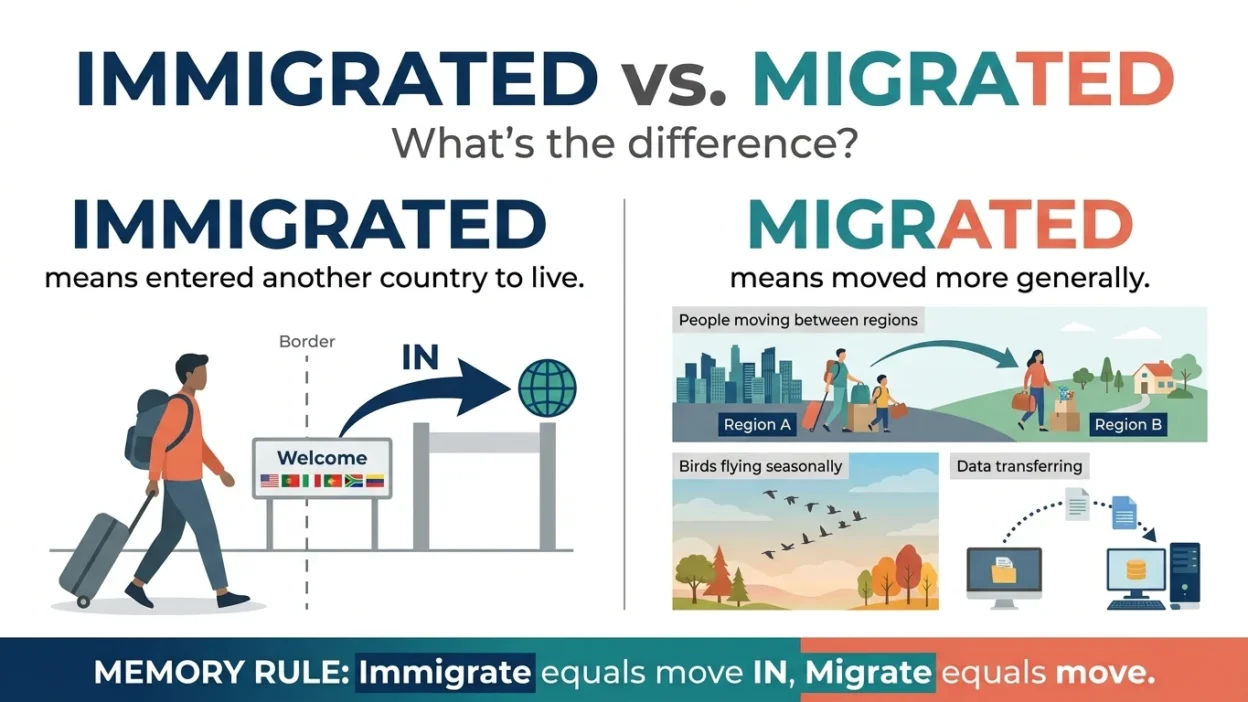
Choosing between immigrated and migrated can be confusing because both words describe movement from one place to another. However, they are not always interchangeable.
Immigrated specifically describes coming into another country to live there, usually permanently or for a long period. For example, “Her family immigrated to Canada” means the family moved into Canada to establish a new home.
Migrated has a broader meaning. It can describe people moving from one place or region to another, but it is also commonly used for animals, birds, data, systems, and other forms of movement or transfer. For example, “The birds migrated south for the winter” and “The company migrated its data to a new system” are both correct.
The easiest distinction is that immigrated focuses on entering another country to live, while migrated describes movement more generally. Understanding this difference will help you choose the right word in travel, geography, technology, business, and everyday English.
Quick Answer
Immigrated means moved into another country to live there, as in “They immigrated to Australia.” Migrated means moved from one place to another more generally and can describe people, animals, data, or systems. Immigration is a specific type of human migration, while migration is the broader concept.
Immigrated vs Migrated Definition and Meaning
Both immigrated and migrated describe movement, but their scope is different.
Immigrated is the past tense and past participle of immigrate.
It normally refers to a person coming into another country to establish residence.
Example:
“She immigrated to Canada.”
Migrated is the past tense and past participle of migrate.
It refers more broadly to movement from one location, region, environment, or system to another.
Example:
“The birds migrated south.”
It can also describe people:
“Workers migrated to the cities.”
And technology:
“The company migrated its data.”
The key distinction is:
IMMIGRATED equals entered another country to live
MIGRATED equals moved from one place or system to another
Why People Confuse Immigrated and Migrated
People confuse immigrated and migrated because immigration is itself a form of migration.
Someone who immigrates is moving from one country to another, so the general concept of migration is involved.
For example:
“Thousands of people migrated to the region.”
This describes movement broadly.
“They immigrated to Canada.”
This specifically describes people entering Canada to establish residence.
The words therefore overlap, but immigrate is more specific.
Another reason for confusion is that English also has the word emigrate.
These three words are related:
immigrate
emigrate
migrate
Understanding the direction and focus of movement helps separate them.
What Does Immigrated Mean?
Immigrated means came into another country to live there, usually permanently or for an extended period.
For example:
“My grandparents immigrated to the United States.”
The sentence focuses on the country they entered.
Other examples include:
“She immigrated to Australia.”
“They immigrated to Canada several years ago.”
“His family immigrated to New Zealand.”
The verb pattern is:
immigrate
immigrates
immigrated
immigrating
The important idea is movement into a country.
If your sentence emphasizes the destination country where someone went to establish a new home, immigrated is often the most precise choice.
What Does Migrated Mean?
Migrated means moved from one place to another.
Its meaning is broader than immigrated.
People can migrate:
“Workers migrated from rural areas to cities.”
Animals can migrate:
“Birds migrated south.”
Technology can be migrated:
“The company migrated its data to the cloud.”
Systems can also be migrated:
“The website was migrated to a new server.”
Therefore, migrated is not limited to international human movement.
It can describe geographical, seasonal, technical, and other forms of movement or transfer.
The central idea is:
MIGRATE equals MOVE FROM ONE PLACE OR ENVIRONMENT TO ANOTHER
Immigrated vs Migrated Comparison
Immigrated
Meaning: Entered another country to establish residence
Usually describes: People
Focus: Destination country
Example: “She immigrated to Canada.”
Scope: More specific
Migrated
Meaning: Moved from one place, region, environment, or system to another
Can describe: People, animals, data, systems, and more
Focus: Movement generally
Example: “The birds migrated south.”
Scope: Broader
The simplest distinction is:
Immigration is a type of migration.
Migration is the broader concept.
Immigrated vs Migrated Pronunciation Guide
Immigrated and migrated have different pronunciations.
Immigrated is pronounced approximately:
“IM uh gray tid”
Migrated is pronounced approximately:
“MY gray tid”
The words share the grate sound in their main stressed portion, which reflects their related origins and meanings.
However, pronunciation is not the main source of confusion.
The important difference is meaning.
Remember:
Immigrated focuses on entering another country to live.
Migrated focuses on movement more generally.
Grammar Rules for Immigrated and Migrated
Both words can function as simple past forms or past participles.
Simple past:
“She immigrated to Canada.”
“The birds migrated south.”
Present perfect:
“She has immigrated to Canada.”
“The birds have migrated south.”
Past perfect:
“They had immigrated before the law changed.”
“The animals had migrated before winter arrived.”
Both verbs are regular in their basic past formation.
Immigrate becomes immigrated.
Migrate becomes migrated.
The major difference is therefore not tense formation but meaning and usage.
When to Use Immigrated
Use immigrated when discussing people who entered another country to establish residence.
Examples:
“She immigrated to Canada.”
“His parents immigrated to Australia.”
“They immigrated to the United States many years ago.”
“The family immigrated to New Zealand.”
The destination is usually introduced with to.
For example:
“immigrated to Canada”
“immigrated to Australia”
“immigrated to France”
The word is specifically associated with people and international movement.
If you are focusing on the country someone entered to live, immigrated is normally appropriate.
When to Use Migrated
Use migrated when describing movement more broadly.
For people:
“Workers migrated to the city.”
For birds:
“The birds migrated south.”
For animals:
“The herd migrated across the region.”
For technology:
“The company migrated its database.”
For websites:
“We migrated the website to a new server.”
For data:
“The data was migrated to the new platform.”
This flexibility is an important distinction.
Immigrated has a specific human and international meaning.
Migrated can describe many different types of movement.
When to Use Each Word
Choose immigrated when all of these ideas are relevant:
The subject is a person or group of people.
They entered another country.
The context concerns establishing residence there.
Example:
“My family immigrated to Canada.”
Choose migrated when the movement is broader.
Example:
“People migrated from villages to cities.”
Also use migrated for animals and technology.
“The birds migrated south.”
“The company migrated its data.”
The easiest rule is:
Country of settlement equals immigrated
General movement equals migrated
Immigrated vs Migrated Examples
Here are 15 examples showing correct usage:
- Her family immigrated to Canada.
- His grandparents immigrated to the United States.
- They immigrated to Australia many years ago.
- She immigrated to New Zealand with her family.
- The couple immigrated to another country and established a new home.
- Many workers migrated to the cities.
- The birds migrated south before winter.
- The animals migrated in search of food.
- People migrated from rural areas to urban centers.
- The herd migrated across the region.
- The company migrated its data to a new platform.
- We migrated the website to a new server.
- The database was migrated successfully.
- Several communities migrated toward the coast.
- The birds had already migrated when winter arrived.
Immigrated to or Migrated to?
Both expressions can be correct, but their meanings and contexts differ.
Use immigrated to when referring to someone entering another country to establish residence.
Example:
“She immigrated to Canada.”
Use migrated to for broader movement.
Example:
“Workers migrated to the city.”
You can also use migrated to in technology:
“The company migrated to a new platform.”
Therefore, the preposition to does not determine which verb is correct.
Instead, examine the kind of movement.
Entering another country to live there suggests immigrated.
General movement suggests migrated.
Immigrated From or Immigrated To?
When using immigrate, the destination is especially important.
A common pattern is:
immigrated to
Example:
“They immigrated to Canada.”
If you want to mention both origin and destination, you can say:
“They immigrated to Canada from France.”
This keeps the focus on entering Canada.
If your focus is specifically on leaving the original country, emigrated from may be more precise.
For example:
“They emigrated from France.”
Therefore:
immigrated to Canada
focuses on arrival.
emigrated from France
focuses on departure.
This directional distinction is one of the most useful rules to remember.
Migrated From or Migrated To?
With migrated, both from and to are common.
Example:
“Workers migrated from rural areas.”
This emphasizes the origin.
Example:
“Workers migrated to the city.”
This emphasizes the destination.
You can include both:
“Workers migrated from rural areas to major cities.”
Because migrate describes movement broadly, it works naturally with both starting and ending locations.
The same pattern can apply to animals:
“Birds migrated from northern regions to warmer areas.”
And technology:
“The data was migrated from the old system to the new platform.”
Immigrate vs Emigrate vs Migrate
These three words are related but have different focuses.
Immigrate means enter another country to live there.
Example:
“She immigrated to Canada.”
Emigrate means leave your country to live elsewhere.
Example:
“She emigrated from France.”
Migrate means move from one place to another more generally.
Example:
“People migrated toward the cities.”
The same person can therefore be described from different perspectives.
Imagine someone moves from Country A to Country B.
They emigrate from Country A.
They immigrate to Country B.
They migrate from Country A to Country B.
This directional approach makes the distinction much easier.
Immigrant vs Migrant
An immigrant is generally a person who has moved into another country to live there.
Example:
“He arrived as an immigrant.”
A migrant is a broader term for someone who moves from one place to another.
Migration can occur internationally or within a country and can have many different causes and durations.
For example:
“Migrant workers traveled to the region for employment.”
Therefore:
immigrant is more specifically associated with immigration into a country.
migrant is broader and focuses on movement.
Context matters because legal, governmental, and academic definitions can sometimes be more specific.
Immigration vs Migration
Immigration is movement into another country for residence.
Migration is the broader process of moving from one place to another.
Therefore, immigration can be understood as one category within migration.
Examples of migration include:
international migration
internal migration
rural to urban migration
seasonal migration
animal migration
data migration
Examples of immigration specifically involve people entering countries to establish residence.
This distinction explains why you can talk about:
“bird migration”
but not ordinarily:
“bird immigration”
Similarly:
“data migration”
is standard in technology.
“data immigration”
is not the normal term.
Internal Migration Meaning
Internal migration refers to people moving from one location to another within the same country.
For example:
“Many people migrated from rural areas to major cities.”
Because they remain within the same country, immigrated would generally not be the appropriate term.
Instead, use:
migrated
This demonstrates an important difference.
Not every human migration is immigration.
A person can migrate between:
cities
regions
provinces
states
rural and urban areas
without crossing an international border.
Therefore, migration is the broader concept.
International Migration Meaning
International migration involves movement across national borders.
For example:
“The report examined international migration patterns.”
International migration can be discussed from several perspectives.
When emphasizing entry into a destination country, the term immigration is commonly used.
When emphasizing departure from the country of origin, emigration may be used.
When discussing the overall movement between countries, migration is a broader and often useful term.
Therefore:
migration describes the general process.
immigration focuses on entering.
emigration focuses on leaving.
Migrated for People
Yes, migrated can absolutely be used for people.
For example:
“People migrated toward the coast.”
“Workers migrated to urban areas.”
“Families migrated across the region.”
A common misconception is that migrate should only be used for animals.
That is incorrect.
Humans can migrate as well.
The difference is that migrate is broader than immigrate.
A person may migrate within the same country, between regions, or across international borders.
Use immigrate when you specifically want to emphasize entering another country to establish residence.
Migrated for Birds
Migrated is commonly used for birds.
Example:
“The birds migrated south for the winter.”
Bird migration can involve regular seasonal movement between different geographic areas.
Other examples include:
“The geese migrated south.”
“The birds migrated to warmer regions.”
“The flock had already migrated.”
Do not normally use immigrated for this natural seasonal movement.
The correct general verb is:
migrate
Past form:
migrated
This is one of the clearest examples showing why migration has a broader meaning than immigration.
Migrated for Animals
Many animals migrate.
For example:
“The herd migrated in search of food.”
“Whales migrated to warmer waters.”
“The animals migrated across the region.”
Migration can occur for reasons such as:
food
breeding
climate
seasonal changes
environmental conditions
The correct word is migrated because the movement is not human immigration into another country for residence.
Therefore:
animals migrate
birds migrate
people can migrate
but only people can ordinarily immigrate in the standard social and legal sense.
Migrated in Technology
Migrated is widely used in technology.
In this context, it means moved or transferred data, software, systems, websites, or services from one environment to another.
Examples:
“We migrated the database.”
“The company migrated its applications.”
“The website was migrated to another server.”
“The organization migrated its systems to the cloud.”
This use has nothing to do with immigration.
It illustrates the broad meaning of migration as movement or transfer.
The correct technical word is:
migrated
not:
immigrated
Data Migrated or Data Immigrated?
The correct technical expression is:
data migrated
For example:
“The data was migrated to the new system.”
You can also say:
“We migrated the data successfully.”
Do not ordinarily use:
“data immigrated”
Immigration is associated with people entering another country to establish residence.
Technology uses migration metaphorically for moving information between systems or environments.
Common expressions include:
“data migration”
“database migration”
“cloud migration”
“system migration”
“server migration”
Therefore, when discussing technology, migrated is normally the correct choice.
Website Migrated Meaning
A website can be migrated from one server, platform, domain setup, or hosting environment to another.
For example:
“We migrated the website to a new server.”
Another example:
“The website was successfully migrated.”
This is a common technical use of migrate.
The movement is digital rather than geographical, but the underlying idea remains the same:
something moves from one environment to another.
Do not use immigrated in this context.
Correct:
“website migrated”
Incorrect in ordinary technical English:
“website immigrated”
Migrated to the Cloud Meaning
In technology, migrated to the cloud means that data, applications, services, or computing resources were moved to cloud based infrastructure.
For example:
“The company migrated its systems to the cloud.”
Another example:
“Our applications were migrated to the cloud.”
The exact process can vary greatly depending on the systems and services involved.
For grammar purposes, the important point is that migrated is the correct word.
The broader idea of moving from one environment to another makes migration suitable for technical contexts.
Immigrated and Migrated in Real Life Usage
Imagine a family moves from one country to another and establishes a new home.
You might say:
“The family immigrated to Canada.”
Now imagine people moving from villages to cities within the same country.
You might say:
“Many families migrated to urban areas.”
Now imagine birds moving seasonally:
“The birds migrated south.”
Finally, imagine a company transferring information:
“The company migrated its data.”
These examples reveal the main distinction.
Immigrated has a specific human international meaning.
Migrated has a broad meaning covering many types of movement.
Immigrated and Migrated in Business English
Both words can appear in business writing, but their contexts differ.
Immigrated may appear when discussing international employees, demographic history, or population movement.
Example:
“His family immigrated to the country many years ago.”
Migrated is especially common in technical and organizational business contexts.
Examples:
“The company migrated its database.”
“We migrated to a new software platform.”
“The organization migrated its services to the cloud.”
Therefore, in modern business technology, migrated is much more flexible.
Always identify what is moving before selecting the verb.
Immigrated and Migrated in Academic Writing
Both terms are common in academic writing, especially in fields such as geography, sociology, history, demography, economics, and migration studies.
Migration is often the broader analytical concept.
For example:
“The study examines rural to urban migration.”
Immigration can focus more specifically on movement into a country.
For example:
“The research examines immigration patterns in the destination country.”
Precise terminology is particularly important in academic writing because migration can be internal or international, temporary or long term, voluntary or forced.
The exact definitions used may also depend on the study, institution, or legal framework.
Formal vs Informal Use
Both immigrated and migrated are standard English words appropriate for formal and informal contexts.
Informal:
“My grandparents immigrated to Canada.”
Formal:
“The population immigrated from several countries over different periods.”
Informal:
“Many people migrated to the city.”
Formal:
“The study examines populations that migrated between regions.”
The distinction is not based on formality.
It is based on scope and direction.
Immigrated specifically emphasizes entry into another country to establish residence.
Migrated describes movement more broadly.
American vs British English
The basic distinction between immigrated and migrated is the same in American and British English.
Both use immigrate for entering another country to establish residence.
Both use migrate for broader movement.
For example:
“She immigrated to Canada.”
“Workers migrated to urban areas.”
“The birds migrated south.”
“The company migrated its data.”
Terminology in official immigration law and government policy can vary between countries, but the general English distinction remains consistent.
Common Mistakes With Immigrated and Migrated
One common mistake is assuming that only animals can migrate.
That is incorrect.
People can migrate too.
Correct:
“Workers migrated to the city.”
Another mistake is using immigrated for movement within one country.
Less appropriate for the ordinary meaning:
“They immigrated from one city to another.”
Better:
“They migrated from one city to another.”
Also avoid using immigrated for technology.
Incorrect:
“The company immigrated its data.”
Correct:
“The company migrated its data.”
Always identify the type of movement first.
Memory Trick for Immigrated vs Migrated
Use the beginning of immigrate as your clue.
Think:
IMMIGRATE equals IN
Both begin with an I sound, which can remind you of movement into a country.
For migrate, think:
MIGRATE equals MOVE
Both begin with M.
Therefore:
IMMIGRATE equals move IN
MIGRATE equals MOVE generally
You can remember these examples:
“She immigrated to Canada.”
“The birds migrated south.”
“The company migrated its data.”
This simple pattern separates the specific word from the broader one.
Expert Tips for Choosing Immigrated or Migrated
First, identify what is moving.
If it is an animal, data, website, database, or software system, use migrated.
If people are moving, ask another question:
Are they specifically entering another country to establish residence?
If yes, immigrated may be the most precise word.
If the movement is within a country or is being described generally, use migrated.
Also consider direction.
Immigrated to emphasizes arrival.
Emigrated from emphasizes departure.
Migrated from one place to another describes the overall movement.
Mistakes to Avoid
Do not assume immigrated and migrated are perfect synonyms.
Immigration is more specific.
Do not write:
“The birds immigrated south.”
Use:
“The birds migrated south.”
Do not write:
“The database immigrated to another server.”
Use:
“The database was migrated to another server.”
Do not assume people cannot migrate.
Correct:
“People migrated from rural areas to cities.”
Finally, remember that emigrate is useful when focusing on departure from a country.
Meaning and perspective determine the best word.
Similar Words
Several related words belong to the same area of vocabulary.
Immigrate
Enter another country to establish residence.
Emigrate
Leave a country to establish residence elsewhere.
Migrate
Move from one place to another.
Immigrant
A person viewed in relation to entering a destination country.
Emigrant
A person viewed in relation to leaving a country.
Migrant
A broader term for a person who moves.
Learning these words together makes their directional differences much easier to understand.
Related Confusing Words
If immigrated vs migrated is confusing, these related topics may also be useful:
immigrate vs emigrate
immigrant vs emigrant
immigrant vs migrant
migration vs immigration
emigration vs immigration
migrate vs immigrate
move vs migrate
refugee vs immigrant
expatriate vs immigrant
resident vs citizen
The most important rule for the current pair is:
Immigrated means entered another country to live.
Migrated means moved more generally.
FAQs About Immigrated vs Migrated
What is the difference between immigrated and migrated?
Immigrated specifically refers to people entering another country to establish residence. Migrated refers more broadly to movement from one place or environment to another.
Can you use migrated for people?
Yes. People can migrate between cities, regions, rural and urban areas, or countries. The word is not limited to animals.
Is it immigrated to or migrated to a country?
Both may be possible depending on context. Immigrated to a country specifically emphasizes entering it to establish residence, while migrated to a country describes the movement more generally.
Is it immigrated from or immigrated to?
Immigrated to is the usual pattern when emphasizing the destination. Emigrated from is commonly used when emphasizing the country someone left.
Can animals immigrate?
In ordinary English, animal movement is generally described with migrate, not immigrate. For example, “The birds migrated south.”
Can data migrate?
Yes. Migrate is widely used in technology. You can migrate data, databases, websites, applications, and systems.
Is immigration a type of migration?
Yes. In broad usage, immigration is a specific form of human migration involving movement into a destination country.
What is the difference between immigrate, emigrate, and migrate?
Immigrate focuses on entering a country, emigrate focuses on leaving a country, and migrate describes movement more generally.
Final Verdict on Immigrated vs Migrated
The difference between immigrated and migrated becomes clear when you consider scope and direction. Immigrated is more specific. It refers to people entering another country to establish residence. For example, “Her family immigrated to Canada” focuses on Canada as the destination country.
Migrated is the broader word. It can describe people moving between countries, cities, or regions, animals moving seasonally, and even data or software moving between technical systems.
For example, “Workers migrated to cities,” “Birds migrated south,” and “The company migrated its data” are all correct. Remember that immigration is a specific type of migration. The easiest rule is: immigrated means moved into another country to live, while migrated means moved more generally.
Remember This
IMMIGRATED
Entered another country to establish residence
Example:
“She immigrated to Canada.”
Think:
IMMIGRATE equals move IN
MIGRATED
Moved from one place or environment to another
Examples:
“Workers migrated to cities.”
“Birds migrated south.”
“The company migrated its data.”
Think:
MIGRATE equals MOVE
The easiest rule is:
IMMIGRATED equals moved INTO a country
MIGRATED equals MOVED generally

Carol Amanda is a passionate writer and faith-driven author dedicated to sharing the wisdom of the Bible. At BiblyWord, she creates inspiring and meaningful content that encourages spiritual growth and daily reflection. Her work focuses on helping readers connect with God’s Word and find guidance, peace, and strength in their faith journey.