The words either and neither are small but powerful in English. They often confuse learners because they are used in similar situations involving choices, but their meanings are opposite. Using the wrong one can completely change the meaning of your sentence.
Understanding how to use either vs neither correctly will improve your grammar, clarity, and confidence in speaking and writing. In this guide, you’ll learn clear definitions, grammar rules, examples, and easy memory tricks to master these two words.
Quick Answer
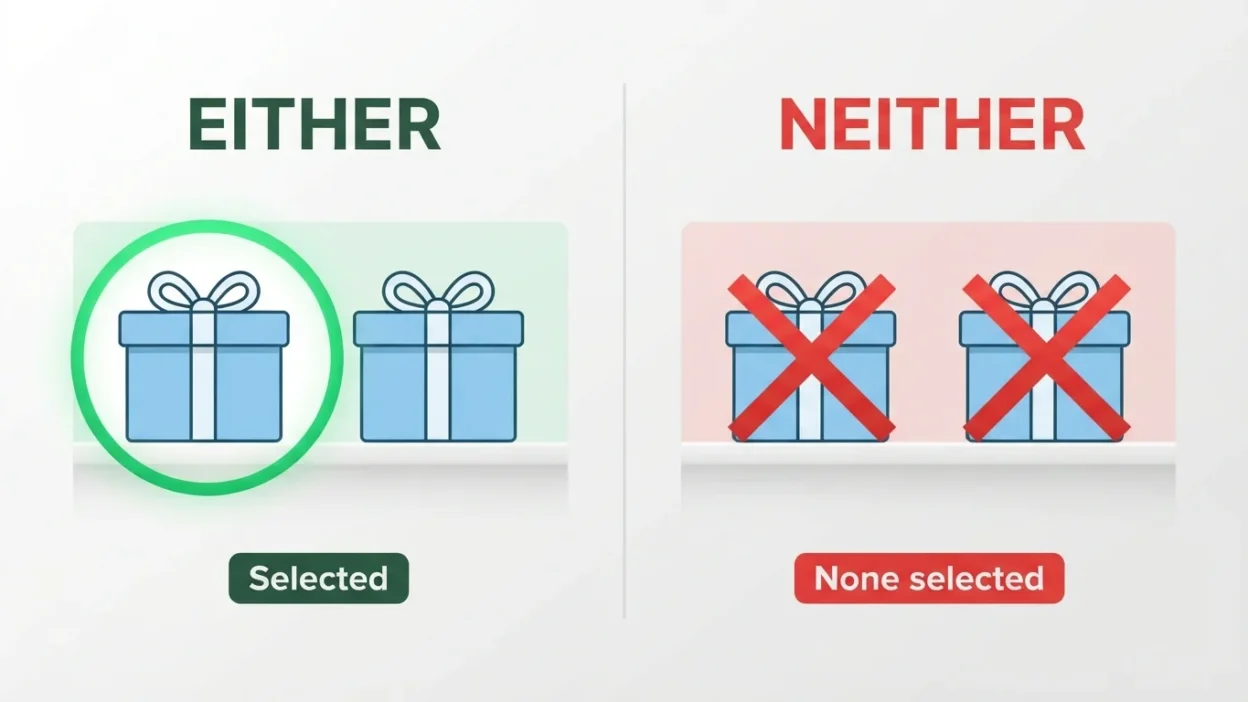
Either means one or the other (positive choice).
Neither means not one and not the other (negative choice).
Use either for options and neither to reject both options.
Definition and Meaning
Either refers to one of two choices.
Neither means none of the two options.
So:
- Either = one of the two
- Neither = none of the two
Why People Confuse It
The confusion comes from their similar structure and usage.
Both are used when talking about two options, which makes them seem interchangeable.
However, their meanings are completely opposite.
First Word: Either
Either is used when choosing between two options.
It can also be used in negative sentences.
Examples:
- You can choose either option.
- I don’t like either choice.
Second Word: Neither
Neither is used to reject both options.
Examples:
- Neither answer is correct.
- I like neither of them.
Grammar Rules Explained
Both either and neither can act as:
- Determiners
- Pronouns
- Conjunctions
Use:
- Either…or for choices
- Neither…nor for negatives
Comparison Table
| Feature | Either | Neither |
|---|---|---|
| Meaning | One of two | None of two |
| Type | Determiner/Pronoun | Determiner/Pronoun |
| Usage | Choice | Negative |
| Example | Either option works | Neither option works |
When to Use Each
Use either when:
- Giving a choice
- Referring to one of two
Use neither when:
- Rejecting both options
- Making a negative statement
Real Life Usage
In daily conversation, both words are very common.
They are used when making decisions, comparisons, or expressing preferences.
Formal vs Informal Use
Both words are used in formal and informal English.
They are important in academic and professional writing.
Pronunciation Guide
- Either: /ˈiːðər/ or /ˈaɪðər/
- Neither: /ˈniːðər/ or /ˈnaɪðər/
Both pronunciations are correct.
Synonyms and Alternatives
For either:
- One
- Any
For neither:
- None
- Not one
Common Sentences
Examples:
- You can take either road.
- Neither answer is correct.
- Either of them can help.
- Neither of them agreed.
Examples
Here are 10 examples:
- You can choose either option.
- Either book is useful.
- I don’t like either choice.
- Neither answer is correct.
- Neither of them came.
- Either path leads to success.
- I will accept either solution.
- Neither idea worked.
- Either of the players can win.
- Neither option is easy.
Common Mistakes
A common mistake is mixing either with negative sentences incorrectly.
Another mistake is using neither when only one option is being rejected.
Mistakes to Avoid
Avoid:
- Using “either” when you mean none
- Mixing either and neither incorrectly
- Double negatives
Memory Trick
Remember:
Either = one
Neither = none
Think: “N” in neither = none.
American vs British English
There is no difference in usage between American and British English.
Similar Words
Other similar pairs:
- Both vs All
- Each vs Every
- Any vs Some
Related Confusing Words
More examples:
- Affect vs Effect
- Advice vs Advise
- Accept vs Except
Expert Tips
Use either…or for choices.
Use neither…nor for negative statements.
Check sentence meaning carefully.
When Does It Apply
Use these words when:
- Making choices
- Comparing two options
- Writing clearly
Final Verdict
Either is used for choosing one of two options.
Neither is used for rejecting both.
Understanding this difference ensures clear communication.
FAQs
1. What is the difference between either and neither?
Either means one of two, neither means none.
2. Can either be used in negative sentences?
Yes, but carefully.
3. What does neither mean?
Not one and not the other.
4. Can I use both together?
No, they have opposite meanings.
5. How do I remember the difference?
Neither has “n” for none.
6. Is there a grammar rule?
Use either…or and neither…nor.
Remember This
Either means one.
Neither means none.
N = none.
Conclusion
The difference between either and neither is simple once you understand their meanings. Either is used to refer to one of two options, while neither is used to reject both. Even though they are used in similar contexts, their meanings are completely opposite.
By remembering that “either means one” and “neither means none,” you can avoid confusion easily. With practice, using these words correctly will become natural, improving both your writing and speaking skills.

Carol Amanda is a passionate writer and faith-driven author dedicated to sharing the wisdom of the Bible. At BiblyWord, she creates inspiring and meaningful content that encourages spiritual growth and daily reflection. Her work focuses on helping readers connect with God’s Word and find guidance, peace, and strength in their faith journey.