The words payed and paid look very similar, but only one is correct in most everyday situations. This confusion is extremely common, especially in writing about money, salaries, or transactions. However, the truth is simple once you understand the rule.
While paid is the standard past tense of pay, payed is rarely used and only applies in specific technical contexts. In this guide, you’ll learn the meanings, grammar rules, examples, and memory tricks to confidently use payed vs paid without mistakes.
Quick Answer
Paid is the correct past tense of pay in almost all situations.
Payed is rarely used and only refers to sealing a ship’s deck or rope with tar.
Use paid for money and transactions.
Definition and Meaning
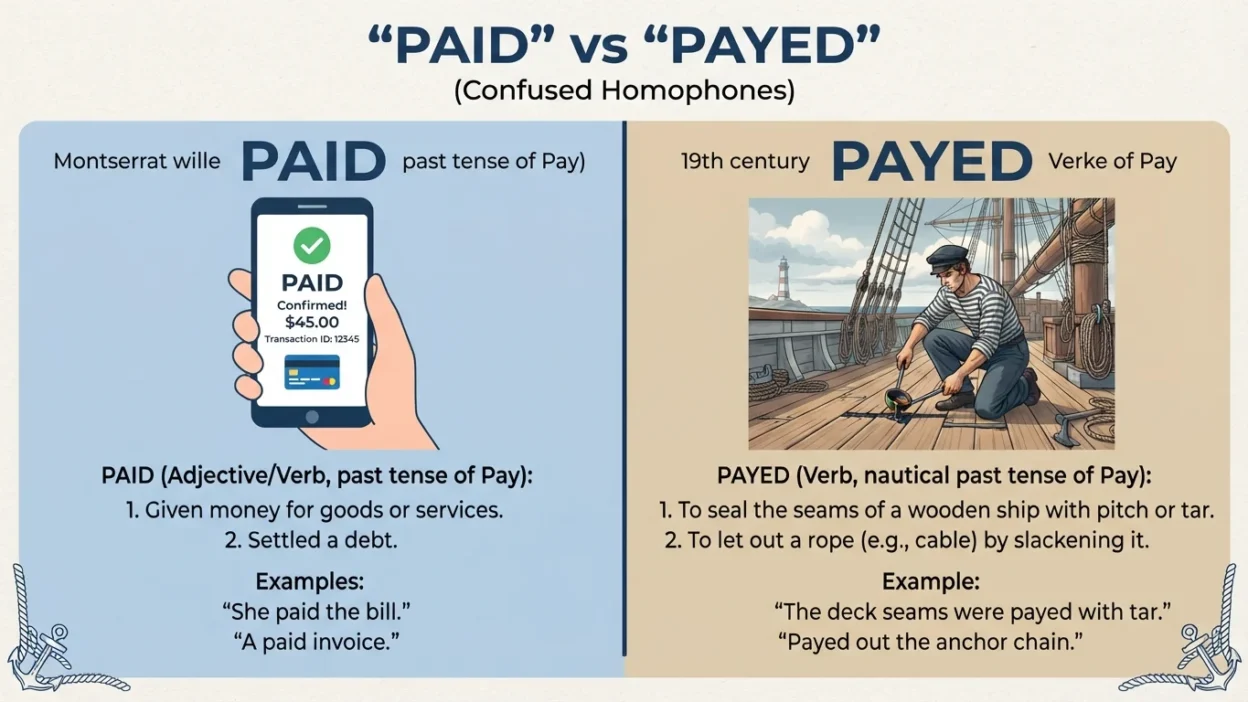
Paid is the past tense and past participle of the verb pay, meaning to give money or settle a debt.
Payed is a rare form used in nautical contexts, meaning to coat with tar or waterproof material.
So:
- Paid = money or payment
- Payed = nautical use only
Why People Confuse It
The confusion comes from spelling patterns.
Most English verbs add “-ed” to form the past tense, so people assume pay becomes payed.
However, pay is an irregular verb, and its correct past form is paid.
First Word: Paid
Paid is the correct and widely used form.
It is used in all contexts related to money, work, and transactions.
Examples:
- She paid the bill.
- He was paid for his work.
Second Word: Payed
Payed is rarely used.
It appears mainly in nautical language, such as sealing a ship’s hull with tar.
Example:
- The sailors payed the deck with tar.
This usage is uncommon in daily English.
Grammar Rules Explained
The verb pay follows this pattern:
- Present: pay
- Past: paid
- Past participle: paid
Do not add “-ed” in regular situations.
Comparison Table
| Feature | Paid | Payed |
|---|---|---|
| Correct usage | Yes | Rare |
| Meaning | Gave money | Coated with tar |
| Type | Verb (past tense) | Technical verb |
| Example | Paid the bill | Payed the deck |
When to Use Each
Use paid when:
- Talking about money
- Referring to wages or bills
- Describing transactions
Use payed only in rare nautical contexts.
Real Life Usage
In everyday life, paid is used constantly.
You will see it in:
- Banking
- Work and salaries
- Shopping
Payed is almost never used outside specialized contexts.
Formal vs Informal Use
Paid is used in both formal and informal writing.
Payed is mostly limited to technical or historical writing.
Pronunciation Guide
Both words are pronounced the same: /peɪd/
This identical pronunciation leads to confusion.
Synonyms and Alternatives
For paid:
- Settled
- Compensated
- Rewarded
These can be used depending on context.
Common Sentences
Examples:
- I paid the rent yesterday.
- She paid for the meal.
- He paid his employees on time.
Examples
Here are 10 examples:
- I paid my bills on time.
- She paid for the groceries.
- He paid his workers fairly.
- They paid the fee online.
- We paid attention to details.
- She paid the price for her mistake.
- He paid his debts quickly.
- They paid for the service.
- I paid the taxi driver.
- She paid her tuition fees.
Common Mistakes
A common mistake is writing payed instead of paid.
This happens because people apply regular verb rules incorrectly.
Mistakes to Avoid
Avoid:
- Writing “payed” for money
- Assuming all verbs follow “-ed” pattern
- Ignoring irregular verb rules
Memory Trick
Remember:
Paid = correct for money
Payed = rare and technical
Or think:
“Money is always PAID.”
American vs British English
There is no difference between American and British English.
Both use paid as the correct form.
Similar Words
Other irregular verbs:
- Said vs Sayed
- Laid vs Layed
- Made vs Maked
Related Confusing Words
More examples:
- Affect vs Effect
- Advice vs Advise
- Accept vs Except
Expert Tips
Always use paid unless you are writing about ships or nautical topics.
When in doubt, choose paid.
When Does It Apply
Use paid when writing about:
- Money
- Work
- Transactions
- Daily communication
Final Verdict
Paid is correct in almost all situations.
Payed is rare and used only in technical contexts.
Always use paid for everyday English.
FAQs
1. Is “payed” correct?
Only in rare nautical contexts.
2. What is the correct past tense of pay?
Paid.
3. Why is “payed” wrong?
Because pay is an irregular verb.
4. Can I use “payed” in writing?
Only in technical contexts.
5. Which is more common?
Paid is far more common.
6. How do I remember it?
Money is always paid.
Remember This
Paid is correct for money.
Payed is rare and technical.
Always choose paid.
Conclusion
The difference between payed and paid is simple once you understand their usage. Paid is the correct past tense of pay and is used in all common situations involving money or transactions. On the other hand, payed is a rare term limited to nautical contexts and is almost never used in everyday English.
By remembering the simple rule “money is always paid,” you can easily avoid this common mistake. With practice, choosing the correct form will become natural and improve your writing accuracy.

Donald Andrew is a dedicated author at BiblyWord, passionate about sharing biblical teachings in a clear and inspiring way. He creates meaningful content that helps readers understand scripture, reflect on their faith, and apply God’s Word in daily life. His work supports spiritual growth, guidance, and a deeper connection with biblical wisdom.