The words laid and layed often confuse English learners because they look like simple past tense forms. However, only one of them is correct in standard English. Using the wrong form can make your writing appear incorrect, especially in formal or professional contexts.
This confusion usually happens because many verbs in English form the past tense by adding -ed, but lay is an irregular verb. In this guide, you’ll learn the correct usage, grammar rules, examples, and easy memory tricks to master laid vs layed with confidence.
Quick Answer
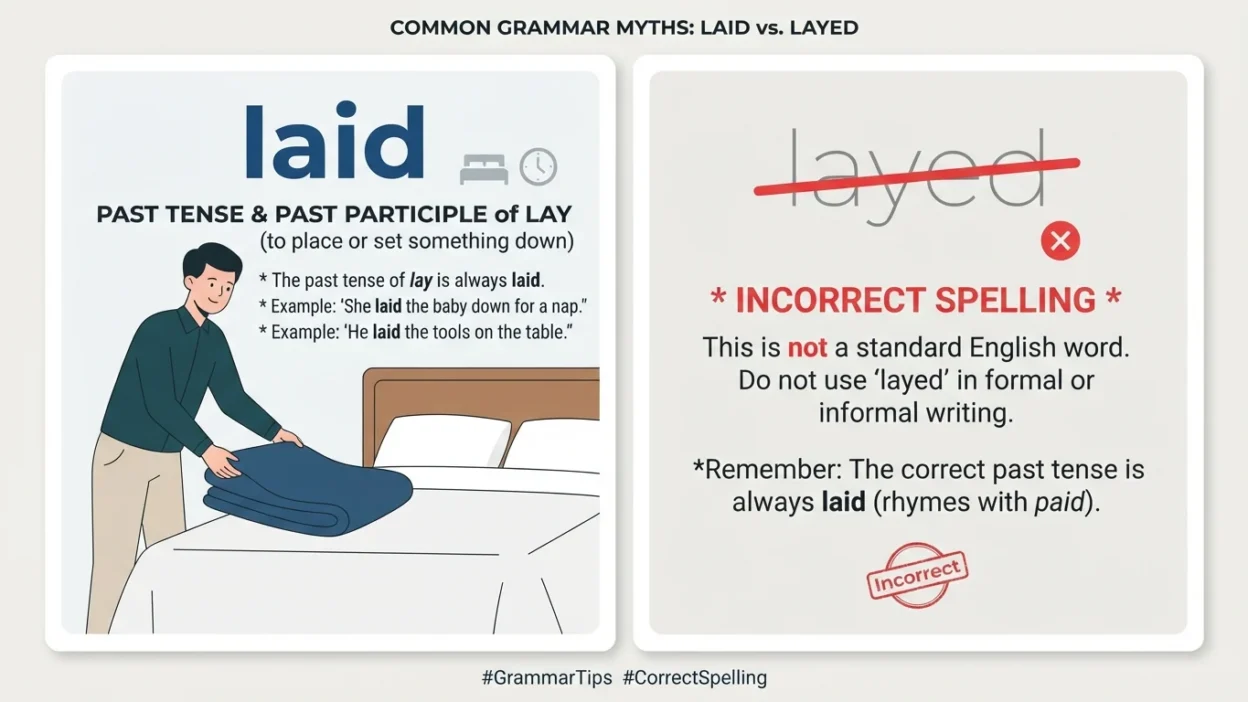
Laid is the correct past tense of lay.
Layed is incorrect and should not be used.
Always use laid when referring to placing or putting something down.
Definition and Meaning
Laid is the past tense and past participle of the verb lay, meaning to put or place something down.
Layed is not a correct word in standard English.
So:
- Laid = correct past form
- Layed = incorrect
Why People Confuse It
The confusion comes from regular verb patterns.
Most verbs add “-ed” in the past tense, so people assume lay becomes layed.
However, lay is irregular, and its correct past form is laid.
First Word: Laid
Laid is the correct form.
It is used when something is placed or put somewhere.
Examples:
- She laid the book on the table.
- He laid the foundation for success.
Second Word: Layed
Layed is incorrect.
It is not accepted in standard English.
Avoid using it in all contexts.
Grammar Rules Explained
The verb lay follows this pattern:
- Present: lay
- Past: laid
- Past participle: laid
It does not follow the regular “-ed” rule.
Comparison Table
| Feature | Laid | Layed |
|---|---|---|
| Correct usage | Yes | No |
| Meaning | Put or placed | Incorrect |
| Grammar | Past tense of lay | Not valid |
| Example | She laid the book | ❌ Incorrect |
When to Use Each
Use laid when:
- Referring to placing something
- Talking about past actions
Never use layed.
Real Life Usage
In daily life, laid is commonly used in both spoken and written English.
It appears in:
- Everyday conversations
- Academic writing
- Professional communication
Formal vs Informal Use
Laid is used in both formal and informal contexts.
Layed should never be used.
Pronunciation Guide
Laid is pronounced /leɪd/
There is no correct pronunciation for “layed” since it is incorrect.
Synonyms and Alternatives
For laid:
- Placed
- Set
- Put
These can replace it depending on context.
Common Sentences
Examples:
- She laid the keys on the table.
- He laid the groundwork for the project.
- They laid the carpet carefully.
Examples
Here are 10 examples:
- She laid the book on the desk.
- He laid the tools in the box.
- They laid the foundation last year.
- She laid the baby in the crib.
- He laid the papers neatly.
- They laid the carpet perfectly.
- She laid the clothes on the bed.
- He laid the bricks carefully.
- They laid the table for dinner.
- She laid the plan clearly.
Common Mistakes
A common mistake is writing layed instead of laid.
This happens due to misunderstanding irregular verbs.
Mistakes to Avoid
Avoid:
- Writing “layed”
- Treating lay as a regular verb
- Ignoring verb forms
Memory Trick
Remember:
Lay → Laid (not layed)
Think: “I laid it down.”
American vs British English
There is no difference between American and British English.
Both use laid as the correct form.
Similar Words
Other irregular verbs:
- Paid vs Payed
- Said vs Sayed
- Made vs Maked
Related Confusing Words
More examples:
- Affect vs Effect
- Advice vs Advise
- Accept vs Except
Expert Tips
Always memorize irregular verb forms.
If unsure, remember that laid is always correct.
When Does It Apply
Use laid when:
- Describing past actions
- Writing professionally
- Communicating clearly
Final Verdict
Laid is correct.
Layed is incorrect.
Always use laid to maintain proper grammar.
FAQs
1. Is “layed” a word?
No, it is incorrect.
2. What is the past tense of lay?
Laid.
3. Why is “layed” wrong?
Because lay is an irregular verb.
4. Can I use “layed” in writing?
No, avoid it.
5. Is laid formal?
Yes, it works in all contexts.
6. How do I remember it?
Lay becomes laid.
Remember This
Laid is correct.
Layed is wrong.
Lay becomes laid.
Conclusion
The difference between laid and layed is straightforward. Laid is the correct past tense of lay and is used in all standard English contexts. On the other hand, layed is a common mistake that should always be avoided.
By remembering that lay becomes laid, you can easily avoid this error. With practice, using the correct form will become natural, helping you communicate clearly and professionally

Kevin Brian is a passionate author at BiblyWord, dedicated to sharing the message of the Bible through thoughtful and inspiring content. He focuses on creating clear and meaningful writings that help readers understand scripture, strengthen their faith, and find guidance in everyday life through God’s Word.