The words farther and further often confuse English learners because they are very similar in spelling and meaning. While they are sometimes used interchangeably, there is a traditional difference that can help you choose the right word more precisely.
Understanding this difference improves clarity, especially in formal writing. In simple terms, one relates to physical distance, while the other is more abstract. In this guide, you’ll learn clear meanings, grammar rules, real-life examples, and easy memory tricks to master farther vs further confidently.
Quick Answer
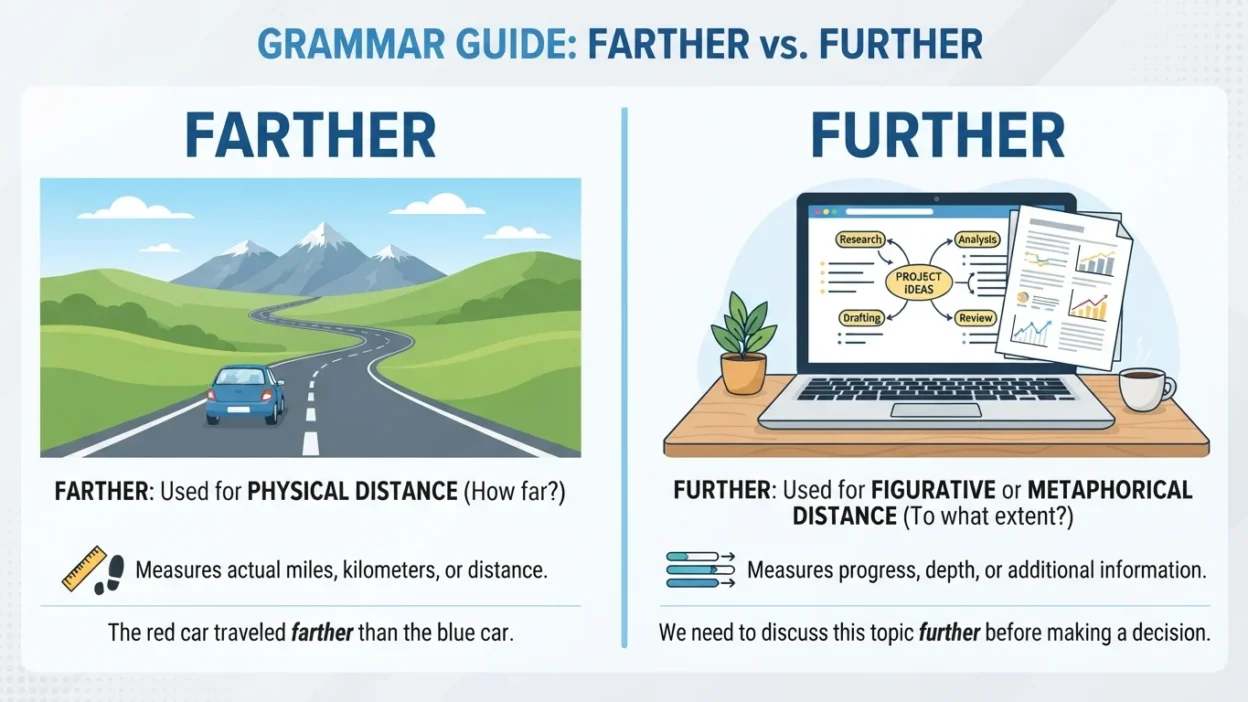
Farther is used for physical distance.
Further is used for abstract or figurative distance and additional information.
Use farther for measurable space and further for ideas, time, or degree.
Definition and Meaning
Farther refers to a greater physical distance.
Further refers to additional degree, extent, or abstract distance such as ideas or time.
So:
- Farther = physical distance
- Further = figurative or additional
Why People Confuse It
The confusion comes from their similar spelling and meaning.
In everyday speech, people often use them interchangeably.
Also, both words can sometimes fit in the same sentence, making the distinction less obvious.
First Word: Farther
Farther is used when talking about measurable, physical distance.
Examples:
- He ran farther than before.
- The school is farther down the road.
It refers to actual space you can measure.
Second Word: Further
Further is used for abstract ideas, time, or degree.
It can also mean “additional.”
Examples:
- We need to discuss this further.
- For further information, contact us.
Grammar Rules Explained
Both farther and further can function as adverbs or adjectives.
Use farther for physical distance.
Use further for non-physical or figurative contexts.
Comparison Table
| Feature | Farther | Further |
|---|---|---|
| Meaning | Physical distance | Abstract or additional |
| Usage | Measurable space | Ideas, time, degree |
| Type | Adjective/Adverb | Adjective/Adverb |
| Example | Walk farther | Think further |
When to Use Each
Use farther when:
- Talking about distance you can measure
Use further when:
- Referring to ideas or degree
- Adding information
Ask:
- Is it physical distance? → farther
- Is it abstract? → further
Real Life Usage
In everyday conversation, further is more common.
People often use it even when talking about distance.
However, using farther correctly improves accuracy.
Formal vs Informal Use
In formal writing, the distinction is more important.
In informal speech, both words are often used interchangeably.
Pronunciation Guide
Both words are pronounced similarly:
- Farther: /ˈfɑːrðər/
- Further: /ˈfɜːrðər/
The difference is slight.
Synonyms and Alternatives
For farther:
- More distant
- Further away
For further:
- Additional
- More
- Extended
Common Sentences
Examples:
- The park is farther away.
- We need to think further about this.
- He ran farther than his friend.
- She explained the idea further.
Examples
Here are 10 examples:
- He walked farther than expected.
- The store is farther down the street.
- She moved farther away.
- We need further discussion.
- He explained it further.
- The journey went farther than planned.
- For further details, call us.
- She pushed the idea further.
- They traveled farther than ever.
- We will discuss this further tomorrow.
Common Mistakes
A common mistake is using further for physical distance.
Another is ignoring the distinction entirely.
Mistakes to Avoid
Avoid:
- Using further for measurable distance in formal writing
- Ignoring context
Memory Trick
Remember:
Farther = far (distance)
Further = future or more
This helps distinguish them.
American vs British English
In American English, the distinction is more strictly followed.
In British English, further is often used for both meanings.
Similar Words
Other confusing pairs:
- Affect vs Effect
- Less vs Fewer
- Bring vs Take
Related Confusing Words
More examples:
- Advice vs Advise
- Accept vs Except
- Principal vs Principle
Expert Tips
When in doubt, use further, as it is more widely accepted.
However, use farther when referring clearly to physical distance.
When Does It Apply
Use these words when:
- Describing distance
- Explaining ideas
- Writing formally
Final Verdict
Farther is best for physical distance.
Further is best for abstract or additional meaning.
Using them correctly improves clarity and precision.
FAQs
1. What is the difference between farther and further?
Farther is for distance, further is for ideas or degree.
2. Can they be used interchangeably?
Sometimes, but not in formal writing.
3. Which is more common?
Further is more commonly used.
4. Is farther outdated?
No, it is still correct.
5. How do I remember the difference?
Farther relates to “far.”
6. Is there a regional difference?
British English often uses further for both.
Remember This
Farther = physical distance.
Further = abstract or additional.
Think: farther has “far.”
Conclusion
The difference between farther and further becomes simple when you focus on context. Farther is used for measurable physical distance, while further applies to abstract ideas, additional information, or degree. Although they are sometimes used interchangeably in casual speech, using the correct word improves clarity and professionalism.
By remembering that “farther relates to far distance” and “further relates to more or additional,” you can easily avoid confusion. With practice, choosing the right word will become natural and enhance your communication skills.

Kevin Brian is a passionate author at BiblyWord, dedicated to sharing the message of the Bible through thoughtful and inspiring content. He focuses on creating clear and meaningful writings that help readers understand scripture, strengthen their faith, and find guidance in everyday life through God’s Word.