Spelling can sometimes be confusing, especially when two words look almost the same. A common example is “gummy” vs “gummie.” Many people are unsure which one is correct, especially when writing about candy, vitamins, or even describing texture.
This confusion often appears in everyday writing, product descriptions, and social media posts. Since “gummy” is widely used in food and health contexts, using the wrong spelling can make your writing look less professional. The good news is that the rule is simple once you understand it.
Let’s explore the difference clearly so you can always use the correct word with confidence.
Quick Answer
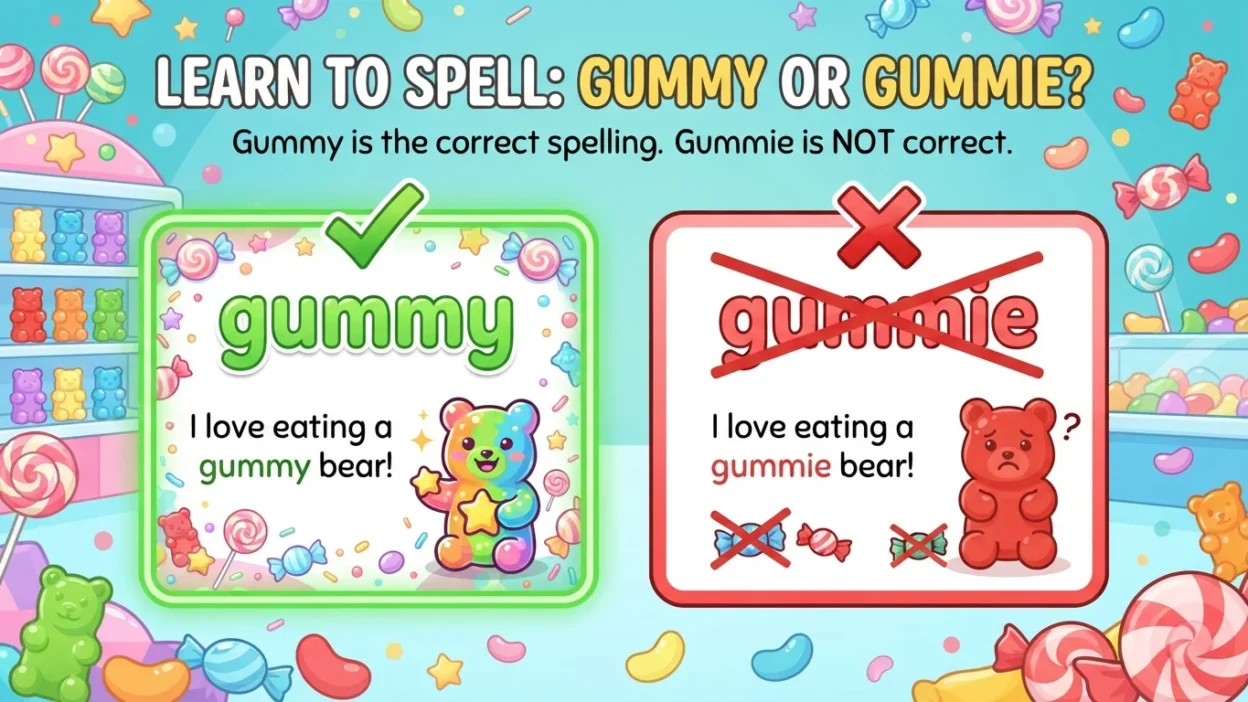
“Gummy” is the correct spelling. “Gummie” is incorrect and should not be used. Always use “gummy” when referring to chewy candy or a soft sticky texture.
Definition and Meaning
The word “gummy” has two main meanings in English. First, it refers to something soft, chewy, and slightly sticky, like gummy candy. Second, it can describe something covered in gum or having a glue like texture.
The word is commonly used in food contexts, especially when talking about gummy bears, gummy vitamins, and other chewable products. In informal language, it can also describe a texture that feels rubbery or sticky.
“Gummie” does not exist as a standard English word. It is simply a misspelling of “gummy.” You may occasionally see it in casual writing or brand variations, but it is not grammatically correct.
Understanding the correct meaning of “gummy” helps you use it properly in both everyday and professional writing. If you are describing candy or texture, “gummy” is the only accepted form.
Why People Confuse It
The confusion between “gummy” and “gummie” comes from common spelling patterns in English. Many words ending in a “y” change to “ie” in certain forms, which leads people to assume “gummie” might be correct. For example, words like “puppy” can become “puppies” in plural form, so people mistakenly apply the same idea here.
Another reason is pronunciation. Both “gummy” and “gummie” sound almost identical when spoken, so people rely on how the word sounds rather than how it is spelled. Fast typing and lack of proofreading also contribute to the mistake.
Additionally, some product labels or informal uses online may use creative spellings, which adds to the confusion. Once you understand that “gummy” is the standard dictionary form, the confusion becomes easy to avoid.
First Word
“Gummy” is the correct spelling and is widely used in English. It is both an adjective and a noun in some contexts. As an adjective, it describes something soft, sticky, or chewy.
As a noun, it can refer to a type of candy, especially gummy bears or similar treats. The word is very common in modern usage, especially in food and health industries.
Examples include phrases like gummy candy, gummy vitamins, and gummy texture. It is also used to describe things that feel sticky, such as gummy residue or gummy surfaces.
Because it is the standard spelling, it appears in dictionaries, textbooks, and professional writing. Using “gummy” ensures your writing is clear, correct, and easily understood by readers. It is the only form you should rely on in all contexts.
Second Word
“Gummie” is incorrect and not recognized in standard English. It does not follow accepted spelling rules and is not found in dictionaries as a correct word. Even though it may look similar to other words that end in “ie,” it is not a valid form of “gummy.” Using “gummie” can make your writing appear careless or unprofessional.
Some people mistakenly use “gummie” because they are influenced by plural forms like “candies” or “puppies.” However, this rule does not apply to the base form of the word.
“Gummie” might occasionally appear in informal writing, branding, or typos, but it should not be used in proper English. To maintain accuracy and clarity, always avoid “gummie” and stick with “gummy” instead. This ensures your writing remains correct and trustworthy.
Grammar Rules Explained
The spelling of “gummy” follows a simple English rule for adjectives and nouns ending in “y.” The base form remains “gummy” when used as a singular noun or adjective.
When forming the plural noun, the “y” changes to “ies,” resulting in “gummies.” This is where confusion often begins, as people mistakenly think the singular form should also end in “ie.”
Correct forms include gummy for singular and gummies for plural. The incorrect form “gummie” does not fit into this pattern. Understanding this rule helps you apply it to other similar words as well.
For example, “happy” becomes “happies” only in plural, not “happie.” The same logic applies here. By remembering that “gummy” stays the same in singular form, you can avoid spelling mistakes and use the word correctly in all situations.
Pronunciation Guide
“Gummy” is pronounced as “gum ee.” It has two simple syllables that are easy to say and remember. The first part “gum” sounds like the word gum, and the second part “ee” gives it a light ending sound. This pronunciation is consistent across different accents of English.
The confusion with spelling often comes from this pronunciation because “gummy” and “gummie” sound exactly the same when spoken. English has many words where spelling does not perfectly match sound, and this is one of those cases.
racticing the correct pronunciation while visualizing the spelling can help reinforce the correct form in your memory. Once you connect the sound “gum ee” with the spelling “gummy,” it becomes much easier to avoid mistakes in writing.
Comparison Table
| Word | Correct | Meaning | Usage |
|---|---|---|---|
| Gummy | Yes | Soft, chewy, or sticky | Always use |
| Gummie | No | Incorrect spelling | Never use |
This table clearly shows that “gummy” is the only correct option in standard English.
When to Use Each
You should use “gummy” whenever you are describing something soft, chewy, or sticky, especially in relation to food items like candy or vitamins. It is also appropriate when talking about textures, such as a gummy surface or gummy residue. The word fits naturally in both casual and professional contexts, making it very versatile.
On the other hand, “gummie” should never be used. It does not have any correct grammatical function in English. Even in informal writing, it is better to avoid incorrect spellings to maintain clarity and credibility. If you are unsure, always choose “gummy.
” By consistently using the correct form, you build better writing habits and avoid confusion for your readers.
Examples
Here are real life examples using “gummy” correctly in different contexts:
- I bought a pack of gummy bears.
- These gummy vitamins are easy to chew.
- The candy has a soft gummy texture.
- The surface felt sticky and gummy.
- She prefers gummy snacks over hard candy.
- The mixture turned gummy after heating.
- Kids love colorful gummy treats.
- The glue became gummy over time.
- He ate too many gummy candies.
- The dessert has a slightly gummy consistency.
These examples show how commonly the word is used and how it fits naturally into everyday language.
Common Sentences
You will often hear or read sentences like “These gummies taste great,” or “The texture is too gummy.” These phrases are common in conversations about food, cooking, and product reviews. The word is especially popular in health and wellness discussions where people talk about gummy supplements.
Using the correct spelling in these sentences is important because it ensures your message is clear and professional. If you write “gummie,” readers may notice the mistake and question your accuracy.
By consistently using “gummy,” your sentences sound natural and correct. This helps improve both written and spoken communication.
Real Life Usage
“Gummy” is widely used in real life, especially in industries like food, health, and manufacturing. In the food industry, it is commonly used to describe candies such as gummy bears, worms, and fruit snacks. In health and wellness, gummy vitamins have become very popular because they are easier to consume than pills.
The word is also used outside of food to describe textures. For example, a substance can become gummy if it becomes sticky or soft. This makes the word useful in both technical and everyday language.
Because it appears in so many contexts, using the correct spelling is very important. It ensures your communication is clear and aligns with standard English usage.
Formal vs Informal Use
“Gummy” works well in both formal and informal contexts. In formal writing, it may appear in product descriptions, scientific discussions about texture, or business documents related to food and health products. In informal writing, it is commonly used in conversations, social media posts, and casual reviews.
Even though the tone may change, the spelling remains the same. “Gummie” is incorrect in both formal and informal contexts.
Using the correct spelling helps maintain consistency and professionalism in all types of communication. If you are writing a report or a simple message, “gummy” is always the right choice.
Common Mistakes
One of the most common mistakes people make is writing “gummie” instead of “gummy.” This usually happens بسبب misunderstanding plural rules or relying on how the word sounds.
Another mistake is mixing up singular and plural forms, such as using “gummie” instead of “gummies.”
People also tend to skip proofreading, which allows small spelling errors to go unnoticed. To avoid these mistakes, it is important to learn the correct base form and practice using it regularly.
Checking your writing before sharing it can also help catch errors. By paying attention to these details, you can improve your spelling accuracy and avoid common mistakes.
Mistakes to Avoid
Avoid using “gummie” in any type of writing, whether formal or informal. Do not assume that changing “y” to “ie” works for singular words. This rule only applies when forming plurals or certain other forms.
Also, avoid relying solely on pronunciation when spelling words, as English often includes silent or unexpected letters.
Another mistake to avoid is ignoring spell check tools. While they are helpful, they are not always perfect, so manual proofreading is still important.
By being mindful of these common errors, you can ensure your writing remains clear and correct. Always double check your spelling and stick with “gummy” for accuracy.
Memory Trick
A simple way to remember the correct spelling is to focus on the word “gum.” Since “gummy” comes from “gum,” you simply add “my” at the end to form “gummy.” This makes it easy to recall the correct structure without confusion.
Another helpful trick is to remember that the plural form is “gummies.” If the plural uses “ies,” then the singular must end with “y.” This pattern works for many similar words and can help reinforce your understanding.
By using these memory tricks, you can quickly recall the correct spelling and avoid mistakes in your writing.
American vs British English
There is no difference between American and British English when it comes to “gummy.” Both forms of English use the same spelling and meaning. This makes it easier to remember because you do not have to worry about regional variations.
“Gummie” is incorrect in all forms of English, regardless of location. Whether you are writing for an American or British audience, “gummy” is always the correct choice. This consistency makes the word straightforward and easy to use in global communication.
Similar Words
There are many words similar to “gummy” that follow the same pattern. Examples include “funny,” “sunny,” and “happy.” These words all end in “y” and change to “ies” in plural form, such as “funnies” or “happies” in specific contexts.
Understanding these patterns helps reinforce the correct spelling of “gummy.” It also improves your overall understanding of English spelling rules. By learning similar words, you can apply the same logic and avoid mistakes across a wide range of vocabulary.
Synonyms and Alternatives
Depending on the context, you can use alternative words instead of “gummy.” For texture, words like chewy, sticky, or rubbery may be appropriate. For food, you might use terms like soft candy or jelly sweets.
However, “gummy” is often the most precise and widely recognized term, especially when referring to gummy candies or supplements. Using the correct word ensures your message is clear and specific. While synonyms can be helpful, “gummy” remains the best choice in most situations.
Expert Tips
To master spelling, focus on learning patterns rather than memorizing individual words. Practice writing commonly used words like “gummy” regularly to build confidence. Reading books, articles, and product labels can also help reinforce correct spelling.
Experts recommend slowing down while typing and reviewing your work before finalizing it. This helps catch small errors like “gummie.” Using spelling tools can also be helpful, but do not rely on them completely. By combining practice, awareness, and proofreading, you can improve your spelling skills and avoid common mistakes.
Related Confusing Words
There are many similar spelling confusions in English, such as “candy” vs incorrect forms like “candie,” or “baby” vs “babie.” In each case, the correct base form ends with “y,” not “ie.” Understanding this pattern helps you avoid multiple spelling errors.
By recognizing these related mistakes, you can develop a stronger understanding of English spelling rules. This not only improves your writing but also increases your confidence when using new words. Learning one pattern can help you avoid many similar errors.
Final Verdict
“Gummy” is the correct spelling and should always be used. “Gummie” is incorrect and does not belong in standard English. By understanding the simple spelling rule and practicing regularly, you can avoid this common mistake with ease.
FAQs
Is gummie ever correct
No, it is always incorrect in standard English
What is the correct spelling
The correct spelling is gummy
What is the plural of gummy
The plural form is gummies
Why do people write gummie
Because of confusion with plural rules and pronunciation
Can I use gummie informally
No, it is still incorrect even in casual writing
What does gummy mean
It describes something soft, chewy, or sticky
Conclusion
Understanding the difference between “gummy” and “gummie” is simple once you know the rule. While the words may sound the same, only “gummy” is correct in writing. Learning this small detail can make a big difference in how your writing is perceived.
By practicing correct spelling and paying attention to patterns, you can avoid common mistakes and improve your overall communication. Whether you are writing about candy, vitamins, or texture, always choose “gummy” for clarity and accuracy.
Remember This
Always use “gummy” with a “y” at the end
“Gummie” is incorrect and should never be used

Kevin Brian is a passionate author at BiblyWord, dedicated to sharing the message of the Bible through thoughtful and inspiring content. He focuses on creating clear and meaningful writings that help readers understand scripture, strengthen their faith, and find guidance in everyday life through God’s Word.