Spelling mistakes can quietly weaken your writing, especially when the words look almost identical. A common confusion many people face is between “excelerate” and “accelerate.” At first glance, both may seem correct, but only one is accepted in standard English.
This mistake often happens in emails, academic writing, and even professional documents. Since “excel” is a real word, people sometimes assume “excelerate” must also be valid. However, English does not work that way. Understanding the correct form will help you write more clearly and avoid embarrassing errors.
Let’s break it down in a simple and practical way so you can use the right word with confidence every time.
Quick Answer
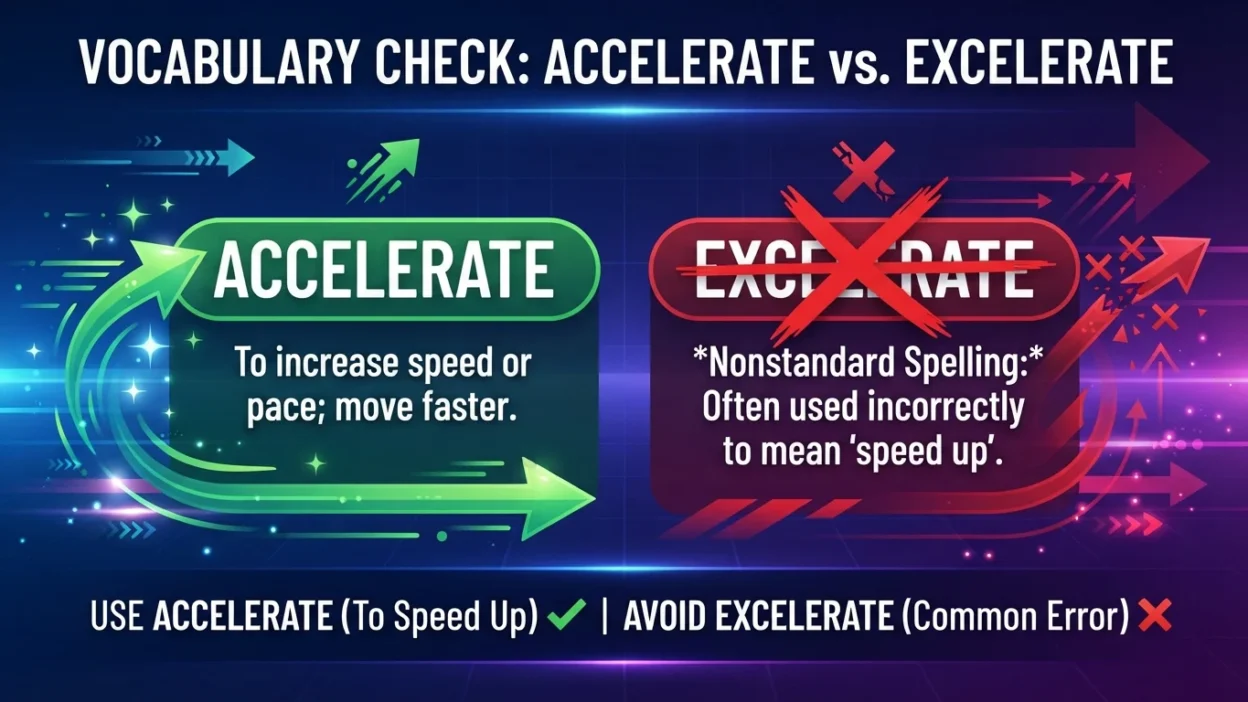
“Accelerate” is the correct spelling and means to increase speed or progress. “Excelerate” is incorrect and not recognized in standard English. Always use “accelerate” in writing.
Definition and Meaning
“Accelerate” means to move faster, increase speed, or make something happen more quickly. It is commonly used in both physical and abstract contexts.
Examples:
- The car began to accelerate on the highway.
- The company plans to accelerate growth this year.
“Excelerate” is not a real word. It likely comes from confusion with “excel,” which means to perform very well. However, combining “excel” with “erate” does not create a valid term.
Understanding the meaning of “accelerate” helps you use it correctly in both everyday and professional situations.
Why People Confuse It
The confusion happens mainly because of the word “excel.” Since “excel” is a valid English word, people assume “excelerate” must also exist.
Common reasons include:
- Mixing “excel” with “accelerate”
- Relying on sound instead of spelling
- Typing quickly without proofreading
Another reason is that “accelerate” has a slightly complex spelling, which makes it easier to misspell. Once you recognize the correct structure, the confusion becomes easy to avoid.
First Word
“Excelerate” is incorrect and should not be used in any form of writing.
Why it is wrong:
- It is not listed in dictionaries
- It does not follow standard word formation rules
- It can make your writing look unprofessional
Even though it may sound logical, it is simply a misspelling. Always avoid using it in essays, emails, or reports.
Second Word
“Accelerate” is the correct and widely accepted word. It is used in both literal and figurative contexts.
Examples:
- The driver accelerated quickly.
- Technology helps accelerate innovation.
- The program aims to accelerate learning.
Using “accelerate” correctly improves clarity and makes your writing sound polished and professional.
Grammar Rules Explained
“Accelerate” is a regular verb, which means it follows standard grammar patterns.
Forms:
- Present: accelerate
- Past: accelerated
- Present participle: accelerating
Examples:
- She accelerated the process.
- They are accelerating their efforts.
Since it is a regular verb, you simply add “ed” for past tense and “ing” for continuous forms.
Pronunciation Guide
Understanding pronunciation can help reinforce spelling.
Accelerate is pronounced as “ak sel uh rate”
Breakdown:
- ak
- sel
- uh
- rate
The double “c” creates a soft “k” sound followed by an “s” sound. Practicing this pronunciation can help you remember the correct spelling.
Comparison Table
| Word | Correct | Meaning | Usage |
|---|---|---|---|
| Accelerate | Yes | Increase speed or progress | Always use |
| Excelerate | No | Incorrect spelling | Never use |
This table clearly shows that “accelerate” is the only correct option.
When to Use Each
Use “accelerate” whenever you want to describe something speeding up or progressing faster.
Examples:
- The car accelerated بسرعة.
- We need to accelerate our plans.
Do not use “excelerate” in any situation. It has no correct usage in English.
Examples
Here are real life examples using “accelerate” correctly:
- The car accelerated after the signal turned green.
- The company wants to accelerate its growth.
- He accelerated his pace to catch the bus.
- Technology can accelerate progress.
- The teacher used tools to accelerate learning.
- The project accelerated after funding arrived.
- She accelerated the process by working harder.
- The plane accelerated before takeoff.
- New policies may accelerate change.
- The athlete accelerated toward the finish line
These examples show how versatile the word is.
Common Sentences
You may often see sentences like:
- We need to accelerate the process.
- The vehicle accelerated quickly.
- They are accelerating their efforts.
Using the correct spelling ensures your sentences are clear and professional.
Real Life Usage
“Accelerate” is widely used in different fields:
- Business: accelerate growth
- Science: accelerate reactions
- Technology: accelerate performance
- Daily life: accelerate speed
Because it appears in so many contexts, using the correct spelling is very important.
Formal vs Informal Use
“Accelerate” works in both formal and informal writing.
Formal:
- Reports
- Academic papers
- Business communication
Informal:
- Conversations
- Social media
- Messages
“Excelerate” is incorrect in all contexts and should always be avoided.
Common Mistakes
Here are common errors:
- Writing “excelerate” instead of “accelerate”
- Confusing it with “excel”
- Misspelling due to pronunciation
To avoid mistakes:
- Double check spelling
- Practice writing the word
- Use grammar tools if needed
Mistakes to Avoid
Avoid these:
- Using “excelerate” in professional writing
- Assuming it is correct because of “excel”
- Ignoring proofreading
Always verify your spelling before finalizing your work.
Memory Trick
A simple trick:
Think of “ACCEL” in accelerate
It stands for speed or action
So, accelerate means to move faster. This helps you remember the correct spelling.
American vs British English
There is no difference between American and British English for this word.
Both use:
- Accelerate as correct
- Excelerate as incorrect
This makes it easy to remember across all regions.
Similar Words
Here are similar words related to speed and progress:
- Increase
- Boost
- Advance
- Speed up
These can sometimes be used as alternatives depending on context.
Synonyms and Alternatives
You can replace “accelerate” with:
- Speed up
- Enhance
- Promote
- Fast track
Choose the best option based on your sentence.
Expert Tips
To master spelling:
- Break words into parts
- Practice regularly
- Read more English content
Experts suggest focusing on patterns rather than memorizing random words.
Related Confusing Words
Other confusing pairs include:
- Separate vs seperate
- Receive vs recieve
- Occurred vs occured
Learning correct spelling patterns helps avoid these mistakes as well.
Final Verdict
“Accelerate” is the correct spelling and should always be used. “Excelerate” is incorrect and not accepted in standard English.
By remembering the structure and meaning, you can avoid this common mistake and improve your writing instantly.
FAQs
Is excelerate a real word?
No, it is not a valid English word.
What is the correct spelling?
The correct spelling is “accelerate.”
Why do people write excelerate?
Because of confusion with the word “excel.”
Can I use excelerate informally?
No, it is incorrect in all contexts.
What does accelerate mean?
It means to increase speed or progress.
Is accelerate a regular verb?
Yes, it follows regular verb rules.
Conclusion
Spelling may seem like a small detail, but it plays a big role in effective communication. Confusing “excelerate” with “accelerate” is a common mistake, but it is easy to fix once you understand the correct form.
By practicing and paying attention to spelling patterns, you can improve your writing and avoid similar errors. Always choose “accelerate” to ensure clarity and professionalism in your work.
Remember This
Always use “accelerate” when you mean to increase speed.
“Excelerate” is incorrect and should never be used.

Carol Amanda is a passionate writer and faith-driven author dedicated to sharing the wisdom of the Bible. At BiblyWord, she creates inspiring and meaningful content that encourages spiritual growth and daily reflection. Her work focuses on helping readers connect with God’s Word and find guidance, peace, and strength in their faith journey.