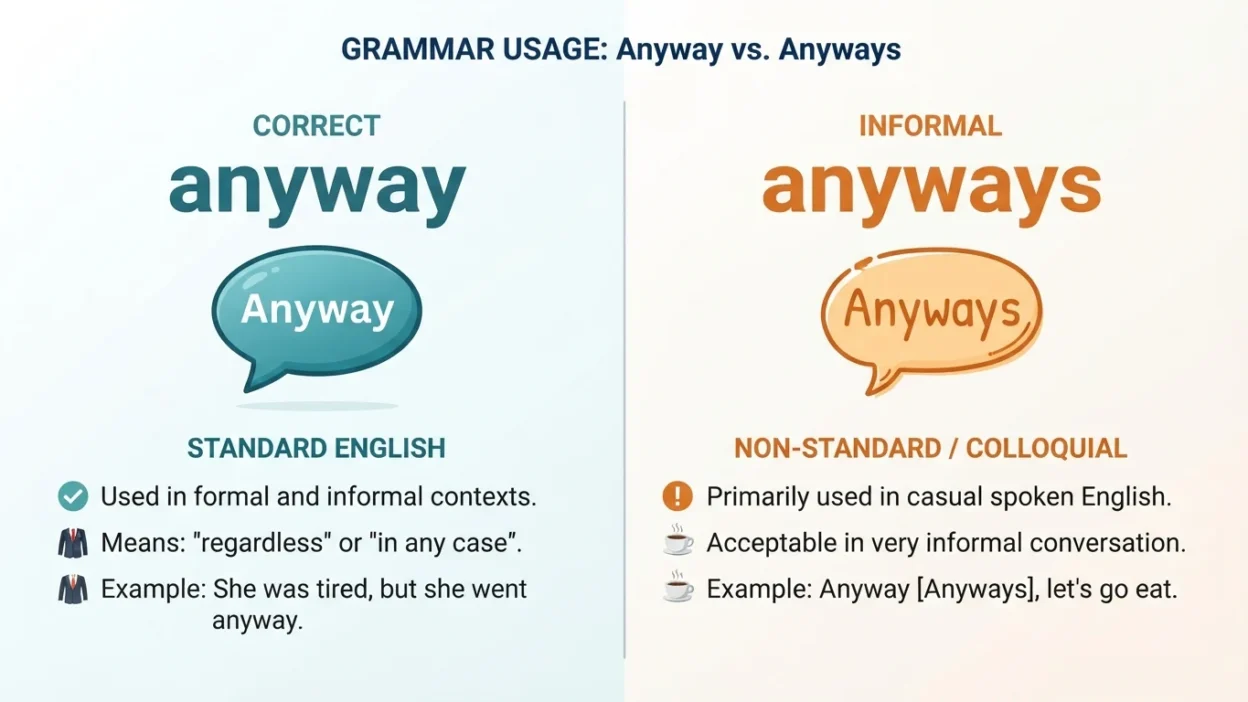
Many people use anyway and anyways interchangeably, but they are not exactly the same in standard English. While both can appear in conversation, one is considered correct in formal writing, and the other is more informal or even nonstandard in some contexts.
Understanding the difference helps you sound more natural and professional, especially in emails, assignments, and workplace communication. In this guide, you’ll learn the meanings, usage, grammar rules, and real-life examples so you can confidently choose between anyway vs anyways.
Quick Answer
Anyway is the correct and standard form in English.
Anyways is informal and often considered nonstandard.
Use anyway in formal writing and most situations, and avoid anyways unless speaking casually.
Definition and Meaning
Anyway is an adverb used to:
- Continue a conversation
- Change the topic
- Emphasize a point
Anyways has the same meaning but is informal and not widely accepted in formal writing.
So:
- Anyway = standard
- Anyways = informal/nonstandard
Why People Confuse It
The confusion comes from spoken English. Many people casually say anyways, so it feels natural.
Another reason is that English often adds s to words, making people assume both forms are correct.
However, in proper grammar, anyway is the preferred choice.
First Word: Anyway
Anyway is the correct and widely accepted form.
It is used in both formal and informal contexts.
Examples:
- Anyway, let’s continue the discussion.
- I didn’t like it, but I went anyway.
It helps shift or conclude ideas smoothly.
Second Word: Anyways
Anyways is considered informal or nonstandard.
It is mostly used in casual speech and should be avoided in formal writing.
Example:
- Anyways, let’s move on.
While commonly heard, it is not recommended in professional contexts.
Grammar Rules Explained
Anyway is an adverb and fits grammatically in sentences.
Anyways is also used as an adverb but is not standard in formal English.
For correct grammar, always prefer anyway.
Comparison Table
| Feature | Anyway | Anyways |
|---|---|---|
| Correct usage | Yes | Informal only |
| Type | Adverb | Informal adverb |
| Formal writing | Accepted | Not recommended |
| Usage | Common | Casual speech |
| Example | Anyway, let’s go | Anyways, let’s go |
When to Use Each
Use anyway in:
- Formal writing
- Emails
- Academic work
- Professional communication
Use anyways only in:
- Casual conversations
- Informal speech
Real Life Usage
In real life, anyway appears in books, articles, and professional communication.
Anyways is more common in spoken language, especially in casual settings among friends.
However, it rarely appears in formal writing.
Formal vs Informal Use
Anyway works in all situations.
Anyways is informal and should be avoided in professional or academic contexts.
Using anyway helps maintain clarity and correctness.
Pronunciation Guide
Both anyway and anyways are pronounced similarly.
The only difference is the extra s sound at the end of anyways.
Synonyms and Alternatives
For anyway, you can use:
- In any case
- Regardless
- Still
These alternatives can help vary your writing.
Common Sentences
Examples:
- Anyway, let’s finish this task.
- I didn’t plan to go, but I went anyway.
- Anyways, what were you saying? (informal)
These show the difference clearly.
Examples
Here are 10 examples:
- Anyway, let’s move forward.
- I will do it anyway.
- Anyway, we should leave now.
- He didn’t agree, but he came anyway.
- Anyway, the meeting is over.
- Anyways, let’s talk later. (informal)
- Anyway, I understand your point.
- She finished the work anyway.
- Anyways, it doesn’t matter. (informal)
- Anyway, thanks for your help.
Common Mistakes
A common mistake is using anyways in formal writing.
Another mistake is assuming both forms are equally correct.
This can affect the professionalism of your writing.
Mistakes to Avoid
Avoid:
- Using anyways in essays or emails
- Assuming informal speech is always correct
- Ignoring tone and context
Stick with anyway for safety.
Memory Trick
Remember:
Anyway = correct way
Anyways = casual way
This simple trick helps you choose quickly.
American vs British English
Both American and British English prefer anyway.
Anyways may appear in casual speech in both, but it is still considered informal.
Similar Words
Other similar confusing words:
- Alright vs All right
- Toward vs Towards
- Backward vs Backwards
Related Confusing Words
Common pairs:
- Affect vs Effect
- Accept vs Except
- Advice vs Advise
Expert Tips
When in doubt, always choose anyway.
It is safe, correct, and accepted everywhere.
Avoid anyways in writing unless the tone is very casual.
When Does It Apply
Use these words when:
- Changing topics
- Ending statements
- Emphasizing points
Correct usage improves flow and clarity.
Final Verdict
Anyway is the correct and standard form.
Anyways is informal and should be avoided in formal writing.
Using anyway ensures clear, professional communication.
FAQs
1. Is anyways grammatically correct?
It is informal and not recommended in standard English.
2. Which is better, anyway or anyways?
Anyway is the correct choice.
3. Can I use anyways in emails?
It’s better to avoid it in professional emails.
4. Why do people say anyways?
Because it is common in casual speech.
5. Is anyways wrong?
Not always wrong, but informal.
6. Is anyway formal?
Yes, it works in both formal and informal contexts.
Remember This
Anyway is standard and correct.
Anyways is informal and casual.
Use anyway for clear and professional writing.
Conclusion
The difference between anyway and anyways comes down to formality and correctness. Anyway is the standard form used in all types of writing, while anyways is informal and best avoided in professional contexts. Even though both are understood in conversation, choosing the correct word improves your credibility and clarity.
By sticking with anyway, you ensure your writing remains polished and accurate. With time and practice, this small distinction will become second nature, helping you communicate more effectively in both speaking and writing.

Carol Amanda is a passionate writer and faith-driven author dedicated to sharing the wisdom of the Bible. At BiblyWord, she creates inspiring and meaningful content that encourages spiritual growth and daily reflection. Her work focuses on helping readers connect with God’s Word and find guidance, peace, and strength in their faith journey.