The words edition and addition often confuse learners because they sound alike and differ by just one letter. However, their meanings are completely different. Using the wrong one can change your sentence entirely, especially in academic, publishing, or everyday contexts.
Understanding this difference is simple once you break it down. One relates to versions of something, like books or newspapers, while the other refers to adding or increasing something. In this guide, you’ll learn clear meanings, grammar rules, real life examples, and easy memory tricks to master edition vs addition with confidence.
Quick Answer
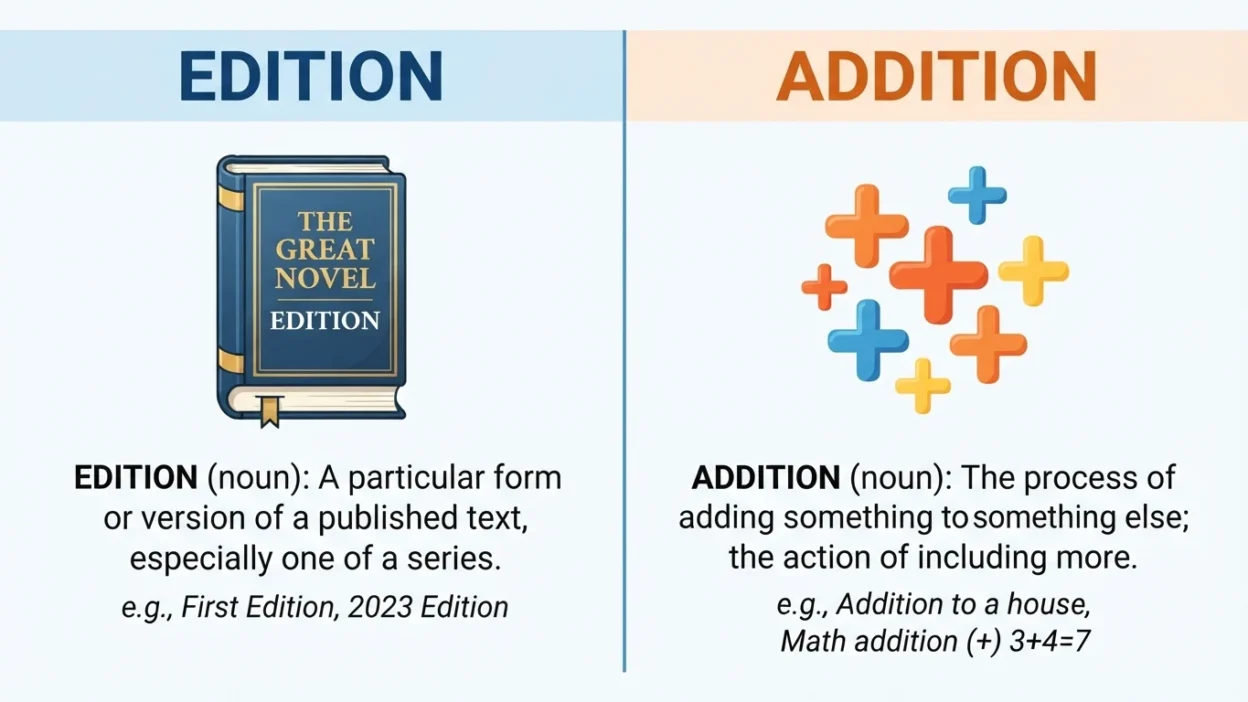
Edition refers to a version of a book, magazine, or publication.
Addition means the act of adding something or including more.
Use edition for versions and addition for increases or extra items.
Definition and Meaning
Edition is a noun that refers to a specific version of a published work. It can also describe a release of a newspaper or magazine.
Addition is a noun that means the act of adding something or the result of that action.
So:
- Edition = version
- Addition = increase or extra
Why People Confuse It
The confusion comes from their similar spelling and pronunciation.
Both words share a similar ending, making them easy to mix up, especially in fast writing.
Another reason is lack of context. Without context, it’s hard to identify which word fits correctly.
First Word: Edition
Edition refers to a particular version of a publication.
It is commonly used in:
- Books
- Magazines
- Newspapers
Examples:
- This is the latest edition of the book.
- The morning edition was delayed.
Second Word: Addition
Addition refers to the act of adding something.
It can also mean something that has been added.
Examples:
- The addition of new features improved the app.
- They built an addition to the house.
Grammar Rules Explained
Both edition and addition are nouns.
The key difference lies in meaning, not grammar structure.
Use edition for versions and addition for increases or inclusion.
Comparison Table
| Feature | Edition | Addition |
|---|---|---|
| Meaning | Version of a publication | Act of adding |
| Usage | Books, newspapers | Math, growth |
| Type | Noun | Noun |
| Example | First edition | New addition |
When to Use Each
Use edition when referring to versions of something published.
Use addition when talking about adding or including something.
Ask:
- Talking about a version? → edition
- Talking about adding? → addition
Real Life Usage
In publishing, edition is very common when referring to different versions of books.
In everyday life, addition is used when something new is included or increased.
Both words appear frequently but in very different contexts.
Formal vs Informal Use
Both words are used in formal and informal writing.
Edition appears more in academic and publishing contexts.
Addition is used in general conversation and formal writing.
Pronunciation Guide
Both words are similar in sound:
- Edition: /ɪˈdɪʃən/
- Addition: /əˈdɪʃən/
The difference is in the first syllable.
Synonyms and Alternatives
For edition:
- Version
- Release
For addition:
- Increase
- Inclusion
- Extra
Common Sentences
Examples:
- This is the second edition of the book.
- The addition of sugar changed the taste.
- The latest edition is available now.
- The addition improved the design.
Examples
Here are 10 examples:
- I bought the first edition of the novel.
- The new edition includes updated content.
- The addition of new staff improved service.
- They built an addition to the house.
- This edition is more detailed.
- The addition of features made it better.
- The special edition was expensive.
- His addition to the team was valuable.
- The revised edition is available now.
- The addition of color improved the design.
Common Mistakes
A common mistake is using edition when you mean adding something.
Another mistake is using addition when referring to a version of a book.
These errors can confuse readers.
Mistakes to Avoid
Avoid:
- Using edition for increase
- Using addition for publication version
- Ignoring context
Always check the meaning carefully.
Memory Trick
Remember:
Edition = version (like book edition).
Addition = add (contains the word “add”).
This simple trick helps you choose correctly.
American vs British English
There is no difference in usage between American and British English.
Both follow the same rules.
Similar Words
Other confusing pairs:
- Affect vs Effect
- Advice vs Advise
- Stationary vs Stationery
Related Confusing Words
More examples:
- Accept vs Except
- Compliment vs Complement
- Loose vs Lose
Expert Tips
Focus on context.
If it relates to books or versions, use edition.
If it relates to increasing or adding, use addition.
When Does It Apply
Use these words when writing:
- Academic content
- Publishing topics
- Daily communication
Correct usage improves clarity.
Final Verdict
Edition refers to a version of a publication.
Addition refers to the act of adding something.
Knowing this difference helps you avoid confusion and write more accurately.
FAQs
1. What is the difference between edition and addition?
Edition means version, while addition means adding something.
2. Can edition mean adding something?
No, it refers to versions.
3. Is addition used in math?
Yes, it refers to adding numbers.
4. Why are they confusing?
Because they sound similar.
5. What is a special edition?
A unique or limited version of a publication.
6. How do I remember the difference?
Addition has “add” in it.
Remember This
Edition equals version.
Addition equals add.
Think: add is inside addition.
Conclusion
The difference between edition and addition is easy once you understand their meanings. Edition refers to versions of books or publications, while addition refers to the act of adding or including something. Even though they sound similar, their usage is completely different.
By remembering simple tricks like “addition contains add,” you can quickly choose the correct word. With practice, using the right term will become natural and improve your writing accuracy.

Donald Andrew is a dedicated author at BiblyWord, passionate about sharing biblical teachings in a clear and inspiring way. He creates meaningful content that helps readers understand scripture, reflect on their faith, and apply God’s Word in daily life. His work supports spiritual growth, guidance, and a deeper connection with biblical wisdom.