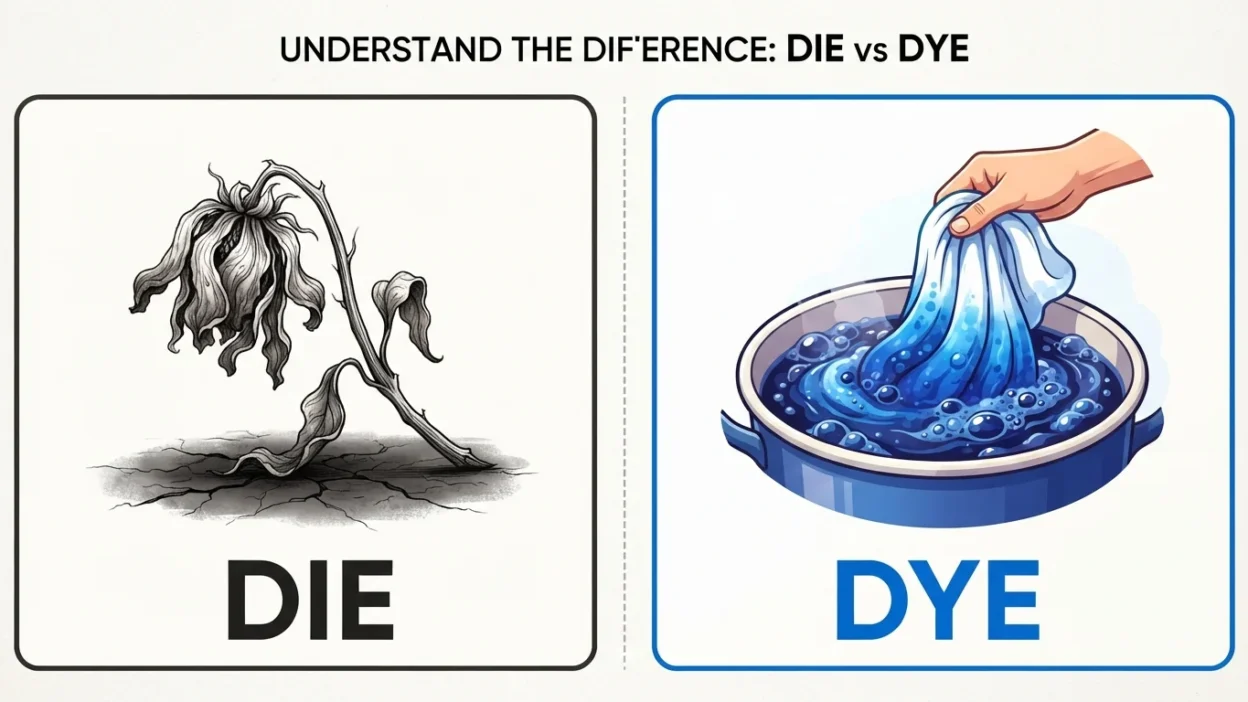
The words die and dye may look similar, but they have completely different meanings. Confusing them can lead to serious misunderstandings, especially because one relates to life and death while the other refers to coloring or changing the appearance of something.
This mix-up often happens due to their similar pronunciation and spelling. However, once you understand their meanings and usage, it becomes easy to tell them apart. In this guide, you’ll learn clear definitions, grammar rules, real-life examples, and simple memory tricks to master die vs dye confidently.
Quick Answer
Die means to stop living or refers to a tool used for shaping.
Dye means to color or change the color of something.
Use die for life-related meaning and dye for coloring.
Definition and Meaning
Die is mainly used as a verb meaning to stop living. It can also be a noun referring to a tool used in manufacturing.
Dye is a verb and noun related to coloring materials such as hair, clothes, or fabric.
So:
- Die = stop living or tool
- Dye = color
Why People Confuse It
The confusion comes from pronunciation. Both words sound exactly the same.
Another reason is spelling similarity. Since only one letter differs, it’s easy to make mistakes while writing quickly.
Without context, it’s difficult to identify the correct word.
First Word: Die
Die has two main uses.
As a verb, it means to stop living.
As a noun, it refers to a tool used for cutting or shaping material.
Examples:
- The plant will die without water.
- The machine uses a metal die.
Second Word: Dye
Dye refers to coloring or changing the color of something.
It can be used as both a noun and a verb.
Examples:
- She will dye her hair.
- The dye stained the fabric.
Grammar Rules Explained
Both die and dye can function as verbs.
However, their meanings are completely different.
Choose die for life or death situations, and dye for coloring.
Comparison Table
| Feature | Die | Dye |
|---|---|---|
| Meaning | Stop living or tool | Color or coloring substance |
| Type | Verb and noun | Verb and noun |
| Usage | Life, death, machinery | Hair, fabric, color |
| Example | Plants die | Dye your hair |
When to Use Each
Use die when referring to death or tools.
Use dye when referring to coloring or changing appearance.
Ask:
- Talking about life ending? → die
- Talking about color? → dye
Real Life Usage
In daily life, die is used in serious or biological contexts.
Dye is used in fashion, beauty, and art industries.
Both words appear frequently but in very different situations.
Formal vs Informal Use
Both words are used in formal and informal contexts.
Die is more serious and often used carefully.
Dye is common in casual and professional discussions about color.
Pronunciation Guide
Both die and dye are pronounced the same: /daɪ/
This identical pronunciation is the main cause of confusion.
Synonyms and Alternatives
For die:
- Pass away
- Perish
For dye:
- Color
- Tint
- Stain
Common Sentences
Examples:
- Plants die without water.
- She wants to dye her hair.
- The flowers will die soon.
- He dyed the fabric blue.
Examples
Here are 10 examples:
- The plant will die without sunlight.
- He didn’t want the character to die.
- The animal may die if untreated.
- She decided to dye her hair red.
- The dye changed the fabric color.
- They used natural dye for clothes.
- The leaves will die in winter.
- He dyed his shirt blue.
- Without care, the fish will die.
- The dye stained her hands.
Common Mistakes
A common mistake is using die instead of dye when talking about hair or clothes.
Another mistake is confusing the two because they sound the same.
Mistakes to Avoid
Avoid:
- Writing “I will die my hair”
- Using the wrong word based on sound
Always check meaning.
Memory Trick
Remember:
Dye has a “y” for color (like yellow).
Die has no “y” and relates to life ending.
American vs British English
There is no difference in usage between American and British English.
Both follow the same rules.
Similar Words
Other confusing pairs:
- Affect vs Effect
- Accept vs Except
- Brake vs Break
Related Confusing Words
More examples:
- Bare vs Bear
- Loose vs Lose
- Principal vs Principle
Expert Tips
Always check context carefully.
If the sentence involves color, use dye.
If it involves life or death, use die.
When Does It Apply
Use these words when writing about:
- Health or biology
- Fashion or coloring
- Everyday communication
Final Verdict
Die refers to stopping life or a tool.
Dye refers to coloring or changing color.
Understanding this difference helps avoid serious confusion.
FAQs
1. What is the difference between die and dye?
Die means to stop living, while dye means to color.
2. Are they pronounced the same?
Yes, they sound identical.
3. Can dye be a verb?
Yes, it means to color something.
4. What does die mean?
It means to stop living or refers to a tool.
5. Why are they confusing?
Because they sound the same.
6. How do I remember the difference?
Dye has “y” for color.
Remember This
Die equals life ending.
Dye equals color.
Think: “y” stands for color.
Conclusion
The difference between die and dye is clear once you understand their meanings. Die relates to life and death or machinery, while dye is all about color and appearance. Even though they sound the same, their uses are completely different.
By remembering simple tricks like “dye has y for color,” you can avoid confusion easily. With practice, you’ll naturally choose the correct word and communicate more clearly in both writing and speech.

Kevin Brian is a passionate author at BiblyWord, dedicated to sharing the message of the Bible through thoughtful and inspiring content. He focuses on creating clear and meaningful writings that help readers understand scripture, strengthen their faith, and find guidance in everyday life through God’s Word.