Spelling mistakes can easily change how your writing is understood, especially when two words look almost the same. A common confusion is between “skiddish” and “skittish.” Many people use both forms, but only one is correct in standard English.
This word is often used to describe someone who is nervous, easily scared, or restless. Because it appears in everyday conversation and writing, it is important to use the correct spelling. In this guide, you will learn the difference, correct usage, and simple ways to remember it.
Quick Answer
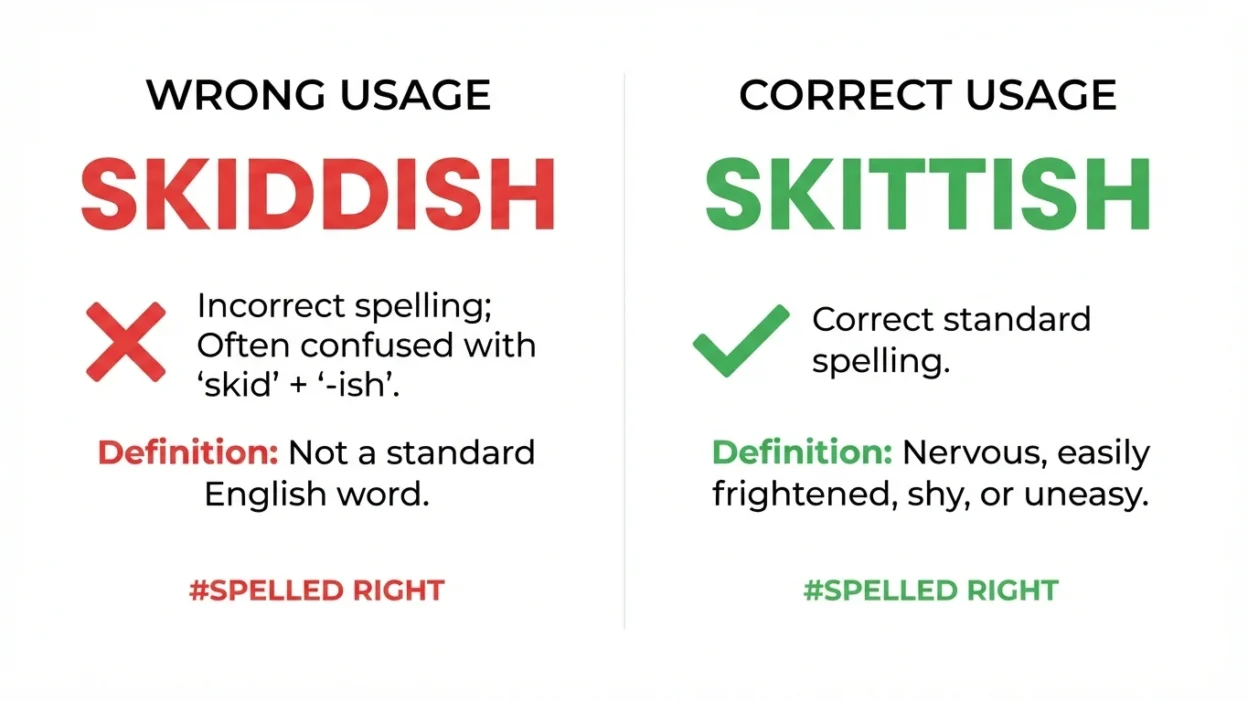
The correct spelling is “skittish.” The word “skiddish” is incorrect and not recognized in standard English. Always use “skittish” when describing someone nervous, easily frightened, or jumpy.
Why People Confuse It
People confuse “skiddish” and “skittish” mainly because of pronunciation. The word sounds like skid ish or skit ish, which makes it easy to guess the wrong spelling.
Another reason is spelling patterns. Many English words end with ish, so “skiddish” feels natural even though it is incorrect.
Typing habits also play a role. When writing quickly, people may replace the double t with d, leading to the wrong form.
First Word
“Skiddish” is not a correct English word. It does not appear in standard dictionaries and should not be used in writing.
This spelling usually comes from guessing based on sound. Some people think it is a variation, but it is simply a mistake.
Using “skiddish” can make your writing look unpolished. It is best to avoid it completely.
Second Word
“Skittish” is the correct spelling. It describes someone who is easily frightened, nervous, or quick to react.
The word is often used for animals like horses, as well as people who are anxious or restless.
Using “skittish” correctly helps your writing sound clear and natural.
Definition and Meaning
“Skittish” means easily scared or nervous. It can also describe someone who is unpredictable or quick to react.
For example, a skittish horse may jump at small sounds. A skittish person may feel uneasy in new situations.
Understanding the meaning helps you use the word correctly in both literal and figurative contexts.
Pronunciation Guide
“Skittish” is pronounced as skit ish. The sound is quick, with a clear emphasis on the first part.
The pronunciation can be misleading, which is why spelling errors happen. Listening carefully can help you connect sound with correct spelling.
Practicing pronunciation alongside writing improves accuracy.
Grammar Rules Explained
“Skittish” is an adjective. It describes a person, animal, or behavior.
The incorrect form “skiddish” does not follow any grammar rules because it is not a real word.
Learning the correct spelling ensures proper usage in sentences.
Comparison Table
| Word | Correct | Meaning |
|---|---|---|
| skiddish | No | Incorrect spelling |
| skittish | Yes | Easily frightened or nervous |
This table clearly shows the correct form.
When to Use Each
Use “skittish” when describing someone or something nervous, jumpy, or easily scared.
Do not use “skiddish” in any context. It is always incorrect and should be avoided.
Choosing the correct word keeps your writing clear and professional.
Real Life Usage
“Skittish” is commonly used in real life. People describe animals as skittish when they react quickly to sounds.
It is also used for people. For example, someone may feel skittish before a big event.
Using the correct spelling helps your message feel natural and easy to understand.
Formal vs Informal Use
“Skittish” works in both formal and informal writing. It can appear in stories, reports, and everyday conversation.
The incorrect form “skiddish” should not be used in any setting. It reduces clarity and credibility.
Using correct spelling improves communication skills.
Synonyms and Alternatives
Here are some alternatives for “skittish”:
- Nervous
- Jumpy
- Anxious
- Restless
- Easily frightened
These words can help vary your writing.
Common Sentences
Here are some natural sentences using “skittish”:
- The horse became skittish
- She felt skittish before the interview
- The dog was skittish around strangers
- He acted skittish in the crowd
These examples show everyday usage.
Examples
Here are ten real examples:
- The cat is skittish around loud noises
- He felt skittish during the meeting
- The horse turned skittish suddenly
- She seemed skittish in new places
- The child became skittish at night
- Investors grew skittish about the market
- The dog remained skittish after the storm
- He looked skittish before speaking
- The animal was skittish in the wild
- She became skittish in stressful situations
These examples show correct usage across contexts.
Common Mistakes
A common mistake is writing “skiddish” instead of “skittish.” This usually happens because of pronunciation confusion.
Another mistake is not checking spelling carefully. Small errors can change meaning.
Being aware of these mistakes helps you avoid them.
Mistakes to Avoid
Do not rely only on how a word sounds when spelling it. English spelling can be tricky.
Avoid typing too quickly without reviewing your work.
Always proofread your writing for accuracy.
Memory Trick
Remember that “skittish” has double t, like “little.” Think of someone small and jumpy to connect the idea.
This simple trick helps you recall the correct spelling.
Practice makes it easier to remember.
American vs British English
“Skittish” is spelled the same in both American and British English.
There is no variation, which makes it easier for learners.
You can use it confidently in any context.
Similar Words
Other confusing words include:
- Shiny and shiney
- Spicy and spicey
- Habit and habbit
These words also involve spelling patterns that can cause mistakes.
Related Confusing Words
Words like “jittery” and “restless” are similar in meaning but different in spelling.
Understanding these differences improves your vocabulary.
Practice helps you master such words.
Expert Tips
Always double check your spelling when writing important content.
Use reliable tools, but also review manually.
Practice regularly to improve your spelling accuracy.
Comparison Table
| Feature | Skittish | Skiddish |
|---|---|---|
| Spelling | Correct | Incorrect |
| Usage | Standard English | Not used |
| Meaning | Nervous or jumpy | No meaning |
This second table reinforces the correct choice.
Final Verdict
“Skittish” is the correct spelling and should always be used. The word “skiddish” is incorrect and should be avoided in all contexts.
Understanding the difference helps improve clarity and professionalism in your writing.
FAQs
Is skiddish a real word
No, it is a spelling mistake.
What is the correct spelling
The correct spelling is “skittish.”
Why do people write skiddish
Because of pronunciation confusion.
Can skiddish be used informally
No, it is incorrect in all contexts.
What does skittish mean
It means nervous or easily frightened.
Is skittish used worldwide
Yes, it is used in both American and British English.
Conclusion
Spelling accuracy plays a key role in clear communication. Choosing between “skiddish” and “skittish” becomes simple once you understand the correct form. Using the right spelling ensures your writing is clear and professional.
With regular practice and attention to detail, you can avoid this common mistake. Over time, correct spelling becomes natural and improves your overall language skills.
Remember This
Always write “skittish” with double t. Never use “skiddish” because it is incorrect.

Carol Amanda is a passionate writer and faith-driven author dedicated to sharing the wisdom of the Bible. At BiblyWord, she creates inspiring and meaningful content that encourages spiritual growth and daily reflection. Her work focuses on helping readers connect with God’s Word and find guidance, peace, and strength in their faith journey.