Spelling mistakes can easily confuse readers, especially when two words look almost identical. A common example is “simular” vs “similar.” Many people accidentally swap the letters, but only one of these forms is correct in standard English.
This word is widely used in daily communication, academic writing, and professional content. Because it appears so often, using the correct spelling is important for clarity and credibility. In this guide, you will learn the correct form, why confusion happens, and how to use the word properly with confidence.
Quick Answer
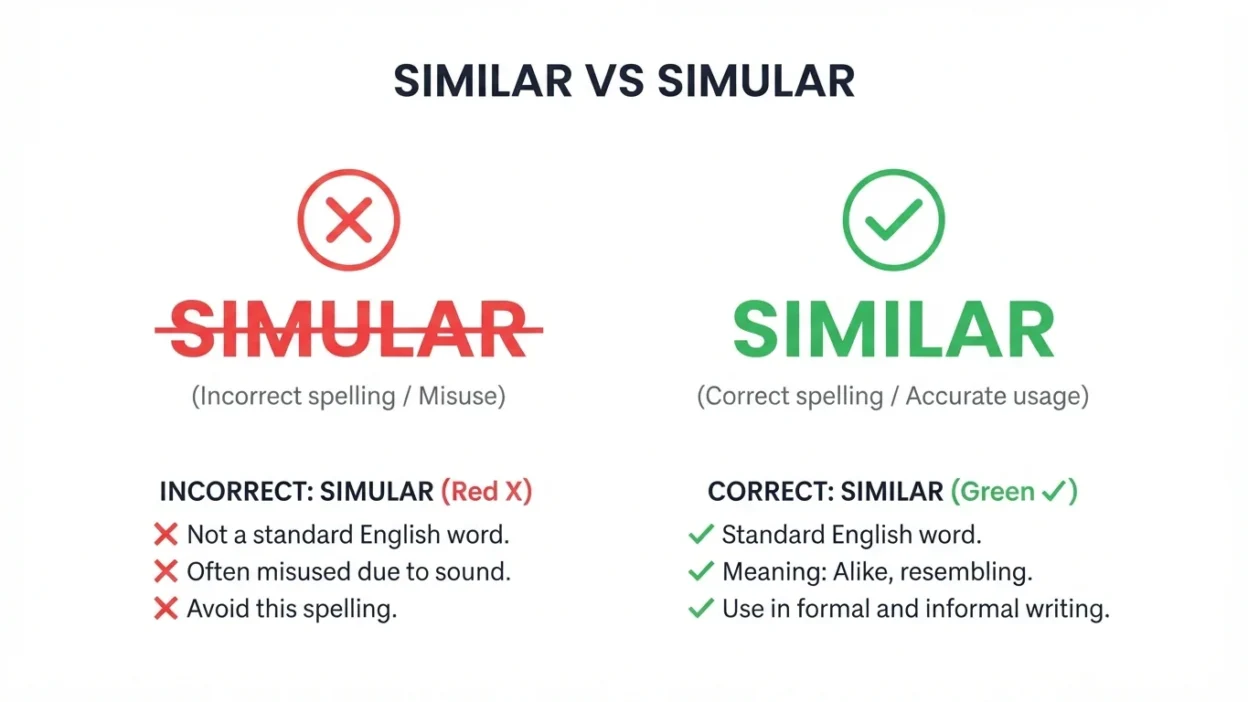
The correct spelling is “similar.” The word “simular” is incorrect and not accepted in standard English. Always use “similar” when comparing things that are alike.
Why People Confuse It
People confuse “simular” and “similar” mainly because of pronunciation. When spoken, the middle sound is soft, making it hard to clearly hear whether it is “a” or “u.”
Another reason is typing habits. The letters “a” and “u” are close on the keyboard, so it is easy to press the wrong key by mistake.
Also, learners sometimes rely on sound instead of memorizing spelling. Since English spelling is not always phonetic, this leads to errors like “simular.”
First Word
“Simular” is not a correct English word. It does not appear in dictionaries and has no accepted meaning in standard usage.
This spelling usually happens due to confusion or typing errors. Some people assume it is a variation, but it is simply incorrect.
Using “simular” can make your writing look unprofessional and unclear. It should always be avoided.
Second Word
“Similar” is the correct spelling. It is an adjective used to describe things that are alike or have common features.
For example, two designs can be similar, or two ideas can be similar in meaning. It is a very common and useful word in English.
Using “similar” correctly helps your writing sound clear and natural.
Definition and Meaning
“Similar” means almost the same or alike in some way. It does not mean identical, but it shows a close resemblance.
For example, two phones may look similar but have different features. Two opinions may be similar but not exactly the same.
Understanding the meaning helps you use the word correctly in comparisons.
Pronunciation Guide
“Similar” is pronounced as sim uh ler. The middle vowel sound is soft, which is why people sometimes confuse it.
The pronunciation does not clearly show the correct spelling, making it easy to guess incorrectly.
Practicing the word aloud can help connect the sound with the correct spelling.
Grammar Rules Explained
“Similar” is an adjective. It is used to compare nouns and describe similarities.
For example, you can say “These two books are similar.” The word usually follows a linking verb like “are” or “seem.”
The incorrect form “simular” does not follow any grammar rules because it is not a real word.
Comparison Table
| Word | Correct | Meaning |
|---|---|---|
| simular | No | Incorrect spelling |
| similar | Yes | Alike or nearly the same |
This table clearly shows the correct choice.
When to Use Each
Use “similar” whenever you want to compare two or more things that share common features.
Do not use “simular” in any context. It is always incorrect and should be avoided.
Choosing the correct word ensures your message is clear and professional.
Real Life Usage
“Similar” is used in many real life situations. People compare products, ideas, designs, and experiences using this word.
For example, two students may have similar answers, or two cities may have similar cultures.
Using the correct spelling helps your audience understand comparisons easily.
Formal vs Informal Use
“Similar” works in both formal and informal writing. It is commonly used in essays, reports, emails, and conversations.
The incorrect form “simular” should never be used, even in casual writing. It can reduce the quality of your content.
Correct spelling improves trust and readability.
Synonyms and Alternatives
Here are some alternatives for “similar”:
- Alike
- Comparable
- Resembling
- Related
- Close
These synonyms help add variety to your writing.
Common Sentences
Here are some natural sentences using “similar”:
- These two designs are similar
- They have similar ideas
- The results look similar
- Our experiences were similar
These examples show everyday usage.
Examples
Here are ten real examples:
- The twins look very similar
- These phones have similar features
- Their opinions are similar
- The patterns appear similar
- We had similar experiences
- The designs are quite similar
- Their answers were similar
- The buildings look similar
- The styles are similar
- The results are similar
These examples show correct usage across contexts.
Common Mistakes
A common mistake is writing “simular” instead of “similar.” This usually happens because of pronunciation confusion.
Another mistake is not proofreading. Small spelling errors can easily go unnoticed.
Being aware of these mistakes helps you avoid them.
Mistakes to Avoid
Do not rely only on how a word sounds when spelling it. English spelling can be tricky.
Avoid typing too quickly without reviewing your work.
Always check your writing before finalizing it.
Memory Trick
A simple trick is to remember that “similar” contains “mil” in the middle.
Think of “mil” as a familiar pattern in words like “million.” This helps you recall the correct spelling.
Practicing this trick can reduce mistakes.
American vs British English
“Similar” is spelled the same in both American and British English.
There is no variation in spelling, which makes it easy to remember.
You can use it confidently in any region.
Similar Words
Other confusing words include:
- Particular and particuler
- Regular and reguler
- Popular and populer
These words also involve vowel confusion.
Related Confusing Words
Words like “familiar” and “similar” can also be mixed up because of similar structure.
Understanding these differences improves your vocabulary and spelling accuracy.
Regular practice helps you master such words.
Expert Tips
Always proofread your writing carefully, especially important documents.
Use spell check tools, but do not rely on them completely.
Practice writing regularly to improve accuracy and confidence.
Comparison Table
| Feature | Similar | Simular |
|---|---|---|
| Spelling | Correct | Incorrect |
| Usage | Standard English | Not used |
| Meaning | Alike or nearly the same | No meaning |
This second table reinforces the correct choice clearly.
Final Verdict
“Similar” is the correct spelling and should always be used in writing. The word “simular” is incorrect and should be avoided in all contexts.
Understanding this difference helps improve clarity and professionalism in your writing.
FAQs
Is simular a real word
No, it is a spelling mistake.
What is the correct spelling
The correct spelling is “similar.”
Why do people write simular
Because of pronunciation confusion or typing errors.
Can simular be used informally
No, it is incorrect in all contexts.
What does similar mean
It means things that are alike or nearly the same.
Is similar used worldwide
Yes, it is used in both American and British English.
Conclusion
Spelling accuracy is essential for clear communication. Choosing between “simular” and “similar” becomes simple once you understand the correct form. Using the right spelling ensures your writing is professional and easy to understand.
With practice and careful proofreading, you can avoid this common mistake. Over time, correct spelling becomes natural and improves your overall language skills.
Remember This
Always write “similar” with “mil” in the middle. Never use “simular” because it is incorrect.

Kevin Brian is a passionate author at BiblyWord, dedicated to sharing the message of the Bible through thoughtful and inspiring content. He focuses on creating clear and meaningful writings that help readers understand scripture, strengthen their faith, and find guidance in everyday life through God’s Word.