Spelling mistakes can make even simple words look confusing, especially when the difference is just one letter. A common example is “annual” vs “anual.” Many people drop one letter by mistake, but only one of these forms is correct in standard English.
This word is widely used in everyday life, from school exams to business reports and yearly events. Because of its frequent use, it is important to spell it correctly. In this guide, you will learn the difference, proper usage, and easy ways to remember the correct spelling.
Quick Answer
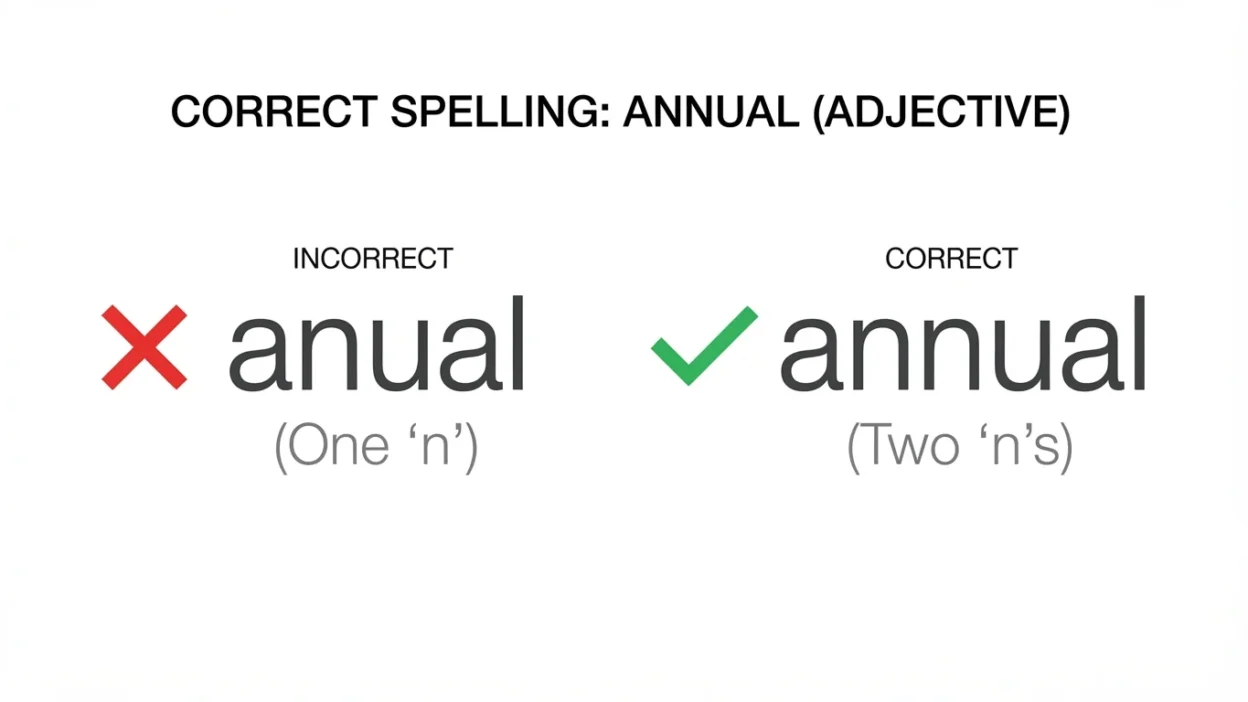
The correct spelling is “annual.” The word “anual” is incorrect and not accepted in standard English. Always use “annual” when referring to something that happens once every year.
Why People Confuse It
People confuse “annual” and “anual” mainly because of the double “n.” When typing quickly, it is easy to miss one letter and write “anual” by mistake.
Another reason is pronunciation. When spoken, the word sounds smooth, and the double “n” is not clearly emphasized. This makes it harder to identify the correct spelling from sound alone.
Also, many learners assume simpler spelling is correct. They may remove one “n” to make the word easier, but this leads to an incorrect form.
First Word
“Anual” is not a correct English word. It does not appear in dictionaries and should not be used in writing.
This spelling usually happens due to typing errors or lack of attention to double letters. Some people think it is a shorter version, but it is simply incorrect.
Using “anual” can make your writing look careless. It is best to avoid it completely and use the correct spelling.
Second Word
“Annual” is the correct spelling. It refers to something that happens once every year or relates to a year.
This word is commonly used in many contexts, such as annual events, annual reports, and annual income.
Using “annual” correctly ensures your writing is clear, accurate, and professional.
Definition and Meaning
“Annual” means happening once every year or lasting for a year. It can describe events, reports, payments, or activities.
For example, an annual meeting takes place once a year. An annual report summarizes yearly performance.
Understanding the meaning helps you use the word correctly in different situations.
Pronunciation Guide
“Annual” is pronounced as an yoo uhl. The word has three clear parts when spoken.
Even though it sounds simple, the double “n” is not strongly heard, which is why spelling mistakes happen.
Practicing pronunciation along with spelling can help you remember the correct form.
Grammar Rules Explained
“Annual” is an adjective. It describes something related to a year or happening every year.
The incorrect form “anual” does not follow any grammar rules because it is not a valid word.
Learning the correct spelling helps you use the word properly in sentences and avoid confusion.
Comparison Table
| Word | Correct | Meaning |
|---|---|---|
| anual | No | Incorrect spelling |
| annual | Yes | Happening once a year |
This table clearly shows the correct choice.
When to Use Each
Use “annual” when describing yearly events, reports, or activities. It works in both formal and informal writing.
Do not use “anual” in any situation. It is always incorrect and should be avoided.
Choosing the correct word ensures your message is clear and professional.
Real Life Usage
“Annual” is used in many real life situations. Companies prepare annual reports, schools hold annual events, and people track annual income.
For example, businesses review their annual performance, and families may celebrate annual traditions.
Using the correct spelling helps your communication stay clear and effective.
Formal vs Informal Use
“Annual” is suitable for both formal and informal writing. It is commonly used in reports, emails, and everyday conversations.
The incorrect form “anual” should never be used, even in casual writing. It can reduce the quality of your message.
Consistent correct spelling improves your writing skills.
Synonyms and Alternatives
Here are some alternatives for “annual”:
- Yearly
- Once a year
- Per year
- Yearly recurring
These synonyms help vary your writing and avoid repetition.
Common Sentences
Here are some natural sentences using “annual”:
- The company released its annual report
- We attend an annual meeting
- She tracks her annual expenses
- The festival is an annual event
These examples show how the word is used in daily life.
Examples
Here are ten real examples:
- The school hosts an annual function
- They prepare an annual budget
- He attends the annual conference
- The company publishes an annual report
- She reviews her annual goals
- The event is held on an annual basis
- They celebrate an annual tradition
- The organization plans annual activities
- He calculates his annual income
- The team organizes an annual meeting
These examples show correct usage in different contexts.
Common Mistakes
A common mistake is dropping one “n” and writing “anual.” This often happens during fast typing.
Another mistake is not proofreading. Small spelling errors can easily go unnoticed.
Being aware of these mistakes helps you avoid them.
Mistakes to Avoid
Do not assume shorter spelling is correct. Many English words require double letters.
Avoid typing too quickly without checking your work. Even small errors can affect clarity.
Always review your writing before finalizing it.
Memory Trick
A simple trick is to remember that “annual” has two “n” letters, just like “year has many months.”
You can also think of “ann” as a repeated sound, reminding you to double the letter.
This helps you recall the correct spelling easily.
American vs British English
“Annual” is spelled the same in both American and British English.
There is no variation in spelling, which makes it easy to remember.
You can use it confidently in any region.
Similar Words
Other confusing words include:
- Occasion and ocassion
- Necessary and neccessary
- Address and adress
These words also involve double letters and can cause mistakes.
Related Confusing Words
Words like “annually” and “anniversary” also use double “n.” Understanding this pattern helps reinforce correct spelling.
Practicing similar words improves your overall accuracy.
Regular exposure helps you remember these patterns.
Expert Tips
Always proofread your writing, especially important documents.
Use spell check tools, but also review manually for accuracy.
Practice writing regularly to build confidence and improve your spelling.
Comparison Table
| Feature | Annual | Anual |
|---|---|---|
| Spelling | Correct | Incorrect |
| Usage | Standard English | Not used |
| Meaning | Yearly | No meaning |
This second table reinforces the correct choice clearly.
Final Verdict
“Annual” is the correct spelling and should always be used. The word “anual” is incorrect and should be avoided in all types of writing.
Understanding the correct form helps improve clarity and professionalism. It ensures your writing is accurate and easy to understand.
FAQs
Is anual a real word
No, it is a spelling mistake.
What is the correct spelling
The correct spelling is “annual.”
Why do people write anual
Because they miss one “n” while typing or spelling.
Can anual be used informally
No, it is incorrect in all contexts.
What does annual mean
It means something that happens once every year.
Is annual used worldwide
Yes, it is used in both American and British English.
Conclusion
Spelling accuracy is important for clear communication. Choosing between “annual” and “anual” becomes simple once you understand the correct form. Using the right spelling helps your writing stay professional and easy to read.
With regular practice and careful proofreading, you can avoid this common mistake. Over time, correct spelling becomes natural and improves your overall language skills.
Remember This
Always write “annual” with double “n.” Never use “anual” because it is incorrect.

Kevin Brian is a passionate author at BiblyWord, dedicated to sharing the message of the Bible through thoughtful and inspiring content. He focuses on creating clear and meaningful writings that help readers understand scripture, strengthen their faith, and find guidance in everyday life through God’s Word.