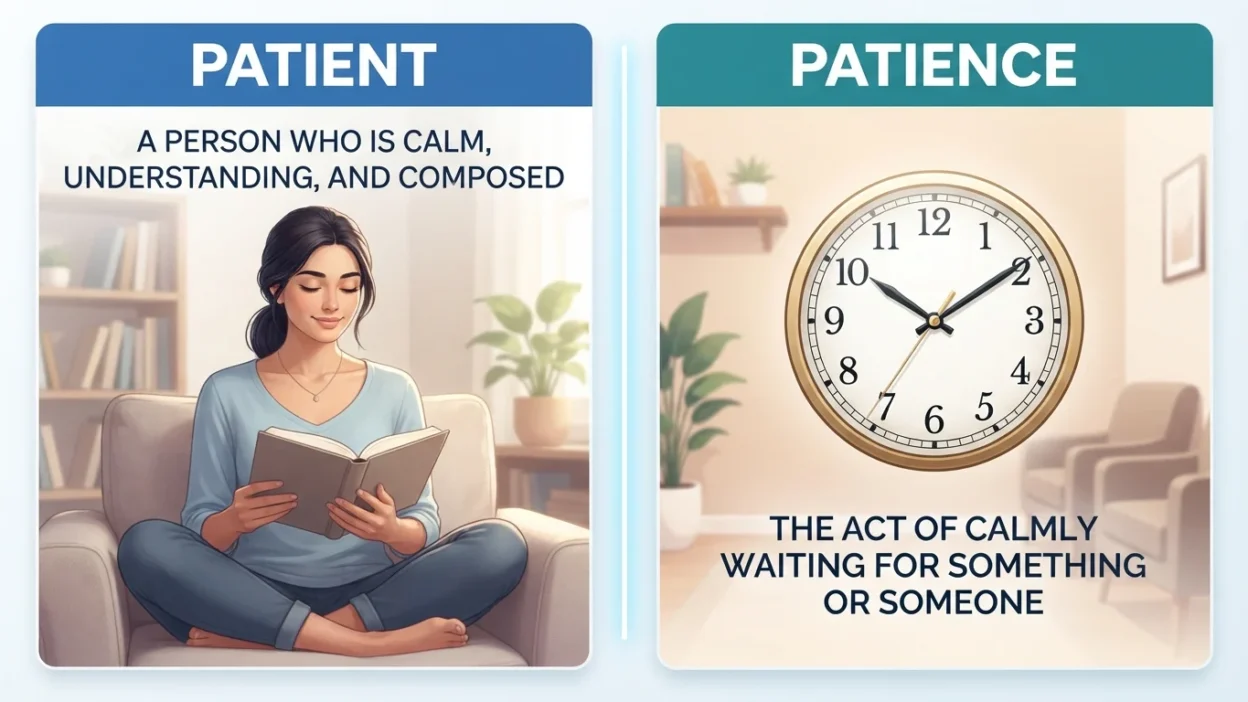
The words patient and patience may look similar, but they have completely different meanings. This common confusion often leads to mistakes in writing, especially for learners of English. While one refers to a person or a personality trait, the other describes a quality or behavior.
Understanding the difference is important for clear communication. Whether you’re writing an email, a school assignment, or speaking in daily life, using the correct word helps you sound more natural and professional. In this guide, you’ll learn the meanings, usage, examples, and simple tricks to master patient vs patience easily.
Quick Answer
Patient is a noun or adjective meaning a person receiving care or someone who stays calm.
Patience is a noun meaning the ability to stay calm and wait without frustration.
Use patient for people or behavior, and patience for the quality itself.
Definition and Meaning
Patient has two meanings. It can refer to a person receiving medical treatment, or describe someone who remains calm in difficult situations.
Patience refers to the ability to wait calmly without getting annoyed or upset.
So:
- Patient = person or calm behavior
- Patience = the quality of being calm
Why People Confuse It
The confusion comes from their similar spelling and pronunciation.
Both words are related in meaning, which makes it harder to separate them. A patient person shows patience, so the connection adds to the confusion.
Many learners also mix them up because they appear in similar contexts.
First Word: Patient
Patient can be used as both a noun and an adjective.
As a noun, it refers to someone receiving medical care.
As an adjective, it describes someone who stays calm and does not get easily upset.
Examples:
- The patient is recovering well.
- She is very patient with children.
Second Word: Patience
Patience is a noun.
It describes the ability to remain calm while waiting or dealing with challenges.
Examples:
- You need patience to learn a new skill.
- His patience was impressive.
Grammar Rules Explained
Patient can function as:
- A noun (a person)
- An adjective (a personality trait)
Patience is always a noun.
You cannot use patience to describe a person directly. Instead, you say someone has patience or is patient.
Comparison Table
| Feature | Patient | Patience |
|---|---|---|
| Meaning | Person or calm behavior | Ability to stay calm |
| Type | Noun and adjective | Noun |
| Usage | Describes person or role | Describes quality |
| Example | She is patient | She has patience |
When to Use Each
Use patient when describing a person or behavior.
Use patience when referring to the quality of staying calm.
Ask yourself:
- Talking about a person? → patient
- Talking about a quality? → patience
Real Life Usage
In hospitals, patient refers to someone receiving care.
In everyday life, patience is used when talking about handling delays or challenges calmly.
Both words are commonly used in daily conversations.
Formal vs Informal Use
Both words are used in formal and informal situations.
Patience is often used in advice or motivational writing.
Patient is used in both medical and general contexts.
Pronunciation Guide
Both words sound similar but differ slightly.
- Patient: /ˈpeɪ.ʃənt/
- Patience: /ˈpeɪ.ʃəns/
The ending sound is the main difference.
Synonyms and Alternatives
For patient:
- Calm
- Tolerant
For patience:
- Endurance
- Calmness
- Self-control
Common Sentences
Examples:
- She is very patient with her students.
- You need patience to succeed.
- The patient is stable.
- His patience helped him succeed.
Examples
Here are 10 examples:
- The patient is waiting for the doctor.
- She is patient during difficult times.
- You need patience to learn driving.
- The patient was treated quickly.
- He remained patient despite delays.
- Her patience paid off.
- The patient is feeling better now.
- Teachers must be patient.
- It takes patience to master skills.
- The patient followed instructions carefully.
Common Mistakes
A common mistake is using patience to describe a person directly.
Another mistake is using patient when referring to the quality.
These errors can change the meaning of a sentence.
Mistakes to Avoid
Avoid:
- Saying “She is patience”
- Saying “He has patient”
Always match the word with its correct function.
Memory Trick
Think:
Patient describes a person.
Patience is a quality.
Or remember:
- “Be patient”
- “Have patience”
American vs British English
There is no difference in usage between American and British English.
Both follow the same rules.
Similar Words
Other similar pairs:
- Affect vs Effect
- Advice vs Advise
- Practice vs Practise
Related Confusing Words
Words often confused:
- Calm vs Calmness
- Strong vs Strength
- Different vs Difference
Expert Tips
Always check whether you are describing a person or a quality.
If you can replace it with “calm person,” use patient.
If you mean “ability to wait,” use patience.
When Does It Apply
Use these words when:
- Describing behavior
- Giving advice
- Talking about emotions
- Writing formally or informally
Final Verdict
Patient refers to a person or calm behavior.
Patience refers to the ability to remain calm.
Understanding this difference helps you avoid common grammar mistakes and communicate clearly.
FAQs
1. What is the difference between patient and patience?
Patient describes a person or behavior, while patience is the quality of staying calm.
2. Can patient be an adjective?
Yes, it describes someone who remains calm.
3. Is patience a verb?
No, it is a noun.
4. How do I use patience in a sentence?
Example: You need patience to succeed.
5. Why are these words confusing?
Because they are related in meaning and look similar.
6. Can patient mean someone in a hospital?
Yes, it is commonly used that way.
Remember This
Patient equals person or calm behavior.
Patience equals the ability to wait calmly.
Use “be patient” and “have patience” to remember easily.
Conclusion
The difference between patient and patience becomes simple once you understand their roles. Patient describes a person or their calm behavior, while patience refers to the ability to remain calm during challenges or delays. Though they are closely related in meaning, their grammatical usage is very different.
By practicing and remembering simple phrases like “be patient” and “have patience,” you can avoid confusion. Over time, choosing the correct word will become natural, improving both your writing and speaking skills.

Kevin Brian is a passionate author at BiblyWord, dedicated to sharing the message of the Bible through thoughtful and inspiring content. He focuses on creating clear and meaningful writings that help readers understand scripture, strengthen their faith, and find guidance in everyday life through God’s Word.