Confusing words can quietly damage your writing, and “insue vs ensue” is a perfect example. Many people type insue thinking it is correct, only to realize later that it does not even exist in standard English. This small mistake can affect clarity, professionalism, and even credibility.
If you have ever paused mid sentence wondering which one is right, you are not alone. This guide will clear up the confusion in a simple and practical way. By the end, you will not only understand the difference but also feel confident using the correct word in real life situations.
Quick Answer
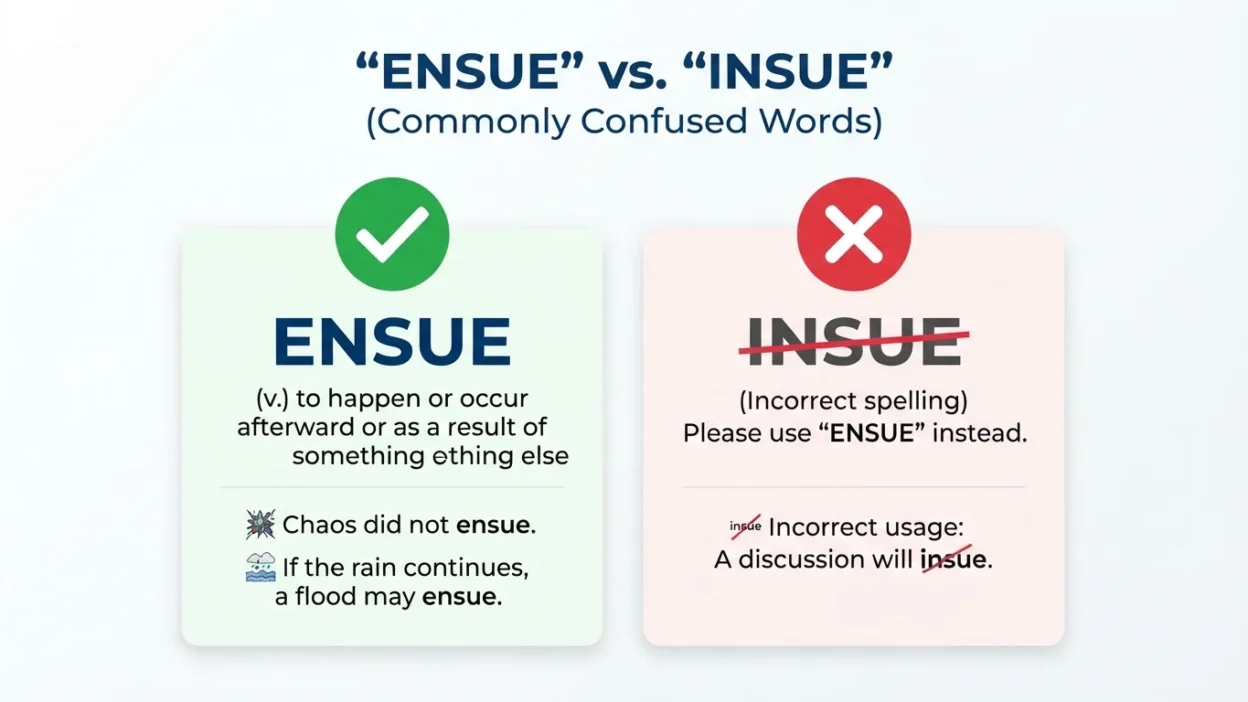
“Ensue” is the correct English word and means “to happen next” or “to follow as a result.” “Insue” is a misspelling and should not be used. Always choose “ensue” when describing something that happens afterward.
Definition and Meaning
“Ensue” is a verb that describes something happening as a result of something else. It is often used in formal and semi formal writing.
For example, if an argument starts, chaos may ensue. The second event follows the first one naturally.
“Insue” has no meaning in English. It is simply a spelling error that comes from confusion in pronunciation or typing mistakes.
Understanding this basic difference is the first step toward using the word correctly in your writing.
Why People Confuse It
People confuse “insue” and “ensue” mainly because they sound very similar when spoken. The vowel sound at the beginning is subtle, which makes it easy to mishear.
Another reason is typing habits. Many users rely on phonetic spelling, and “insue” looks like it could be correct.
Also, autocorrect does not always fix this mistake, especially if the word is typed quickly. That allows the error to slip into emails, essays, or social posts.
First Word
“Insue” is not a real word in English. It does not appear in dictionaries and has no accepted definition.
People often assume it is related to words like “issue” or “pursue,” which adds to the confusion.
Because it is incorrect, using it can make your writing look unprofessional. It is best to completely avoid this spelling.
Think of “insue” as a common typo rather than a word you can ever use properly.
Second Word
“Ensue” is a real and useful verb in English. It means something happens afterward, especially as a result of something else.
It is often used in storytelling, news writing, and formal communication. For example, “A heated debate ensued after the announcement.”
The word helps create a sense of sequence and consequence, which is important in clear communication.
Using “ensue” correctly can make your writing more polished and precise.
Comparison Table One
| Feature | Insue | Ensue |
|---|---|---|
| Is it a real word | No | Yes |
| Meaning | None | To happen next |
| Usage | Incorrect | Correct |
| Example | Not applicable | Chaos ensued |
Comparison Table Two
| Aspect | Insue | Ensue |
|---|---|---|
| Dictionary presence | No | Yes |
| Writing level | Mistake | Standard English |
| Professional use | Not acceptable | Acceptable |
| Clarity | Confusing | Clear |
Pronunciation Guide
“Ensue” is pronounced as “en soo.”
The stress is placed gently at the beginning, making it sound smooth and natural.
Many people accidentally pronounce it closer to “in soo,” which leads to the incorrect spelling “insue.”
Practicing the correct pronunciation can help reinforce the correct spelling in your mind.
Grammar Rules Explained
“Ensue” is used as an intransitive verb, which means it does not need a direct object.
It usually follows an event and describes what happens next. For example, “Silence ensued.”
You should not use it with an object like “ensue something,” because that would be grammatically incorrect.
Keeping this rule in mind ensures accurate sentence construction.
When to Use Each
Use “ensue” when you want to describe something that happens as a result of another action.
Do not use “insue” at all, because it is incorrect in every context.
Examples where “ensue” fits well include storytelling, reports, and formal writing.
Whenever you are unsure, remember that only “ensue” is valid.
Real Life Usage
In daily conversations, “ensue” might not be very common, but it appears often in writing.
For example, in news reports you might read, “Protests ensued after the decision.”
In storytelling, writers use it to move events forward naturally.
Learning how it appears in real life helps you recognize and use it correctly.
Formal vs Informal Use
“Ensue” is more common in formal or semi formal writing.
You will often see it in essays, reports, and professional communication.
In casual speech, people might use simpler phrases like “then happened” instead.
Still, using “ensue” can add a polished tone when needed.
Synonyms and Alternatives
Here are some alternatives to “ensue”:
- Follow
- Result
- Occur
- Happen next
- Come after
These words can be used when you want a simpler or more conversational tone.
However, “ensue” remains the most precise in formal contexts.
Common Sentences
Here are a few common patterns:
- Silence ensued after the announcement
- Confusion ensued among the crowd
- A long discussion ensued
These sentences show how the word fits naturally after an event.
Practicing these patterns can help build confidence.
Examples
Here are real life examples:
- After the power went out, panic ensued
- The teacher left the room and chaos ensued
- A misunderstanding occurred and arguments ensued
- The announcement was made and applause ensued
- Heavy rain started and flooding ensued
- He made a joke and laughter ensued
- The decision shocked everyone and protests ensued
- The lights turned off and silence ensued
- A mistake happened and confusion ensued
- The team lost and disappointment ensued
Common Mistakes
The biggest mistake is spelling “ensue” as “insue.”
Another mistake is using it incorrectly with an object.
Some writers also avoid it completely due to confusion, which limits their vocabulary.
Being aware of these errors helps you avoid them easily.
Mistakes to Avoid
Do not guess the spelling based on sound.
Avoid using “ensue” in overly casual situations where simpler words are better.
Never use “insue” in any form of writing.
Proofreading can help catch this mistake quickly.
Memory Trick
Think of “ensue” as “end follows.”
The word starts with “en,” which can remind you of “end.”
This simple trick helps you remember that it describes what happens next.
It is an easy way to lock the correct spelling in your mind.
American vs British English
“Ensue” is spelled the same in both American and British English.
There is no variation in spelling or meaning across regions.
This makes it easier to remember because you do not need to learn multiple forms.
The confusion only comes from incorrect spelling like “insue.”
Similar Words
Words similar to “ensue” include:
- Pursue
- Issue
- Continue
These words may look or sound similar but have very different meanings.
That is why it is important not to mix them up.
Understanding differences prevents writing errors.
Related Confusing Words
Other commonly confused words include:
- Affect vs Effect
- Then vs Than
- Their vs There
These mistakes are similar because they involve spelling and meaning confusion.
Learning one helps you become better at spotting others.
Expert Tips
Always double check words that you are unsure about.
Use a dictionary or writing tool if needed.
Practice using “ensue” in sentences to build familiarity.
Over time, the correct form will feel natural.
Final Verdict
“Ensue” is the correct word and means something that happens afterward.
“Insue” is simply a spelling mistake and should never be used.
If you remember this one rule, you will never confuse the two again.
Frequently Asked Questions
Is insue a real word
No, it is a misspelling and not recognized in English.
What does ensue mean
It means to happen next or as a result.
Can I use insue in formal writing
No, it is incorrect and should be avoided.
Is ensue common in daily conversation
It is more common in writing than casual speech.
What is a simple synonym for ensue
“Follow” is a simple and common alternative.
How can I remember the correct spelling
Use the memory trick “end follows.”
Conclusion
Understanding the difference between “insue” and “ensue” is simpler than it first appears. One is a real word with a clear meaning, while the other is just a common mistake. Once you know this, your writing becomes more accurate and professional.
The key is practice and awareness. The more you see and use “ensue” correctly, the less likely you are to fall into the trap of misspelling it. Small improvements like this can make a big difference in your communication skills.
Remember This
Only “ensue” is correct and it means something happens next. “Insue” is always wrong, so avoid using it completely.

Kevin Brian is a passionate author at BiblyWord, dedicated to sharing the message of the Bible through thoughtful and inspiring content. He focuses on creating clear and meaningful writings that help readers understand scripture, strengthen their faith, and find guidance in everyday life through God’s Word.