Spelling mistakes can quietly affect how your writing is perceived. One common confusion is between “saucey” and “saucy.” These two forms look very similar, but only one is correct in standard English.
This confusion often appears in casual writing, captions, and online content. Since the word is commonly used to describe attitude, flavor, or bold behavior, it is important to know the correct spelling. In this guide, you will learn the right form, why people confuse it, and how to use it confidently in real life.
Quick Answer
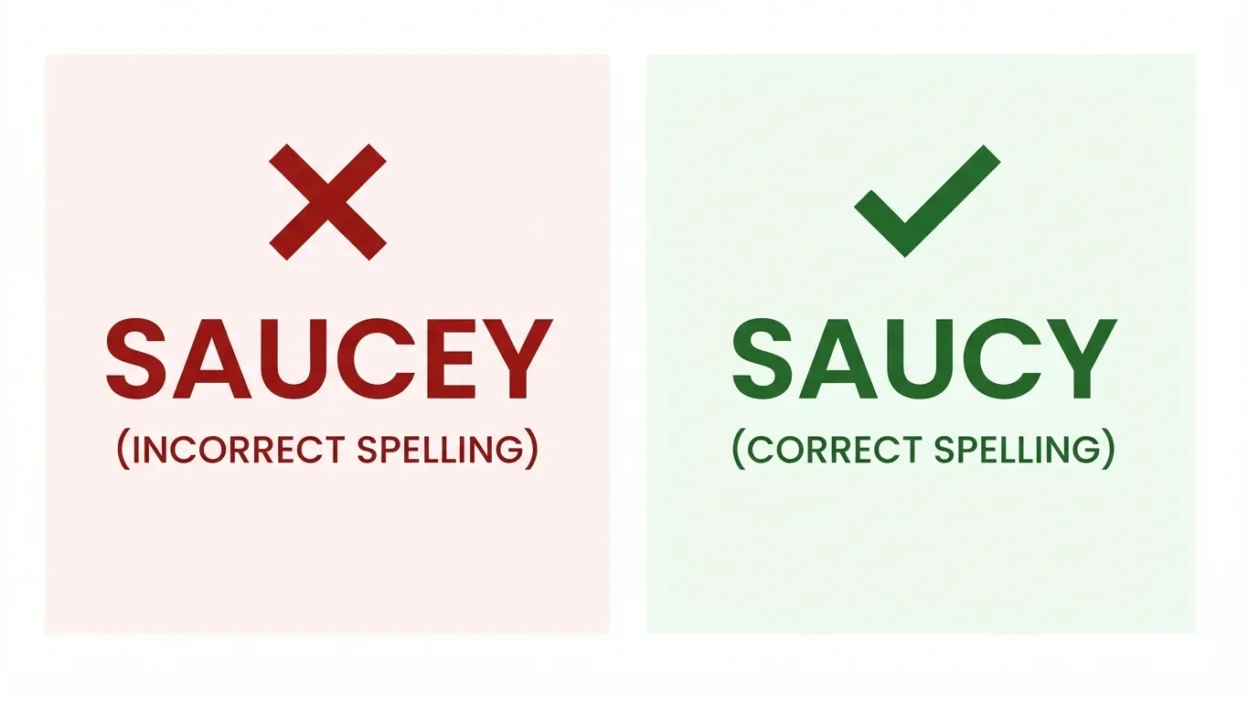
The correct spelling is “saucy.” The word “saucey” is incorrect and not accepted in standard English. Always use “saucy” when describing something bold, playful, or full of flavor.
Why People Confuse It
People often confuse “saucey” and “saucy” because both seem logical. Since “sauce” is a real word, adding a “y” to form “saucey” feels natural, even though it is incorrect.
Another reason is pronunciation. The word “saucy” sounds like saw see, which does not clearly show the correct spelling. This leads people to guess and sometimes choose the wrong form.
Social media also plays a role. Informal spelling like “saucey” may appear in captions, making it look acceptable when it is not standard English.
First Word
“Saucey” is not a correct spelling in standard English. It is considered a common mistake or informal variation that should be avoided in proper writing.
Some people use “saucey” creatively online, but it does not follow dictionary rules. Using it in formal content can reduce credibility.
If you want your writing to be clear and correct, it is best to avoid this form entirely.
Second Word
“Saucy” is the correct spelling. It is a real English word with clear meanings and proper usage.
It can describe something full of flavor, like food, or someone bold, playful, or slightly rude in attitude.
Using “saucy” correctly ensures your writing sounds natural and professional.
Definition and Meaning
“Saucy” has a few meanings depending on context. It can describe food that has a lot of sauce or flavor.
It can also describe a person who is bold, cheeky, or slightly disrespectful in a playful way. For example, a child giving a clever reply might be called saucy.
Understanding these meanings helps you use the word naturally in different situations.
Pronunciation Guide
“Saucy” is pronounced as saw see. The sound is smooth, with two clear syllables.
The pronunciation does not directly show the spelling, which is why confusion happens. Listening and repeating the word can help you remember it.
Practicing pronunciation along with spelling improves accuracy and confidence.
Grammar Rules Explained
“Saucy” is formed by adding “y” to the base word “sauce,” but the spelling changes slightly. The “e” is dropped before adding “y,” which results in “saucy.”
This follows a common English rule where the final “e” is removed before adding a suffix.
The incorrect form “saucey” ignores this rule, which is why it is not accepted.
Comparison Table
| Word | Correct | Meaning |
|---|---|---|
| saucey | No | Incorrect spelling |
| saucy | Yes | Bold, cheeky, or flavorful |
This table clearly shows the correct choice.
When to Use Each
Use “saucy” when describing something flavorful or someone bold and playful. It works in both casual and formal writing.
Do not use “saucey” in standard English. It is always incorrect and should be avoided.
Choosing the correct word ensures clarity and professionalism in your writing.
Real Life Usage
“Saucy” is often used in everyday language. People may describe food as saucy when it has rich flavor.
It is also used to describe attitude. For example, someone might say a person gave a saucy reply.
Using the correct spelling helps your message feel natural and easy to understand.
Formal vs Informal Use
“Saucy” can be used in both formal and informal contexts, depending on the tone. It is common in storytelling, reviews, and casual conversation.
The incorrect form “saucey” should not be used in formal writing. It can make your content look unpolished.
Using correct spelling builds trust with your audience.
Synonyms and Alternatives
Here are some alternatives for “saucy”:
- Bold
- Cheeky
- Spicy
- Lively
- Flavorful
These synonyms help add variety to your writing and avoid repetition.
Common Sentences
Here are some natural sentences using “saucy”:
- She gave a saucy reply
- The pasta is rich and saucy
- He made a saucy comment
- The dish looks very saucy
These examples show how the word fits into daily language.
Examples
Here are ten real examples:
- The chef prepared a saucy dish
- She wore a saucy smile
- The child made a saucy remark
- This burger is extra saucy
- He has a saucy sense of humor
- The noodles are perfectly saucy
- She gave a saucy comeback
- The recipe creates a saucy texture
- His tone sounded a bit saucy
- The wings are spicy and saucy
These examples show correct usage across different contexts.
Common Mistakes
A common mistake is spelling the word as “saucey.” This usually happens because people relate it directly to “sauce.”
Another mistake is relying on how the word sounds rather than learning its correct spelling.
Being aware of these errors helps you avoid them.
Mistakes to Avoid
Do not assume all words formed from “e” endings keep the “e.” Many drop it before adding “y.”
Avoid copying informal spellings from social media. Not all popular forms are correct.
Always check your spelling before finalizing your writing.
Memory Trick
Remember that “saucy” drops the “e” from “sauce” before adding “y.”
A simple trick is to think “sauce becomes saucy,” not “saucey.”
Practicing this pattern makes it easier to remember.
American vs British English
Both American and British English use “saucy” as the correct spelling. There is no difference between the two.
This makes it simple for learners, as only one form is correct worldwide.
You can use it confidently in any context.
Similar Words
Other confusing words include:
- Spicey and spicy
- Shiney and shiny
- Icey and icy
These follow similar spelling patterns where the “e” is dropped.
Related Confusing Words
Words like “juicy” and “pricey” may look similar but follow different patterns. Understanding each pattern is important.
Learning these differences improves your spelling accuracy.
Practice helps you master these words over time.
Expert Tips
Always proofread your writing carefully. Small spelling errors can affect clarity.
Use reliable dictionaries to confirm correct spelling.
Practice writing regularly to build confidence and accuracy.
Comparison Table
| Feature | Saucy | Saucey |
|---|---|---|
| Spelling | Correct | Incorrect |
| Usage | Standard English | Informal error |
| Rule | Drops e before y | Breaks rule |
This second table reinforces the correct choice clearly.
Final Verdict
“Saucy” is the correct and accepted spelling. The form “saucey” is incorrect and should be avoided in all types of writing.
Understanding the spelling rule and practicing it regularly will help you avoid this mistake. It also improves the clarity and professionalism of your writing.
FAQs
Is saucey a real word
No, it is considered incorrect in standard English.
What is the correct spelling
The correct spelling is “saucy.”
Why do people write saucey
Because they connect it with the word “sauce.”
Can saucey be used informally
It may appear online, but it is still incorrect.
What does saucy mean
It means bold, cheeky, or full of flavor.
Is saucy used in both US and UK English
Yes, it is the same in both.
Conclusion
Spelling plays an important role in clear communication. Choosing between “saucey” and “saucy” becomes simple once you understand the rule. Using the correct form helps your writing stay professional and easy to read.
With practice and attention to detail, you can avoid common mistakes like this. Over time, correct spelling becomes natural and improves your overall writing skills.
Remember This
Always write “saucy” by dropping the “e” from “sauce.” Never use “saucey” because it is incorrect.

Kevin Brian is a passionate author at BiblyWord, dedicated to sharing the message of the Bible through thoughtful and inspiring content. He focuses on creating clear and meaningful writings that help readers understand scripture, strengthen their faith, and find guidance in everyday life through God’s Word.