
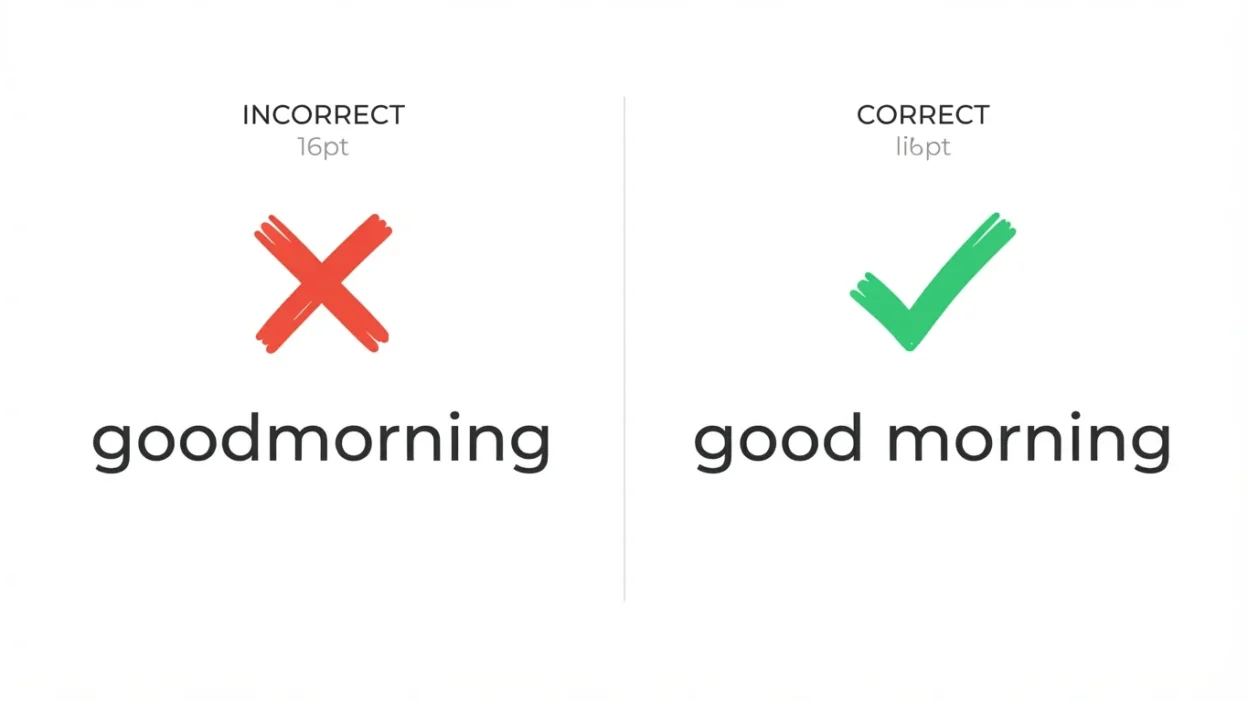
Small spacing mistakes can completely change how professional your writing looks. One of the most common confusions is between “goodmorning” and “good morning.” At first glance, both may seem acceptable, but only one is correct in standard English.
This greeting is used daily in emails, messages, conversations, and formal communication. Because it is so common, using the correct form is important for clarity and professionalism. In this guide, you will learn the difference, correct usage, and simple tips to avoid this mistake.
Quick Answer
The correct form is “good morning.” The word “goodmorning” is incorrect and should not be used. Always write it as two separate words when greeting someone.
Why People Confuse It
People confuse “goodmorning” and “good morning” because many English words are written as a single unit. This makes it seem natural to combine the words.
Another reason is fast typing. When writing quickly, people often remove spaces without noticing.
Also, in casual texting, spacing rules are sometimes ignored, which leads to incorrect habits.
First Word
“Goodmorning” is not a correct standard English word. It is considered a spelling mistake in formal and proper writing.
This form usually appears in informal chats or due to typing errors.
Using “goodmorning” can make your writing look careless or unprofessional, especially in emails or official communication.
Second Word
“Good morning” is the correct and accepted form. It is a common greeting used to wish someone well at the start of the day.
It is used in both spoken and written English, from casual conversations to formal emails.
Using “good morning” correctly ensures clarity and a positive impression.
Definition and Meaning
“Good morning” is a greeting used in the early part of the day, usually from sunrise until noon.
It expresses politeness, friendliness, and respect when addressing someone.
Understanding its meaning helps you use it naturally in different situations.
Pronunciation Guide
“Good morning” is pronounced as good mor ning. The two words are spoken smoothly together.
Even though it sounds like one phrase, it must be written as two separate words.
Practicing pronunciation helps reinforce correct usage.
Grammar Rules Explained
“Good morning” is a phrase made of two words: an adjective “good” and a noun “morning.”
In English, such greetings are written as separate words, not combined.
This is why “goodmorning” is incorrect.
Comparison Table
| Word | Correct | Usage |
|---|---|---|
| goodmorning | No | Incorrect spelling |
| good morning | Yes | Correct greeting |
This table clearly shows the correct form.
When to Use Each
Use “good morning” whenever you greet someone in the morning, whether in speech or writing.
Do not use “goodmorning” in any situation, especially in formal communication.
Choosing the correct form ensures clarity and professionalism.
Real Life Usage
“Good morning” is used daily in emails, messages, and conversations. It is often the first line in professional communication.
For example, you might start an email with “Good morning, I hope you are well.”
Using the correct form creates a positive impression.
Formal vs Informal Use
“Good morning” works in both formal and informal contexts. It is appropriate for emails, meetings, and casual chats.
The incorrect form “goodmorning” should not be used even in informal writing.
Correct spacing improves readability and professionalism.
Synonyms and Alternatives
Here are some alternatives for “good morning”:
- Morning
- Hello
- Greetings
- Hi
These can be used depending on context.
Common Sentences
Here are some natural sentences using “good morning”:
- Good morning, how are you
- Good morning, everyone
- Good morning, I hope you are doing well
- Good morning, team
These examples show everyday usage.
Examples
Here are ten real examples:
- Good morning, I hope you slept well
- Good morning, let’s start the meeting
- Good morning, how can I help you
- Good morning, everyone in the office
- Good morning, have a great day
- Good morning, I will send the report soon
- Good morning, thank you for your email
- Good morning, it is nice to see you
- Good morning, let’s begin the session
- Good morning, welcome to the event
These examples show correct usage in context.
Common Mistakes
A common mistake is writing “goodmorning” as one word. This usually happens in fast typing or casual messaging.
Another mistake is ignoring spacing rules in formal writing.
Being aware of these mistakes helps you avoid them.
Mistakes to Avoid
Do not combine separate words into one unnecessarily.
Avoid copying incorrect forms from informal chats.
Always proofread your writing.
Memory Trick
A simple trick is to remember that “good” and “morning” are two separate words.
Think of other greetings like “good evening” and “good afternoon,” which are also written separately.
This helps you recall the correct form.
American vs British English
“Good morning” is used the same way in both American and British English.
There is no variation in spelling or usage.
You can use it confidently anywhere.
Similar Words
Other greetings include:
- Good afternoon
- Good evening
- Good night
These also follow the same spacing rule.
Related Confusing Words
Words like “goodbye” are written as one word, which can cause confusion.
Understanding which phrases are combined and which are separate helps improve accuracy.
Expert Tips
Always check spacing in common phrases.
Use grammar tools to catch small errors.
Practice writing formal greetings regularly.
Comparison Table
| Feature | Good morning | Goodmorning |
|---|---|---|
| Spacing | Two words | One word |
| Usage | Correct | Incorrect |
| Formality | Acceptable | Not acceptable |
This second table reinforces the correct choice.
Final Verdict
“Good morning” is the correct form and should always be used. The word “goodmorning” is incorrect and should be avoided in all contexts.
Understanding this simple rule helps improve clarity and professionalism in your writing.
FAQs
Is goodmorning a real word
No, it is a spelling mistake.
What is the correct form
The correct form is “good morning.”
Can I use goodmorning informally
No, it is incorrect in all contexts.
Why do people write goodmorning
Because of fast typing and confusion about spacing.
Is good morning used worldwide
Yes, it is used in both American and British English.
Can I use good morning in emails
Yes, it is commonly used in professional emails.
Conclusion
Using the correct greeting is important for clear communication. “Good morning” is the correct form, while “goodmorning” is a common mistake.
By paying attention to spacing and practicing proper writing habits, you can avoid this error. Over time, correct usage becomes natural and improves your communication skills.
Remember This
Always write “good morning” as two separate words. Never combine them.

Steven Mark is the administrator and a dedicated author at BiblyWord, responsible for managing the platform and maintaining high-quality content. Alongside his administrative role, he writes insightful biblical articles that inspire faith, reflection, and spiritual growth. His work supports the mission of sharing God’s Word in a clear and meaningful way.