English spelling can sometimes feel confusing, especially when prefixes change the form of a word. A common example is “unpure” vs “impure.” While both might seem logical, only one follows standard English usage.
This word is often used in science, ethics, and everyday language to describe something that is not clean or not morally pure. Because it appears in both formal and informal contexts, using the correct form is important.
In this guide, you will learn the difference, correct usage, and practical tips to avoid mistakes.
Quick Answer
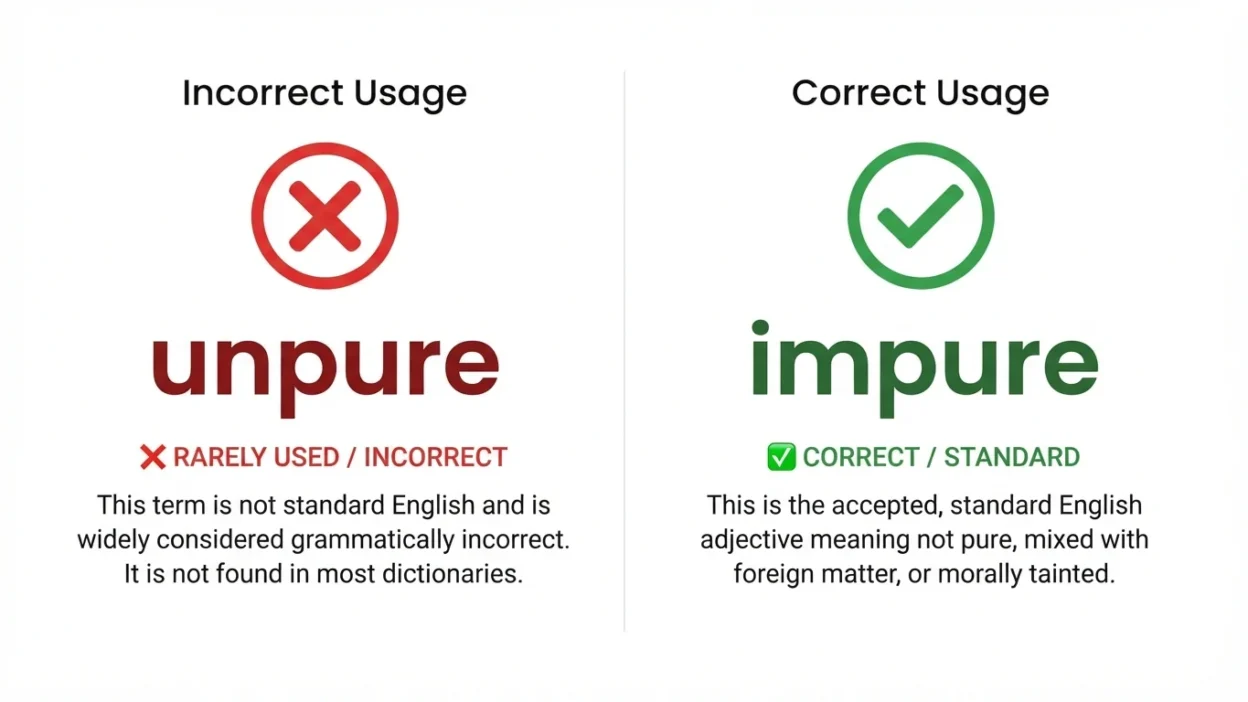
The correct word is “impure.” The word “unpure” is incorrect and not commonly accepted in standard English. Always use “impure” when describing something that is not pure.
Why People Confuse It
People confuse “unpure” and “impure” because both “un” and “im” are common negative prefixes in English. This makes it seem like either could work.
Another reason is pattern guessing. Many words use “un” to show the opposite, such as unhappy or unclear, so learners assume “unpure” should be correct.
However, English often changes prefixes depending on the root word. This is why “impure” is the correct form instead of “unpure.”
First Word
“Unpure” is not considered standard English. Although it may appear understandable, it is rarely used and not accepted in formal writing.
This form comes from applying the “un” prefix incorrectly. While it may make sense logically, it does not follow common usage patterns.
Using “unpure” can make your writing seem incorrect or unnatural. It is best to avoid it entirely.
Second Word
“Impure” is the correct and widely accepted word. It means something that is not pure, clean, or morally good.
It is commonly used in science to describe substances that contain unwanted elements. It is also used in moral or symbolic contexts.
Using “impure” ensures your writing is accurate and professional.
Definition and Meaning
“Impure” means mixed with something unwanted or lacking purity. It can describe physical substances or abstract ideas.
For example, water with dirt is impure, and intentions with bad motives can also be described as impure.
Understanding the meaning helps you apply the word correctly in different contexts.
Pronunciation Guide
“Impure” is pronounced as im pyur. The “im” prefix blends smoothly with the base word.
The pronunciation clearly includes the “im” sound, which helps distinguish it from incorrect forms.
Practicing pronunciation can help reinforce the correct spelling.
Grammar Rules Explained
English uses different prefixes to form opposites. The prefix “im” is often used before words starting with “p,” “b,” or “m.”
For example:
- Possible becomes impossible
- Pure becomes impure
This rule explains why “impure” is correct and “unpure” is not.
Comparison Table
| Word | Correct | Meaning |
|---|---|---|
| unpure | No | Incorrect form |
| impure | Yes | Not pure |
This table clearly shows the correct choice.
When to Use Each
Use “impure” whenever you want to describe something that is not pure or contains unwanted elements.
Do not use “unpure” in any situation. It is not standard and should be avoided.
Choosing the correct word improves clarity and professionalism.
Real Life Usage
“Impure” is commonly used in science, especially in chemistry. For example, a sample may be described as impure if it contains contaminants.
It is also used in everyday language to describe ideas, actions, or intentions.
Using the correct form ensures your message is clear and accurate.
Formal vs Informal Use
“Impure” works in both formal and informal contexts. It is widely used in academic writing, reports, and conversations.
The incorrect form “unpure” should not be used, even in casual writing.
Correct usage builds trust and clarity.
Synonyms and Alternatives
Here are some alternatives for “impure”:
- Contaminated
- Polluted
- Unclean
- Corrupt
- Tainted
These words can help add variety to your writing.
Common Sentences
Here are some natural sentences using “impure”:
- The water is impure
- The sample was found to be impure
- His intentions were impure
- The air became impure
These examples show everyday usage.
Examples
Here are ten real examples:
- The scientist tested the impure substance
- The water supply became impure
- The metal was impure and weak
- Her motives seemed impure
- The air felt impure in the city
- The solution remained impure
- The material was not pure but impure
- The sample showed impure elements
- His thoughts were described as impure
- The product was rejected for being impure
These examples show correct usage across contexts.
Common Mistakes
A common mistake is using “unpure” instead of “impure.” This happens because of confusion about prefixes.
Another mistake is not understanding prefix rules in English.
Being aware of these mistakes helps you avoid them.
Mistakes to Avoid
Do not assume all opposites use the “un” prefix.
Avoid guessing based on similar words.
Always check correct word forms when unsure.
Memory Trick
A simple trick is to remember that “pure” becomes “impure,” just like “possible” becomes “impossible.”
Think of the “im” prefix as the correct partner for words starting with “p.”
This makes it easier to remember.
American vs British English
“Impure” is used the same way in both American and British English.
There is no difference in spelling or meaning.
You can use it confidently worldwide.
Similar Words
Other words that follow similar patterns include:
- Impossible
- Impolite
- Imbalance
These words also use the “im” prefix.
Related Confusing Words
Words like “unclean” and “impure” may seem similar but are used in slightly different contexts.
Understanding these differences improves your vocabulary.
Practice helps you master such words.
Expert Tips
Learn common prefix rules to improve spelling accuracy.
Use dictionaries to confirm unfamiliar words.
Practice writing regularly to build confidence.
Comparison Table
| Feature | Impure | Unpure |
|---|---|---|
| Spelling | Correct | Incorrect |
| Usage | Standard English | Not accepted |
| Meaning | Not pure | Not valid |
This second table reinforces the correct choice.
Final Verdict
“Impure” is the correct word and should always be used. The word “unpure” is incorrect and not accepted in standard English.
Understanding prefix rules helps you avoid similar mistakes and improves your writing clarity.
FAQs
Is unpure a real word
No, it is not standard English.
What is the correct word
The correct word is “impure.”
Why not unpure
Because English uses the “im” prefix with words like “pure.”
Can unpure be used informally
No, it is incorrect in all contexts.
What does impure mean
It means not pure or mixed with unwanted elements.
Is impure used worldwide
Yes, it is used in both American and British English.
Conclusion
Choosing between “unpure” and “impure” becomes simple once you understand prefix rules. Using the correct word ensures your writing is clear, accurate, and professional.
With practice and attention to detail, you can avoid this common mistake. Over time, correct usage becomes natural and improves your overall language skills.
Remember This
Always use “impure.” Never use “unpure,” because it is not correct in standard English.

Kevin Brian is a passionate author at BiblyWord, dedicated to sharing the message of the Bible through thoughtful and inspiring content. He focuses on creating clear and meaningful writings that help readers understand scripture, strengthen their faith, and find guidance in everyday life through God’s Word.