
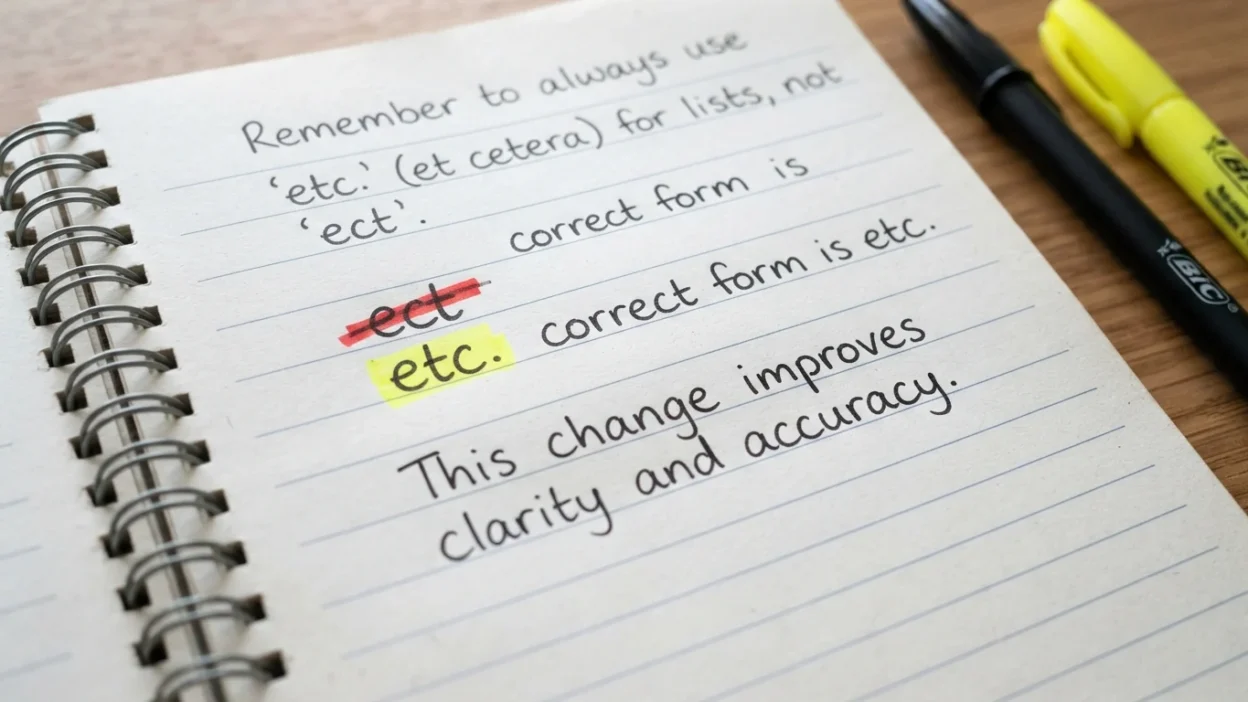
Small writing mistakes can make a big difference, especially when they appear frequently. One of the most common errors people make is confusing “ect” and “etc.” You may have seen both in messages, notes, or even online content, but only one is correct.
This confusion often happens because the abbreviation is spoken quickly and remembered incorrectly. If you want your writing to look polished and professional, understanding the difference between ect vs etc is essential.
Quick Answer
“Etc.” is the correct abbreviation of the Latin phrase et cetera, meaning “and other similar things.”
“Ect” is incorrect and a common spelling mistake. Always use etc. in both formal and informal writing.
Why People Confuse It
The confusion mainly comes from pronunciation and memory. When people say “et cetera,” it often sounds like “ek-setra,” which leads them to rearrange the letters incorrectly as “ect.”
Another reason is habit. Once someone starts using “ect,” they may continue using it without realizing the mistake. Since it looks similar, the error can go unnoticed.
Typing quickly also contributes. People may accidentally switch the order of letters, especially when not paying close attention.
Definition and Meaning
“Etc.” stands for et cetera, a Latin phrase meaning “and other things” or “and so on.” It is used to shorten lists when additional similar items are implied.
For example, instead of listing every item, you can end with “etc.” to indicate there are more.
“Ect” has no meaning in standard English. It is simply an incorrect spelling of “etc.”
First Word
“Ect” is not a valid abbreviation or word. It does not appear in dictionaries and should not be used in proper writing.
It usually appears when someone mistakenly rearranges the letters of “etc.” While it may seem minor, it can make your writing look careless.
To maintain clarity and professionalism, avoid using “ect” entirely.
Second Word
“Etc.” is the correct and widely accepted abbreviation. It is used in writing to indicate that a list continues.
It appears in academic, professional, and casual writing. Because of its versatility, it is important to use it correctly.
Always include the period at the end, as it is an abbreviation.
Pronunciation Guide
“Etc.” is pronounced as /ɪt ˈsɛtərə/ or simply “et-set-ra.”
The pronunciation does not match the spelling exactly, which is why people often confuse the letter order.
Remembering the correct letter sequence will help you avoid errors.
Grammar Rules Explained
“Etc.” is used at the end of a list to represent additional items. It should follow similar examples in a series.
Examples:
- I bought apples, bananas, oranges, etc.
Important rules:
- Do not use “and etc.” because “et” already means “and.”
- Use a comma before “etc.” in a list.
“Ect” does not follow any grammar rules because it is incorrect.
Real Life Usage
“Etc.” is used in everyday writing to simplify lists. It is common in notes, emails, articles, and academic work.
For example, instead of listing every grocery item, you can use “etc.” to save space and time.
Using it correctly helps your writing remain concise and easy to read.
Comparison Table
| Feature | Ect | Etc. |
|---|---|---|
| Correctness | Incorrect | Correct |
| Meaning | None | And so on |
| Usage | Not used | Common |
| Dictionary | Not listed | Recognized |
| Recommendation | Avoid | Always use |
When to Use Each
Use “etc.” when you want to shorten a list of similar items.
Examples:
- Pens, pencils, markers, etc.
- Books, magazines, newspapers, etc.
Never use “ect,” as it is incorrect and may confuse readers.
Examples in Sentences
Here are correct examples:
- We need chairs, tables, decorations, etc.
- She packed clothes, shoes, accessories, etc.
- The store sells fruits, vegetables, snacks, etc.
- Bring notebooks, pens, folders, etc.
- They discussed topics like history, science, math, etc.
- He enjoys sports like football, cricket, tennis, etc.
- The kit includes tools, screws, nails, etc.
- She bought makeup, skincare products, etc.
- We studied grammar, vocabulary, pronunciation, etc.
- The bag contains books, chargers, headphones, etc.
Incorrect:
- We bought fruits, vegetables, ect.
Common Sentences
You will often see “etc.” in phrases like:
- And so on etc.
- Items etc.
- Supplies etc.
However, avoid redundancy like “and etc.”
Common Mistakes
A common mistake is writing “ect” instead of “etc.” This happens due to incorrect memory of the letter order.
Another mistake is using “and etc.” which repeats the meaning unnecessarily.
Not using the period is also an error, as “etc.” is an abbreviation.
Mistakes to Avoid
Avoid these errors:
- Writing “ect” instead of “etc.”
- Using “and etc.”
- Forgetting the period
These small corrections can greatly improve your writing.
Memory Trick
Here is a simple trick:
“Etc.” stands for “et cetera,” and “et” comes first.
So remember the order:
- et + c = etc.
This helps you avoid mixing up the letters.
American vs British English
Both American and British English use “etc.” with the same spelling and meaning.
There is no variation between regions, making it easy to use universally.
“Ect” is incorrect everywhere.
Similar Words
Related abbreviations include:
- e.g.
- i.e.
- vs.
These are often used in similar contexts but have different meanings.
Synonyms and Alternatives
Instead of “etc.,” you can say:
- And so on
- And more
- And others
These alternatives may be useful in formal writing.
Formal vs Informal Use
“Etc.” is acceptable in informal and semi formal writing. In very formal contexts, it is sometimes better to list all items or use alternatives.
However, it is still widely understood and accepted.
Expert Tips
To use “etc.” correctly:
- Use it only for similar items
- Avoid overusing it
- Do not combine with “and”
- Always include the period
These tips will improve clarity and style.
Related Confusing Words
Other similar confusions include:
- e.g. vs i.e.
- Then vs than
- Affect vs effect
Learning these helps improve writing accuracy.
FAQs
Is ect a real word?
No, it is a misspelling.
Which is correct ect or etc?
Etc. is correct.
What does etc mean?
It means “and so on.”
Should etc have a period?
Yes, because it is an abbreviation.
Can I use and etc?
No, it is redundant.
Is etc formal?
It is acceptable but should be used carefully in formal writing.
Final Verdict
“Etc.” is the correct abbreviation and should be used in all forms of writing when you want to shorten a list.
“Ect” is incorrect and should be avoided completely. Using the correct form improves clarity, professionalism, and readability.
Remember This
Always write etc., never ect.
Think of et cetera to remember the correct order.
Conclusion
The difference between “ect” and “etc.” is simple but important. While “ect” may seem harmless, it is incorrect and can weaken your writing.
By using “etc.” correctly, you make your content clearer and more professional. With practice, this common mistake becomes easy to avoid.

Kevin Brian is a passionate author at BiblyWord, dedicated to sharing the message of the Bible through thoughtful and inspiring content. He focuses on creating clear and meaningful writings that help readers understand scripture, strengthen their faith, and find guidance in everyday life through God’s Word.